
Pacific Ocean
The Pacific Ocean is Earth’s largest ocean basin, stretching from Asia and Australia to the Americas. This article outlines its geography, geology, ecology, human uses, and why the Pacific shapes many global processes.
The Pacific Ocean is the world's largest ocean basin and a dominant feature of the planet's surface. It is widely described as the ocean located between Asia and Australia on its western margin and the Americas to the east. Often called the largest named ocean, it covers roughly one third of the Earth's surface and contains the globe's deepest known trenches.
Image gallery
3 Images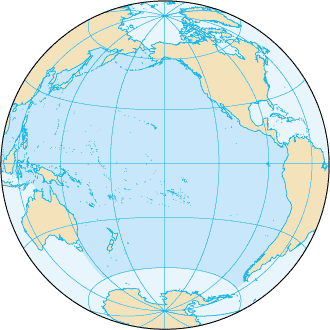


Boundaries and geography
The Pacific meets other oceanic bodies along defined lines and broad transitional zones. To the north it reaches toward the Arctic Ocean, and to the south it borders the Southern Ocean. It is conventionally joined with the Atlantic Ocean by an imaginary line drawn south from Cape Horn (off Argentina) to Antarctica, and with the Indian Ocean by a line south from Tasmania to Antarctica. These boundaries help define shipping routes, climatic zones and legal marine jurisdictions.
Physical characteristics
The Pacific contains vast expanses of open ocean, continental shelves, island arcs and deep basins. Its deepest point lies in the Mariana Trench and exceeds 11,000 metres below sea level, a depth that highlights how the ocean compares with the solid surface of the Earth. Surface currents and large gyres distribute heat and nutrients and influence weather patterns across entire continents. The ocean's circulation interacts with the atmosphere to drive climate phenomena such as El Niño and La Niña.
Tectonics, earthquakes and volcanoes
Plate interactions around the Pacific margin are intense. The ocean basin is shrinking in some regions because oceanic plates are forced beneath continental plates in a process known as subduction. This activity is part of broader plate tectonics and produces frequent earthquakes and many volcanoes. When strain is released violently, sudden ruptures can create undersea waves called tsunamis. Volcanic eruptions emit molten hot rocks, ash and fine dust and occasionally explosive events described as explosions in geological accounts.
Islands, coasts and ecosystems
The Pacific hosts many island groups and extensive coastal habitats. Volcanic activity and coral growth produce chains of islands, while continental margins support fisheries and dense human settlements on adjacent continents. Coral reefs, kelp forests and deep-sea communities contribute to high biodiversity. These ecosystems are important for food security, coastal protection and cultural identity for many Pacific peoples.
Human uses and significance
The Pacific is central to global commerce, fisheries, and cultural exchange. Major shipping lanes cross its surface, carrying goods between Asia, Oceania and the Americas. Marine resources fuel economies but are vulnerable to overfishing, pollution and climate-driven changes such as warming and acidification. Scientific study of the Pacific has advanced understanding of ocean circulation, plate dynamics and the links between oceans and climate.
Notable facts and distinctions
- The Pacific's basin includes both the deepest trenches and some of the broadest shallows formed by continental shelves.
- Its tectonic margins are sometimes called the "Ring of Fire" because of concentrated volcanic and seismic activity.
- Changes in the Pacific can have global consequences for weather, sea level and biodiversity.
Further reading and resources are available through agencies and scientific institutions that monitor ocean conditions and coastal risks; general overviews and data portals can be accessed via regional and international organizations. For more on specific regions, tectonic processes or ecological topics consult specialist sources and research databases.
Location details | Asia | Australia | Americas | Southern Ocean | Arctic Ocean | Size | Atlantic link | Southern line | Cape Horn | Argentina | Antarctica | Indian Ocean | Tasmania | Earth | Subduction | Earthquakes | Volcanoes | Explosions | Hot rocks | Dust | Tsunami | Islands | Continents | Plate tectonics
Related articles
Author
AlegsaOnline.com Pacific Ocean Leandro Alegsa
URL: https://en.alegsaonline.com/art/73925