
Pacific Time Zone (PT) — PST and PDT
Time zone covering western North America, standard time UTC−8 (PST) and daylight time UTC−7 (PDT); used in parts of the United States, Canada and Mexico with key roles in commerce and media.
Overview
The Pacific Time Zone (abbreviated PT) is a principal civil time zone in western North America. Its standard time is eight hours behind Coordinated Universal Time (UTC−8), commonly called Pacific Standard Time (PST). During daylight saving time the zone is seven hours behind UTC (UTC−7), when it is referred to as Pacific Daylight Time (PDT). The system of standard and daylight times simplifies scheduling across regions and aligns clock time with seasonal daylight.
Image gallery
2 Images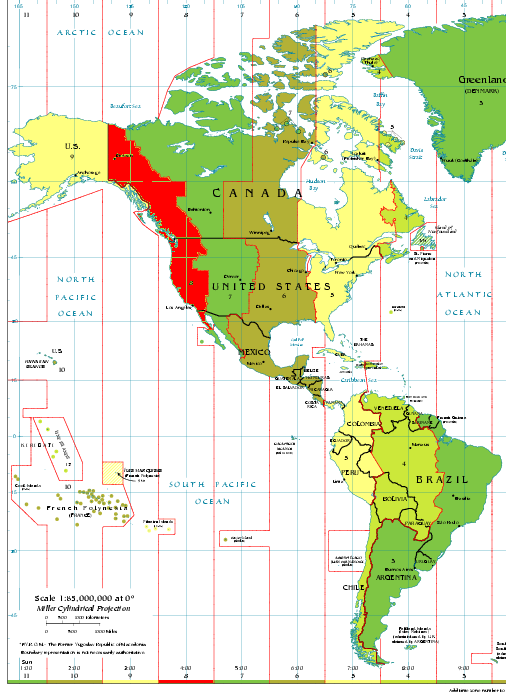

Geographic extent
The Pacific Time Zone includes large portions of the western United States, western Canada and the northwestern part of Mexico. Major population centres in the zone include Los Angeles, the largest city by population, as well as other coastal and inland metropolitan areas. The zone roughly corresponds to the mean solar time of the 120th meridian west, though legal and administrative boundaries determine the actual limits.
Timekeeping and daylight saving
Under standard practice, PT is UTC−8 (PST). In most jurisdictions that observe daylight saving time, clocks move forward by one hour to UTC−7 (PDT) in spring and revert in autumn. In the United States and Canada this change currently begins on the second Sunday in March and ends on the first Sunday in November. Some localities or provinces may adopt different conventions or opt out of daylight saving time.
History and development
Time zones in North America were introduced to coordinate rail schedules and commerce in the late 19th century. Over time, governments refined boundaries and daylight saving rules. While the underlying geographic reference for Pacific Time is the 120th meridian west, the legal definition and observance of holiday or daylight policies are set by national, state, provincial or territorial authorities.
Uses, importance and examples
Pacific Time is central to broadcasting schedules, stock market hours for West Coast operations, transportation timetables and cross-continental business coordination. For scheduling across North America, PT is typically three hours behind Eastern Time (ET), which is useful to remember when planning meetings or media events that involve multiple U.S. time zones.
Notable distinctions and exceptions
Not all places within the geographic band of the Pacific Time Zone follow the same rules. Parts of states and provinces near time-zone boundaries may use Mountain Time instead, and some areas choose not to observe daylight saving. For clarity when travelling or arranging time-sensitive activities, always confirm the local time rule for the specific city or jurisdiction.
Where it is observed (examples)
- United States: the entire states of California and Washington, most of Oregon and Nevada, and portions of the Idaho panhandle.
- Canada: large parts of British Columbia and certain western territories and communities, with local variations.
- Mexico: the state of Baja California follows Pacific Time to align with adjacent U.S. border regions.
Further information and references
For official definitions, local rules and current observance, consult government or time-authority resources. The following links provide entry points to authoritative material and region-specific schedules:
- Time zone listings and definitions
- Coordinated Universal Time (UTC) references
- United States time zone guidance
- Canada time and daylight saving information
- Mexico time zone authorities
- Los Angeles metropolitan information
- Metropolitan area statistics and schedules
- Yukon and northern territories timing
- Northwest Territories communities and time
- British Columbia time practices
- Washington state time rules
- California time and observance
- Oregon time zone details
- Nevada time-zone boundaries
- Idaho panhandle time conventions
When planning events or travel, always verify the current local time, because political decisions and law changes can alter the observance of standard or daylight times.
Questions and answers
Q: What is the Pacific Time Zone?
A: The Pacific Time Zone is one of the time zones in the world that is based on the mean solar time of the 105th meridian west of the Greenwich Observatory.
Q: How far ahead or behind is the Pacific Time Zone compared to Coordinated Universal Time?
A: Normally, the Pacific Time Zone is 8 hours behind Coordinated Universal Time.
Q: Which countries have the Pacific Time Zone?
A: The Pacific Time Zone is in the United States, Canada, and Mexico.
Q: Which city in the Pacific Time Zone has the largest metropolitan area?
A: Los Angeles, California, is the city with the largest metropolitan area in the Pacific Time Zone.
Q: What is the Pacific Time Zone called during Daylight Savings Time?
A: During Daylight Savings Time, the Pacific Time Zone is called Pacific Daylight Time (PDT), which is represented by UTC-7.
Q: What is the Pacific Time Zone called during the winter?
A: During the winter, the Pacific Time Zone is called Pacific Standard Time (PST), which is represented by UTC-8.
Q: Which areas of Canada, the United States, and Mexico are included in the Pacific Time Zone?
A: In Canada, all of Yukon, Tungsten, Northwest Territories, and most of British Columbia are included. In the United States, it includes the entire states of Washington and California, as well as most of Oregon and Nevada. Parts of the Idaho Panhandle are also part of the Pacific Time Zone. In Mexico, Baja California Norte uses the Pacific Time Zone.
Related articles
Author
AlegsaOnline.com Pacific Time Zone (PT) — PST and PDT Leandro Alegsa
URL: https://en.alegsaonline.com/art/73931