
Atlantic Ocean: geography, history, ecology, and human uses
Overview of the Atlantic Ocean including size, physical features, origins, major currents, ecosystems, human uses and environmental challenges.
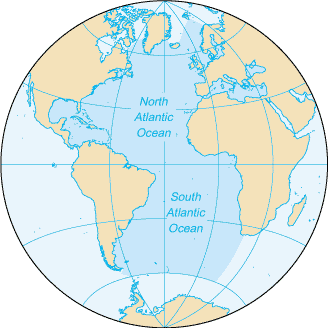
The Atlantic Ocean is the world's second-largest ocean, covering roughly one-fifth of Earth's surface and connecting polar and tropical regions. It is commonly cited as having an area near 106,400,000 km² and takes its name from the mythic figure Atlas, a link to ancient Greek mythology. The ocean forms a central corridor for global climate, biogeography and human transportation.
Image gallery
10 Images





Physical characteristics
The Atlantic is bounded by the Americas to the west and Europe and Africa to the east. Its seafloor is dominated by the Mid-Atlantic Ridge, a vast underwater mountain chain where tectonic plates diverge. Average depth is several thousand metres and the deepest known basin is the Puerto Rico Trench. Major surface features include semi-enclosed seas and large gyres, such as the Sargasso Sea.
Circulation and climate role
Ocean currents in the Atlantic, notably the Gulf Stream and the broader Atlantic Meridional Overturning Circulation, transport heat and influence weather across adjacent continents. These currents affect regional climates, fisheries and patterns of rainfall; changes in their strength or pathways are of keen scientific and societal interest. For more on its global role see regional climate connections.
History and origin
The Atlantic opened as continents separated through plate tectonics during the breakup of the supercontinent Pangaea tens of millions of years ago. Since that time the basin has evolved through seafloor spreading, sedimentation and changing sea levels, shaping coastlines and marine habitats that have influenced migration and trade routes.
Uses, ecosystems and challenges
Human uses include major shipping lanes, commercial fisheries, offshore energy production and recreation. The ocean sustains a wide array of life from plankton and commercially important fish to marine mammals and seabirds. However, it also faces threats such as overfishing, pollution and climate-driven warming and acidification. Conservation and management efforts, research vessels and protected areas aim to respond to these pressures; see research and policy resources at regional data and conservation initiatives at environmental programs.
Notable facts
- The Mid-Atlantic Ridge is one of the most prominent features of Earth\'s underwater topography.
- The Atlantic connects with the Arctic Ocean to the north and the Southern Ocean to the south, forming continuous global circulation.
- Its coasts host some of the world\u2019s busiest ports and long-standing cultural and economic exchanges.
Questions and answers
Q: What is the Atlantic Ocean?
A: The Atlantic Ocean is the world's second largest ocean.
Q: How much area does the Atlantic Ocean cover?
A: The Atlantic Ocean covers a total area of about 106,400,000 square kilometres (41,100,000 square miles).
Q: What percentage of the Earth's surface does the Atlantic Ocean cover?
A: The Atlantic Ocean covers about 20 percent of the Earth's surface.
Q: What is the origin of the name "Atlantic"?
A: The Atlantic Ocean is named after the god Atlas from Greek mythology.
Q: Which is the largest ocean in the world?
A: The Pacific Ocean is the largest ocean in the world.
Q: What are some countries located on the shores of the Atlantic Ocean?
A: Some of the countries located on the shores of the Atlantic Ocean include the United States, Canada, Brazil, Nigeria, and the United Kingdom.
Q: What are some notable features of the Atlantic Ocean?
A: Some notable features of the Atlantic Ocean include the Mid-Atlantic Ridge, the Sargasso Sea, and the Gulf Stream.
Related articles
Author
AlegsaOnline.com Atlantic Ocean: geography, history, ecology, and human uses Leandro Alegsa
URL: https://en.alegsaonline.com/art/6995
Sources
- oceanservice.noaa.gov : "How Big is the Atlantic Ocean?"
- britannica.com : "Atlantic Ocean"
- nationalgeographic.org : "Seafloor Spreading"
- marbef.org : "The Atlantic Ocean"
- encyclopedia.com : "Gulf Stream"
- whc.unesco.org : "The Mid-Atlantic Ridge"
- shorstmeyer.com : Encyclopedia of Global Environmental Change