
Tibeto‑Burman languages
A major branch of the Sino‑Tibetan family spoken across the Himalayan region, Southeast Asia and parts of China and South Asia, comprising hundreds of distinct languages and dialects.
Overview
The Tibeto‑Burman languages form a large and diverse group of related languages traditionally placed within the broader Sino‑Tibetan family and often treated as a principal subfamily by linguists (see discussion). Speakers are distributed across the Himalayan uplands, adjacent plateaus and much of mainland Southeast Asia. The family includes several hundred languages, ranging from national languages with millions of speakers to small local varieties spoken by a few hundred people.
Image gallery
4 Images


Geographic distribution
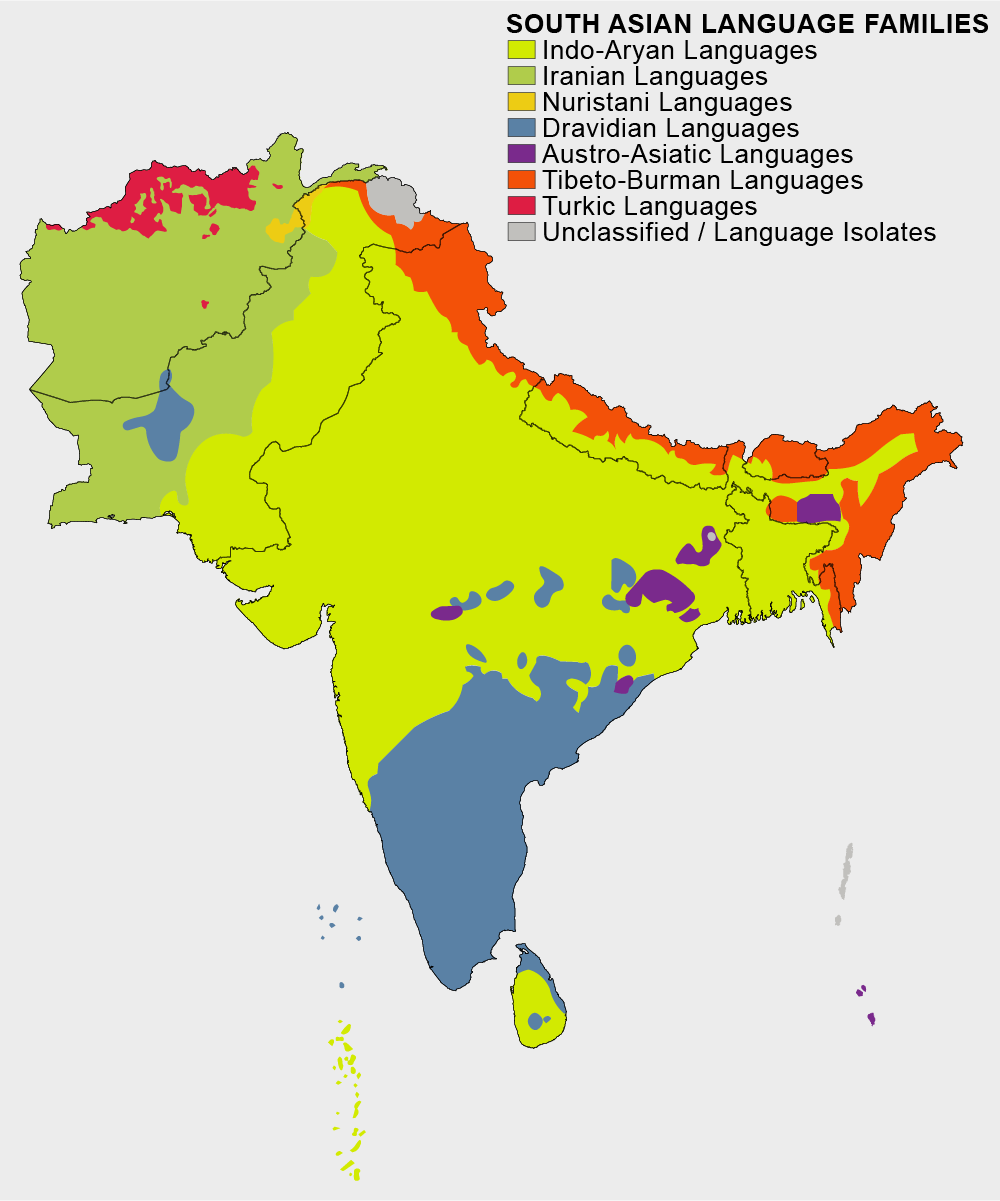
Languages in this group are found in multiple countries and regions. Major concentrations occur in Myanmar, the Tibetan Plateau (Tibet) and parts of mainland Southeast Asia such as northern Thailand, Vietnam, and Laos. Within China they appear in several provinces, including Guizhou and Hunan. The family also spreads across the Himalayan rim: northern Nepal, north‑eastern Bangladesh, Bhutan, and into western areas of Pakistan such as Baltistan. In India many Tibeto‑Burman languages are spoken in the Himalayan and northeastern states including Himachal Pradesh, Uttarakhand, Sikkim, Arunachal Pradesh, Assam, Nagaland, Manipur, Mizoram, and Tripura, as well as in the high‑altitude regions of Ladakh and Kargil.
Size and examples
The subfamily comprises roughly 300–400 languages, depending on classification criteria. The best known large languages include Burmese, which has the largest number of native speakers (around 32 million), and the varieties associated with Tibetan peoples: Tibetans and related groups speak several Tibetan languages and dialects that together account for several million speakers. Many other Tibeto‑Burman languages are regionally important even if numerically smaller.
Classification and internal groups
Scholars divide Tibeto‑Burman into multiple branches rather than a single obvious tree; typical subgroupings include Bodic (Tibetic and closely related languages), Boro‑Garo and Sal languages in northeastern India, Lolo‑Burmese (which includes Burmese), Qiangic, and various Himalayan and Southeast Asian clusters. The exact boundaries and relationships remain active topics of comparative research and historical reconstruction.
Linguistic characteristics
- Typology: Many Tibeto‑Burman languages are analytic or mildly agglutinative, often using serial verb constructions and particle marking rather than elaborate inflection.
- Tone and phonology: Several branches are tonal (e.g., Burmese and many Southeast Asian groups), while others rely more on consonant and vowel contrasts. Consonant clusters and distinctive phonation types appear in some languages.
- Grammar: Word order varies, though Subject‑Object‑Verb (SOV) is common across many Himalayan groups; case markers, postpositions and verb morphology differ widely by branch.
- Lexicon: Shared core vocabulary and cognate sets allow comparative work, but heavy contact with Indo‑Aryan, Tai‑Kadai and Austroasiatic languages has produced extensive borrowing.
History, reconstruction and contact
Historical linguists have used comparative methods to reconstruct aspects of a common Tibeto‑Burman ancestor, though the picture remains incomplete. Migration across the Himalayan range and along river valleys has generated rich internal diversity. Longstanding contact with neighboring language families, plus the spread of regional lingua francas, have shaped phonology and vocabulary in many Tibeto‑Burman languages.
Uses, vitality and notable facts
Several Tibeto‑Burman languages serve as national or literary languages (for example, Burmese), while many others function primarily as community languages with limited written tradition. Language vitality varies: some languages are vigorous and used in education and media, others are endangered with dwindling numbers of speakers. Documentation and revitalization projects are ongoing in many regions.
Further information and region‑specific resources can be found via these links: Sino‑Tibetan overview, classification debates, Myanmar, Tibet, northern Thailand, Vietnam, Laos, Guizhou, Hunan, Nepal, Bangladesh, Bhutan, Pakistan, Baltistan, Himachal Pradesh, Uttarakhand, Sikkim, Arunachal Pradesh, Assam, Nagaland, Manipur, Mizoram, Tripura, Ladakh, Kargil, Burmese, Tibetan peoples, Tibetan dialects.
Related articles
Author
AlegsaOnline.com Tibeto‑Burman languages Leandro Alegsa
URL: https://en.alegsaonline.com/art/99776