
Manipur: history, geography, culture and significance
Manipur is a state in northeastern India known for its valley and hills, ancient royal chronicle, rich dance and textile traditions, Loktak Lake and unique wildlife, and complex cultural and administrative landscape.
Manipur (Meitei: Kangleipak) is a state in the far northeastern region of the Republic of India. Covering roughly 22,347 km² (about 8,628 mi²), it combines a central fertile valley surrounded by hills and forested uplands. The state capital is Imphal, long a commercial and cultural hub for the region.
Image gallery
10 Images



Location and physical features
Manipur sits at a strategic junction between the Indian subcontinent and Southeast Asia. It borders the Indian states of Nagaland to the north, Mizoram to the south and Assam to the west, while its eastern boundary meets the nation of Myanmar. The state’s landscape is dominated by a fertile central valley drained by river systems, and by surrounding hills that support many tribal communities. Notable natural landmarks include Loktak Lake, with its floating biomass formations, and Keibul Lamjao National Park, the world’s only floating national park and the habitat of the endemic sangai deer.
History and political development
Manipur has a long recorded monarchy and recorded court chronicles. The royal lineage of the Ningthouja dynasty and successive rulers is preserved in the Cheitharol Kumbaba, an extensive court chronicle written in the Meitei script that documents the kingdom’s rulers from early traditions through the nineteenth and early twentieth centuries. The historic seat of royal authority, Kangla, remains a symbol of the state’s premodern polity. The kingdom merged with the modern Indian state after 1947, concluding the era of monarchy and leading to integration into India in 1949 (merger with India).
People, language and religion
The majority community in the valley are the Meitei (also spelled Meetei), who speak the Manipuri (Meitei) language and retain distinct traditions, script forms and performing arts. The hill areas are inhabited by a variety of tribal groups — broadly referred to under Naga and Kuki–Chin identities — each with its own languages, customs and social systems. Religious life is plural: Hinduism and indigenous Sanamahi practices are important among the valley population, while Christianity is prominent among many hill communities. Festivals such as Lai Haraoba and Yaoshang reflect the state’s syncretic ritual life.
Culture, arts and sports
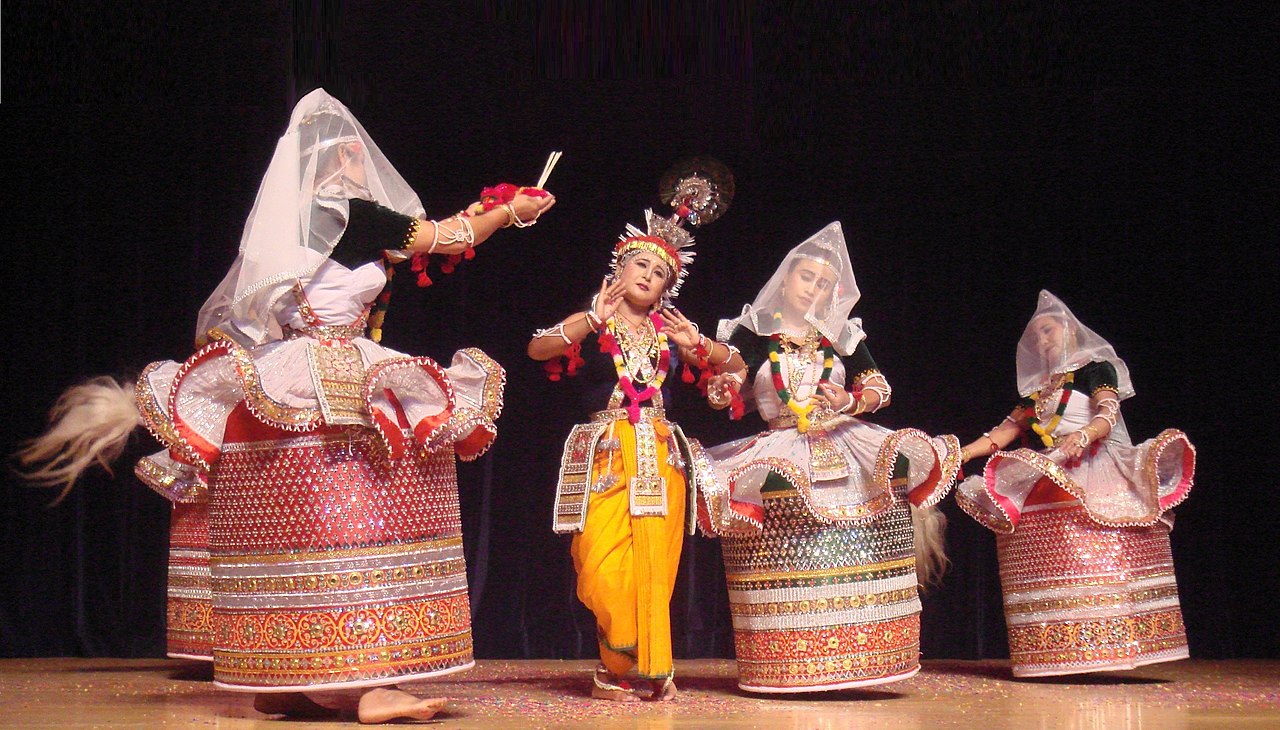
Manipur is celebrated for its classical and folk arts. Manipuri dance, especially the Vaishnavite Raas tradition, is one of India’s recognized classical dance forms. The state has a rich handloom tradition producing finely woven textiles and distinctive motifs used in traditional dress. Music includes instruments such as the pena, and folk theatre and oral storytelling remain vibrant. Manipur is also associated with early forms of polo (sagol kangjei), which has local historical roots and a long association with royal patronage.
Economy, administration and conservation
The state’s economy rests largely on agriculture, horticulture, fishing and cottage industries such as weaving and handicrafts. Its border with Myanmar gives it strategic importance for trade and connectivity, while limited infrastructure and hilly terrain present development challenges. Administratively, Manipur is divided into several districts with Imphal serving as the capital and primary administrative centre; district headquarters handle local governance and public services. Conservation efforts focus on protecting unique lake ecosystems and endemic wildlife such as the sangai deer.
Notable facts and distinctions
- Manipur’s historical chronicles are among the region’s oldest continuous records of rulership.
- Loktak Lake supports floating islands of vegetation (phumdis) and local livelihoods.
- Keibul Lamjao is noted for preserving the rare brow-antlered deer, locally called the sangai.
- Traditional polo and classical Manipuri dance are culturally associated with the state and have broader national recognition.
Related articles
Author
AlegsaOnline.com Manipur: history, geography, culture and significance Leandro Alegsa
URL: https://en.alegsaonline.com/art/61345