
Kargil: town in Ladakh, strategic gateway in the western Himalaya
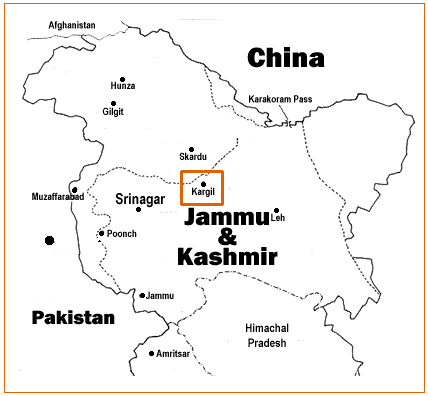
Kargil is a high‑altitude town in the Kargil district of Ladakh, India. Known for its strategic location, cultural mix and role in modern history, it lies between Drass and Srinagar on the Srinagar–Leh corridor.
Overview
Kargil is a principal town and administrative centre in the Kargil district of the Indian union territory historically linked with Jammu and Kashmir. It is the second largest urban centre in the larger Ladakh region after Leh. The town functions as a market and service hub for surrounding valleys and high‑altitude communities.
Image gallery
10 Images


Geography and climate
Kargil sits in a river valley framed by the greater Himalayan and Zanskar ranges. It lies roughly 60 km from Drass and about 204 km from Srinagar, along the main Srinagar–Leh route. The area experiences long, cold winters and short summers typical of high‑altitude continental climates; precipitation is limited and agriculture is concentrated in irrigated valley floors.
History and culture
Historically Kargil was a crossroads on trans‑Himalayan routes and has absorbed influences from Tibetan, Central Asian and South Asian traditions. Its population includes speakers of Ladakhi, Balti and Dardic languages and the town has a predominantly Muslim community with distinct local customs. Kargil also entered recent global awareness after the 1999 conflict that took place in the surrounding mountain passes.
Economy, transport and tourism
The local economy combines small‑scale agriculture, animal herding, trade and services for travelers. Kargil is a staging point for treks and crossings into the Zanskar valleys and for adventure tourism in summer months. Road links along the Srinagar–Leh highway are the principal lifeline; seasonal transport and basic hospitality services support visitors and traders.
Strategic importance and infrastructure
Because of its position on a major east–west corridor and proximity to the Line of Control, Kargil has significant strategic value and a visible security presence. Civilian infrastructure includes district administration, markets, schools and limited healthcare; aviation facilities in the region are primarily for military use.
Notable facts
- Second largest town in Ladakh after Leh.
- Serves as gateway to Zanskar and surrounding high valleys.
- Long, cold winters and brief summer season shape livelihoods.
- Remains an area of cultural blending and historical trade routes.
Related articles
Author
AlegsaOnline.com Kargil: town in Ladakh, strategic gateway in the western Himalaya Leandro Alegsa
URL: https://en.alegsaonline.com/art/52303