Megalosauroidea — overview of the megalosauroid theropods Megalosauroidea Megalosauroidea is a clade of mostly large carnivorous tetanuran theropods that lived from the Middle Jurassic into the Late Cretaceous, including megalosaurids, spinosaurids and r…
Megalosaurus — an early large theropod of the Middle Jurassic Megalosaurus Megalosaurus, among the first dinosaurs described, is a Middle Jurassic carnivorous theropod from Europe known from fragmentary remains and important in the early history of paleon…
Megamouth shark (Megachasma pelagios) Megamouth shark A large, rare filter-feeding shark discovered in 1976. Slow-moving and pelagic, the megamouth inhabits deep and surface waters of the major oceans and is known for its enormous mou…
Meganisoptera: the giant, extinct dragonfly-like insects of the Palaeozoic Meganisoptera Meganisoptera (formerly Protodonata) were large, predatory, dragonfly-like insects of the late Carboniferous to late Permian. This article summarizes their features, fossil record,…
Megapode: the mound-building incubator birds Megapode Megapodes are a family of ground-dwelling birds that incubate eggs with environmental heat. Known as mound-builders, they occur across Australasia and the Pacific and show unique r…
Megaraptor — a large late Cretaceous theropod Megaraptor Megaraptor is a genus of large, lightly built theropod from the Late Cretaceous of South America, known for unusually large manual claws and an uncertain position among carnivorous…
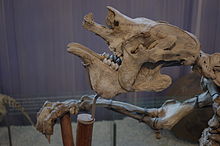
Megatherium Megatherium, a genus of giant ground sloths from Pleistocene South America, was one of the largest terrestrial mammals of its time and is important for understanding Ice Age megafa…
Megazostrodon: early mammaliaform from southern Africa Megazostrodon Small, shrew-sized early mammaliaform from about 200 million years ago found in Lesotho. Shows transitional features between late cynodonts and early mammals: differentiated teeth,…
Megophryidae — Asian leaf-litter and horned frogs Megophryidae Megophryidae is a diverse family of Southeast Asian frogs known for leaf-like camouflage, varied tadpoles, and horned or spade-like appearances; about 70–100 species in roughly a d…
Mekong giant catfish (Pangasianodon gigas) Mekong giant catfish Large freshwater catfish native to the lower Mekong River system. Critically endangered from overfishing, dams and habitat loss; subject to limited aquaculture and conservation eff…
Melanophryniscus — South American red-bellied toads Melanophryniscus Melanophryniscus is a genus of small, often brightly colored toads native to southern South America, known for their red or orange ventral coloration, toxin defenses, and localized…
Melon-headed whale (Peponocephala electra) Melon-headed whale A small, deep‑water dolphin of tropical oceans, the melon‑headed whale forms large social groups and is related to pilot whales and the pygmy killer whale.
Meow: the cat vocalization used to communicate with humans and other cats Meow An overview of the meow: types, meaning, development, and cultural and linguistic variations of the vocalization cats use to signal needs and emotions.
Meowth (Pokémon): the Scratch Cat Meowth Meowth is a Generation I 'Scratch Cat' Pokémon noted for its coin-like forehead, the Pay Day move, regional forms (Alolan, Galarian) and a famous talking Meowth in the Pokémon anim…
Merginae (seaducks) Merginae Merginae, commonly called seaducks, are a subfamily of Anatidae adapted mostly to coastal and cold-water habitats; they are diving birds with salt-tolerance adaptations and varied…
Merostomata: sea scorpions (Eurypterida) and horseshoe crabs (Xiphosura) Merostomata Merostomata is a historical grouping of chelicerate arthropods that included extinct sea scorpions (Eurypterida) and modern horseshoe crabs (Xiphosura); covers anatomy, fossil reco…
Mertensophryne — snouted frogs, an African genus of true toads Mertensophryne Mertensophryne is a genus of African true toads (family Bufonidae) found from eastern Democratic Republic of Congo to Mozambique. Commonly called snouted frogs, they are small, ter…
Mesobatrachia: the intermediate clade of frogs Mesobatrachia Mesobatrachia is a group of frogs positioned between primitive and modern lineages; commonly treated as containing about six families and several dozen genera, its limits have chan…
Mesonychids: extinct hoofed carnivorous mammals Mesonychid Mesonychids were an early group of hoofed, carnivorous mammals from the Paleocene–Oligocene. They show unique teeth and limb adaptations and figured in debates about the origins of…
Mesosaurus — an early aquatic reptile of the Permian Mesosaurus Mesosaurus was an early Permian aquatic reptile known from southern Africa and South America; its distinctive anatomy and disjunct distribution informed studies of paleoecology, pa…
Metatheria: marsupials and their extinct relatives Metatheria Metatheria is the mammal group that includes living marsupials and their fossil kin. This article covers their defining traits, reproduction, fossil record, classification and ecol…
Metriacanthosauridae Metriacanthosauridae were medium-to-large carnivorous theropods mainly known from Jurassic deposits of Europe and Asia; recognized as a distinct carnosaur family with several notab…
Metriacanthosaurus: a Middle Jurassic theropod of Europe Metriacanthosaurus Metriacanthosaurus was a medium-to-large allosauroid theropod from Middle Jurassic Europe (~160 Ma), named for moderately tall neural spines. Known from partial remains, it is plac…
Mew — meanings in language, places, and popular culture Mew Mew is a short word with several distinct meanings: a cat’s cry, historic stables called mews, the Pokémon Mew, and other cultural or technical uses such as the crypto wallet MEW o…
Mexican burrowing toad (Rhinophrynus dorsalis) Mexican burrowing toad A stout, fossorial frog—Rhinophrynus dorsalis—sole member of its genus and family. Native from southern Texas through Central America, adapted to burrowing and explosive, rain-driv…
Mexican West Coast Rattlesnake (Crotalus basiliscus) Mexican west coast rattlesnake A large pit viper native to Mexico's Pacific slope, Crotalus basiliscus is known for its greenish coloration, powerful venom, and role as an ambush predator in dry and tropical low…
Miacis — early carnivorous mammals and precursors to modern Carnivora Miacis Miacis were small, tree‑adapted Paleocene–Eocene carnivoramorphs. Known from fragmentary fossils, they show dental and cranial traits leading toward modern Carnivora but have uncer…
Microbiotheria: the Monito del Monte and its evolutionary significance Microbiotheria Microbiotheria is an order of marsupials represented today by a single species, the Monito del Monte (Dromiciops), native to southern Andean forests and notable for its evolutionar…
Microcaecilia supernumeraria A species of limbless amphibian (caecilian) in the family Caeciliidae, endemic to Brazil and associated with subtropical and tropical lowland forest and rural habitats.
Microhylidae — the narrow‑mouthed frog family Microhylidae Microhylidae is a diverse family of small to medium frogs with 495 species in 68 genera and nine subfamilies, found across tropical regions and known for narrow mouths, varied life…
Micromoth (microlepidoptera): biology, identification, and ecological role Micromoth Micromoths (microlepidoptera) are an informal grouping of small moths. This article covers their traits, life histories, ecological importance, methods of study, and how they diffe…
Micropachycephalosaurus — small ornithischian from the Late Cretaceous of China Micropachycephalosaurus Micropachycephalosaurus is a very small Late Cretaceous ornithischian from Shandong, China, noted for its tiny size, limited fossil remains, debated placement among cerapod dinosau…
Microraptor — a small four-winged feathered dinosaur Microraptor Microraptor was a small, feathered dromaeosaurid from Early Cretaceous China, notable for long flight feathers on both arms and legs and its role in understanding the origins of av…
Microvenator — a small, fast Early Cretaceous theropod Microvenator Microvenator, meaning "small hunter," was a turkey-sized carnivorous theropod from the Early Cretaceous of what is now Montana, known from fragmentary remains that illuminate early…
Midwife toad (Alytes) Midwife toad Alytes, the midwife toads, are a small genus of European and northwestern African frogs whose males famously carry developing eggs on their bodies until the tadpoles are ready for…
Migration (animal movement across habitats) Migration Migration is the regular, often seasonal movement of animals between habitats driven by climate, food and reproduction. It includes seasonal, daily and life-stage movements and has…
Migratory locust (Locusta migratoria) — overview, biology, and impact Migratory locust The migratory locust (Locusta migratoria) is a swarming grasshopper found across Africa, Asia, Australia and New Zealand; notable for phase changes, wide distribution, economic imp…
Milkweed butterflies (Danainae): biology, behavior and ecological role Milkweed butterfly Overview of Danainae (milkweed butterflies), their life cycle, chemical defenses from milkweed, mimicry and migration, notable species such as the monarch, and conservation conside…
Millipede: biology, diversity, behavior, and ecological role Millipede Millipedes (class Diplopoda) are many-segmented arthropods. This article summarizes their anatomy, life cycle, ecology, defenses, differences from centipedes, and interactions with…
Mimathyma ambica — Indian purple emperor Mimathyma ambica Mimathyma ambica, the Indian purple emperor, is a nymphalid butterfly of Asia known for its iridescent purplish sheen, forest canopy habits, and resemblance to other 'emperor' butt…
Mimic octopus (Thaumoctopus mimicus): adaptive mimicry and natural history Mimic octopus Thaumoctopus mimicus is a Southeast Asian octopus notable for impersonating other animals. This article summarizes its appearance, behavior, discovery, habitat, diet, reproduction,…
Mink: semi-aquatic mustelids, biology, distribution and human interactions Mink Minks are small semi-aquatic mustelids with dense fur, opportunistic diets and complex relations with people, including fur farming, wild conservation concerns and invasive populat…
Minke whale Smallest living rorqual, found widely in cold and temperate seas; baleen filter-feeder noted for its compact size, distinctive flipper markings, and importance to whale watching an…
Minnow: small freshwater fish and their roles Minnow Minnow is a common name for small freshwater fish—often cyprinids—used as bait, aquarium food, and ecological indicators. This article explains types, uses, and how 'true minnows'…
Miss Beazley — Presidential Scottish Terrier (2004–2014) Miss Beazley (dog) Miss Beazley was a Scottish Terrier owned by President George W. Bush and First Lady Laura Bush. She featured in BarneyCam videos and died of lymphoma in Dallas in 2014 at age nine…
Mixed-breed dog A dog whose ancestry combines two or more breeds. Covers definitions, appearance and genetics, health and behavior, history, examples (e.g., Labradoodle), and considerations for ad…
Mixosaurus — a small, cosmopolitan Triassic ichthyosaur Mixosaurus Mixosaurus was a small, widespread Triassic ichthyosaur known from many global localities; an important transitional form between primitive eel-like and advanced dolphin-shaped ich…
Moa: extinct giant flightless birds of New Zealand Moa The moa were a group of nine extinct flightless bird species native to New Zealand. This article covers their biology, diversity, human contact, extinction causes, and cultural and…