
Miacis — early carnivorous mammals and precursors to modern Carnivora
Miacis were small, tree‑adapted Paleocene–Eocene carnivoramorphs. Known from fragmentary fossils, they show dental and cranial traits leading toward modern Carnivora but have uncertain, possibly paraphyletic, relationships.
Overview
Miacis is the name historically applied to a group of small, extinct mammal species that lived during the Paleocene and early Eocene (often dated roughly 50–60 million years ago). Known primarily from isolated teeth, jaw fragments and occasional postcranial bones, these animals are generally reconstructed as small-bodied, agile predators or omnivores that spent at least part of their time in trees in forested landscapes.
Image gallery
10 Images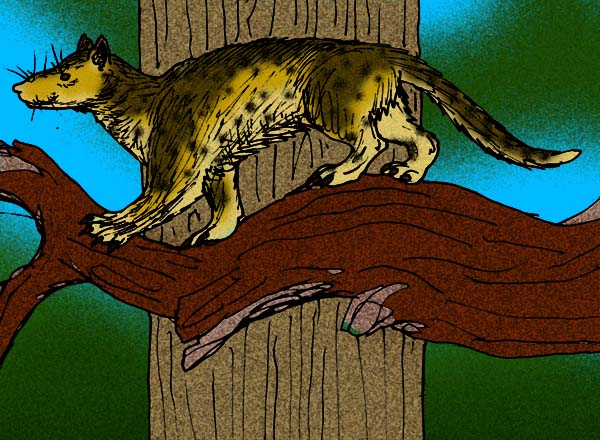


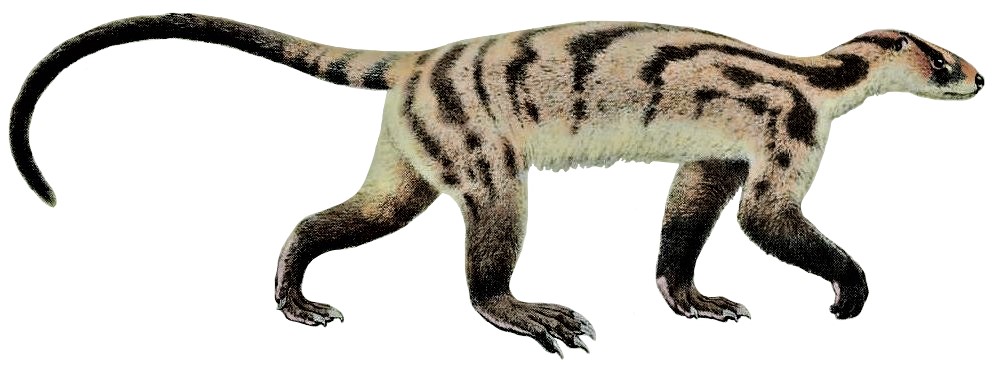

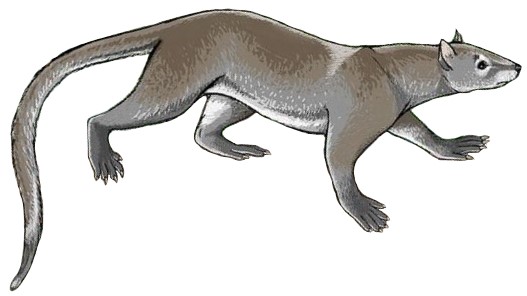
Physical characteristics
Miacids retained a number of primitive mammalian features while showing anatomical changes that foreshadow later carnivorans. Early forms had the ancestral mammalian dental complement (up to 44 teeth), with a clear trend in some lineages toward reduction and specialization of teeth for shearing meat. Limb proportions and grasping digits in many specimens suggest good climbing ability. Cranial features include relatively enlarged braincases compared with contemporary, more primitive carnivorous groups, which has been interpreted as an increase in sensory and behavioural complexity compared with creodonts and other early predators; contrast with creodonts is commonly discussed in the literature.
Diet and behaviour
Dietary reconstructions for species traditionally placed in Miacidae are based on tooth shape and wear, jaw mechanics and comparisons with living small carnivorans. Most authors propose an opportunistic diet including small mammals, reptiles, birds, eggs, invertebrates and plant material such as fruit. Arboreal adaptations imply that hunting and foraging often took place in trees or at forest edges. Larger relative brain size and flexible dentition suggest behaviour that could be more versatile than that of some contemporaneous predators (behaviour and sensory ecology are active areas of study).
Evolutionary significance and classification
Miacids occupy an important position in the early evolution of the group that gave rise to modern carnivores. They are usually placed within the broader assemblage called Carnivoramorpha, which includes stem taxa leading into the crown-group Carnivora. However, the traditional genus name Miacis and the family label Miacidae have been the subject of long-standing taxonomic revision. Many researchers consider that the set of species long assigned to Miacis does not form a single natural (monophyletic) group; in other words, the name may represent an ancestral grade or a paraphyletic assemblage rather than a coherent clade. Some specialists instead identify specific miacid species as early stem members of the modern, or crown-group, Carnivora.
Fossil record and history of study
Fossils attributed to miacids have been found in Paleocene–Eocene deposits in North America, Europe and Asia. Material is often fragmentary, which complicates classification and phylogenetic analysis. Over more than a century of study, new specimens and methods (including detailed dental morphology, postcranial analysis and cladistic approaches) have repeatedly revised ideas about which species belong to Miacis and how they relate to later carnivoran groups. Well preserved partial skeletons, when found, provide crucial information about locomotion and lifestyle but remain relatively rare.
Importance for understanding carnivore origins
Despite uncertainties in classification, studies of miacids and related taxa are central to reconstructing how key carnivoran traits evolved: the transition from generalized, small-bodied predators to animals with more specialized shearing dentition, refined sensory capabilities and diverse locomotor adaptations. Continued discovery of fossils and application of modern analytical techniques are refining the picture of early carnivoramorph diversification and the origins of the living orders.
For introductory summaries and further reading see general treatments of early carnivoran evolution and databases and review articles referenced in specialist sources: Carnivora overview, Miacidae details, Carnivoramorpha resources, creodont comparisons, behavioural studies, crown-group discussions and discussions of paraphyly.
Questions and answers
Q: What is Miacis?
A: Miacis is a small extinct carnivore of the family Miacidae.
Q: Where did Miacis live?
A: Miacis lived in forests and climbed trees.
Q: What did Miacis eat?
A: Miacis ate small prey, such as small mammals, reptiles, and birds, and might have also eaten eggs and fruits.
Q: How many teeth did Miacis have?
A: Miacis had the ancestral mammalian number of 44 teeth, which later began to be reduced.
Q: Was Miacis intelligent?
A: The larger brain size compared to body size of Miacis suggests that their behavior was becoming more flexible, and possibly more intelligent.
Q: When did Miacis live?
A: Miacis lived 50 to 60 million years ago.
Q: Is Miacis a single species or a group of species?
A: Some experts think that Miacis is a paraphyletic taxon and covers a number of different species.
Related articles
Author
AlegsaOnline.com Miacis — early carnivorous mammals and precursors to modern Carnivora Leandro Alegsa
URL: https://en.alegsaonline.com/art/64385
Sources
- tandfonline.com : tandfonline.com/doi/abs/10.1017/S1477201904001518