
Suzuki Method (Talent Education, Mother-Tongue Approach)
A teaching philosophy developed by Shin'ichi Suzuki emphasizing early childhood musical learning by ear, parental involvement, repetition, and character development through a supportive environment.
Overview
The Suzuki method, often called Talent Education or the Mother-Tongue approach, is a pedagogy for learning music that stresses early exposure, listening, imitation and encouragement. Originating in Japan in the mid-20th century, it promotes the idea that children can acquire musical skill much as they acquire their native language: through repeated hearing, imitation, and patient guidance rather than formal analysis at first.
Image gallery
1 Image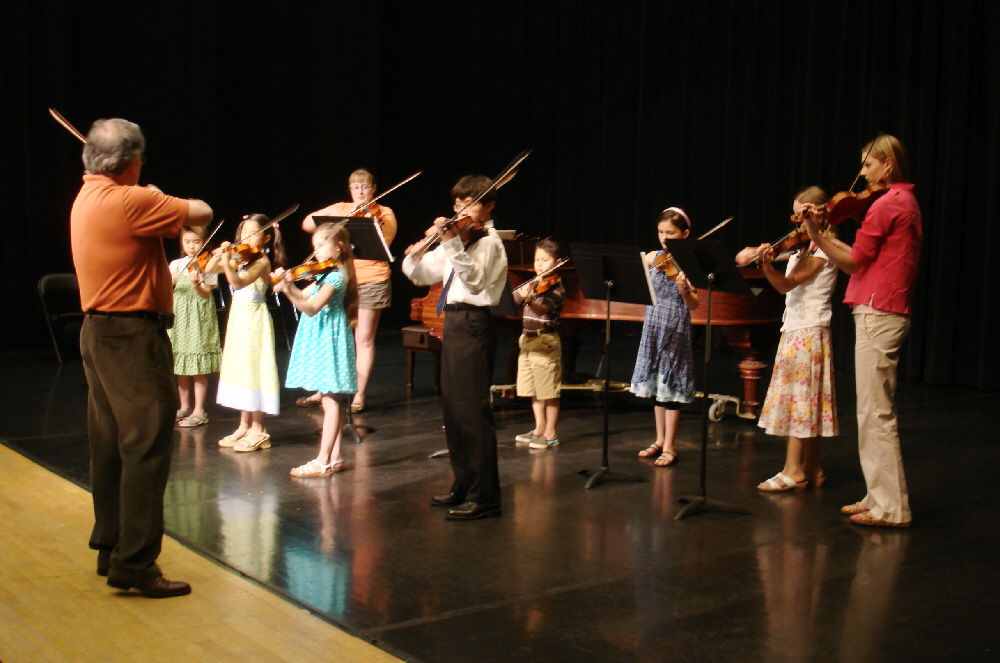
Core principles and characteristics
Several consistent principles distinguish the Suzuki approach: beginning musical training at a young age; learning by ear before learning to read notation; close parental involvement; frequent repetition and review of repertoire; emphasis on tone and musical phrasing; and consistent encouragement so that students develop confidence and motivation. Lessons usually combine private instruction with group classes, and progression follows a graded repertoire and technique sequence designed for steady incremental gains.
Typical structure of lessons
A Suzuki lesson often involves three participants: the teacher, the student, and a parent or caregiver who attends every lesson and helps supervise daily practice. Early learning centers on listening to recordings and watching demonstrations; students memorize pieces and refine tone and bowing (for strings) or other instrument-specific technique. Reading musical notation is introduced gradually, usually after a basic technique and repertoire foundation has been established.
History and development
Dr. Shin'ichi Suzuki, a violinist and educator, developed the method after World War II with the purpose of nurturing beauty and sensitivity in children through music. He observed children's natural capacity to acquire language and proposed that the right environment and encouragement would allow any child to learn an instrument. Over time the approach spread internationally and was adapted for many instruments beyond the violin.
Instruments, repertoire and uses
Although the violin is closely associated with the Suzuki tradition, the method has been applied to piano, flute, recorder, guitar, cello, viola, bass, harp, organ, and voice, among others. Core Suzuki repertoire is organized into books that present short, progressively challenging pieces designed to develop technique, intonation and musicality. Teachers and schools often use group performance opportunities and recordings so students can hear the repertoire continually.
Distinctions, benefits and considerations
Supporters cite early ear training, strong parental engagement, solid tone production and high student motivation as major advantages. Critics or observers sometimes note that reliance on memorization can delay formal music-reading skills for some students or that quality depends heavily on teacher training and fidelity to pedagogical goals. Many programs now balance ear-based learning with early reading to combine strengths.
Further reading and resources
- Talent Education overview
- Principles and practice
- Violin-focused materials
- Piano adaptations
- Flute resources
- Recorder and early wind instruments
- Guitar method adaptations
- Cello pedagogy in Suzuki
- Viola resources
- Bass and lower strings
- Organ adaptations and materials
- Harp and plucked strings
- Voice and singing within Suzuki
- Suzuki repertoire books
- Published Suzuki editions
- Origins in Japan
- Postwar development
- Philosophy of beauty and character
- Work with young children
- National and local programs
- Historical context
- Language acquisition analogy
- Dialects and learning examples
- Role of adults in learning
- Suzuki's pedagogical ideas
- Starting children in preschool
Whether used as a complete system or adapted into other teaching styles, the Suzuki method remains influential in early music education because of its focus on listening, repetition, supportive instruction and the idea that musical ability can flourish in a nurturing environment.
Related articles
Author
AlegsaOnline.com Suzuki Method (Talent Education, Mother-Tongue Approach) Leandro Alegsa
URL: https://en.alegsaonline.com/art/95350