
Portia — inner moon of Uranus
Portia is a small, inner moon of Uranus discovered by Voyager 2 in 1986. It is a prolate, low‑albedo body in the Portia group whose orbit is slowly decaying and may eventually form a ring or impact Uranus.
Portia is one of Uranus's inner satellites, officially designated Uranus XII and discovered in images returned by the Voyager 2 spacecraft on 1986‑01‑03 (initially catalogued as S/1986 U 1). Its name honors the character Portia from William Shakespeare's play William Shakespeare's The Merchant of Venice. Because it orbits close to the planet, Portia is grouped with a set of similar moons and is the second largest of the inner, closely orbiting satellites after Puck.
Image gallery
6 Images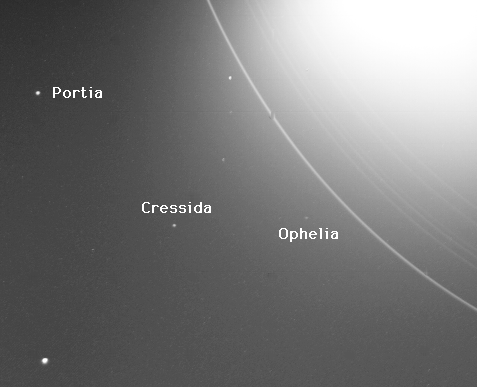



Physical characteristics
Portia is small and elongated, with an overall size on the order of 140 kilometers across. Images from Voyager 2 show a stretched, prolate shape: its long axis points toward Uranus, indicating that the moon is tidally locked. Photometric measurements indicate a low geometric albedo of roughly 0.08 (albedo reference), giving it a dark, grey appearance. Spectroscopic observations obtained with the Hubble Space Telescope and large ground telescopes reveal absorption features consistent with water ice mixed with darker materials, implying a composition of ices and darker, possibly carbonaceous, constituents. The exact bulk density and internal structure remain uncertain because direct mass measurements are not available.
Orbit and long‑term evolution
Portia orbits well inside Uranus's synchronous orbital radius (synchronous radius), which means tidal interactions with the planet are causing the moon's orbit to slowly shrink. Over astronomical timescales this inward spiraling can lead to two possible fates: tidal disruption, in which the satellite is torn apart and its material spreads into a narrow planetary ring (ring formation), or inward collision with Uranus. The current orbital decay is slow, but it illustrates how inner moons can evolve and contribute to ring systems.
Portia group
Portia is the namesake of the so‑called Portia group, a collection of small inner satellites that share similar orbital distances and photometric properties. Members of this group include Bianca, Cressida, Desdemona, Juliet, Rosalind, Cupid, Belinda and Perdita. The similarities among these moons—comparable sizes, dark surfaces, and tightly packed orbits—suggest a related origin or similar processing by Uranus's environment.
Discovery and observations
Voyager 2's flyby provided the first images and basic characterization of Portia, but resolution was limited. Subsequent observations with the Hubble Space Telescope and large terrestrial observatories improved knowledge of its spectrum and surface properties. Photometric studies established the low albedo and handed estimates of shape from how brightness varies as the object rotates. Despite these efforts, many fundamental properties—mass, precise internal composition, and detailed geology—remain unknown due to the moon's small size and distance.
Importance and context
Although modest in size, Portia is scientifically valuable because it exemplifies the population of inner satellites that interact strongly with their parent planet. Studying Portia and its companions helps astronomers understand tidal evolution, satellite fragmentation, and the origin of faint rings. Future missions to the Uranus system, or advances in ground‑based and space telescopic capabilities, would be required to refine measurements of its mass, internal structure and the timeline for its orbital decay.
Related articles
Author
AlegsaOnline.com Portia — inner moon of Uranus Leandro Alegsa
URL: https://en.alegsaonline.com/art/78274
Sources
- adsabs.harvard.edu : "The Orbits of the Inner Uranian Satellites From Hubble Space Telescope and Voyager2 Observations"
- doi.org : 10.1086/300263
- adsabs.harvard.edu : "Voyager's Eleventh Discovery of a Satellite of Uranus and Photometry and the First Size Measurements of Nine Satellites"
- doi.org : 10.1006/icar.2001.6597
- adsabs.harvard.edu : "Comprehensive Photometry of the Rings and 16 Satellites of Uranus with the Hubble Space Telescope"
- doi.org : 10.1006/icar.2001.6596
- cfa-www.harvard.edu : "IAU Circular No. 4164"
- planetarynames.wr.usgs.gov : "Planet and Satellite Names and Discoverers"
- adsabs.harvard.edu : "Hubble Space Telescope NICMOS Multiband Photometry of Proteus and Puck"
- doi.org : 10.1086/375909