
Rosalind (moon) — a small inner satellite of Uranus
Rosalind is a small inner moon of Uranus (Uranus XIII), discovered in Voyager 2 images in 1986. It is a member of the Portia group and remains poorly characterized beyond size, albedo, and basic shape.
Rosalind is one of the inner moons of Uranus. It carries the formal designations S/1986 U 4 and Uranus XIII. Like several other small satellites in the same orbital zone, Rosalind is a modest, dark object only a few tens of kilometres across. Most of what is known about it comes from a brief set of images and follow-up observations; its overall properties remain only lightly constrained.
Image gallery
5 Images
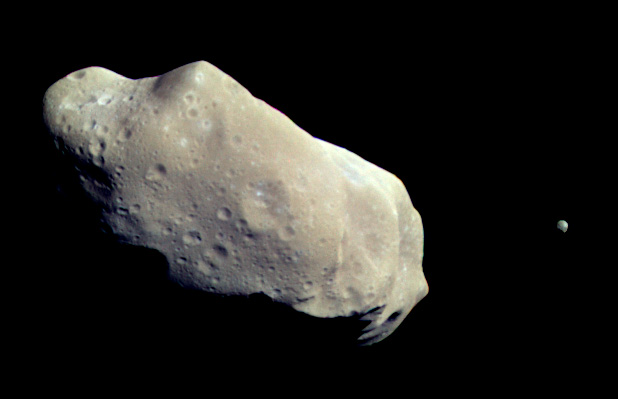


Discovery and name
The moon was identified in images taken by the Voyager 2 spacecraft during its flyby; the discovery images date to 13 January 1986. After confirmation and cataloguing with a provisional designation, the satellite received the name Rosalind, after a principal character in William Shakespeare's comedy As You Like It. The use of Shakespearean and Alexander Pope names is a convention for Uranian satellites.
Physical characteristics
Rosalind is small and faint. Published estimates put its radius at roughly 36 kilometres and give it a low geometric albedo of about 0.08, indicating a dark, non-reflective surface. Voyager 2 images show a nearly rounded body; photometric modelling suggests a prolate spheroid with axial ratios near 1.0 to 0.8. The object appears spectrally neutral or grey in available images, with no prominent color variations documented.
Orbit and group membership
Rosalind orbits close to Uranus in the inner satellite system. It is commonly grouped with other nearby moons that share similar orbital distances and photometric behaviour; this assemblage is often called the Portia group. Members of that group include:
Grouping reflects similarities in orbit and surface brightness rather than proven common origin; they may be collisional fragments or simply a population of small bodies captured or formed in situ around Uranus.
Observations, limitations, and importance
Beyond the initial Voyager 2 imagery, only limited observations from Earth-based telescopes and the Hubble Space Telescope have supplemented knowledge of Rosalind. These follow-ups have generally confirmed its faintness, size order, and grey color but have not revealed detailed geology, composition, or atmosphere (it has none). Because Rosalind and its companions are small and closely spaced, high-resolution imaging is challenging; many finer properties remain unknown.
Studying Rosalind and other inner Uranian moons helps scientists understand the dynamical evolution of the Uranian satellite system, ring–moon interactions, and the outcomes of collisions in tightly packed satellite environments. Future missions or advances in observational techniques could provide higher-resolution photos, improved shape models, compositional measurements, or dynamical constraints on long-term orbital stability.
For further reading and resources about the discovery, spacecraft data, and the literary naming convention see primary mission materials and reference summaries: Voyager 2 mission, the Uranian satellite catalogue overview, discovery notes dated 13 January 1986, and the Shakespearean source As You Like It. Additional background on related moons and comparative properties is available for Bianca, Cressida, Desdemona, Portia, Juliet, Cupid, Belinda, and Perdita. The observed overall shape is summarized in mission imagery notes as approximately spherical.
Related articles
Author
AlegsaOnline.com Rosalind (moon) — a small inner satellite of Uranus Leandro Alegsa
URL: https://en.alegsaonline.com/art/84125
Sources
- adsabs.harvard.edu : "The Orbits of the Inner Uranian Satellites From Hubble Space Telescope and Voyager2 Observations"
- doi.org : 10.1086/300263
- adsabs.harvard.edu : "Voyager's Eleventh Discovery of a Satellite of Uranus and Photometry and the First Size Measurements of Nine Satellites"
- doi.org : 10.1006/icar.2001.6597
- adsabs.harvard.edu : "Comprehensive Photometry of the Rings and 16 Satellites of Uranus with the Hubble Space Telescope"
- doi.org : 10.1006/icar.2001.6596
- cfa-www.harvard.edu : "IAU Circular No. 4164"
- planetarynames.wr.usgs.gov : "Planet and Satellite Names and Discoverers"