
Bianca (Uranian moon)
Bianca is a small inner moon of Uranus discovered by Voyager 2 in 1986. A member of the Portia group, it is elongated, dark (low albedo), about 27 km in radius, and known mainly from spacecraft images.
Overview
Bianca is one of the small inner satellites of Uranus. It was discovered in images taken by the Voyager 2 spacecraft during the 1986 flyby and was provisionally designated S/1986 U 9. The moon was later named Bianca, after a character in Shakespeare's play The Taming of the Shrew, and is also catalogued as Uranus VIII. Because Bianca orbits close to its planet and is faint, nearly all reliable information about it comes from the Voyager 2 images and a small number of later telescopic observations.
Image gallery
6 Images



Physical characteristics
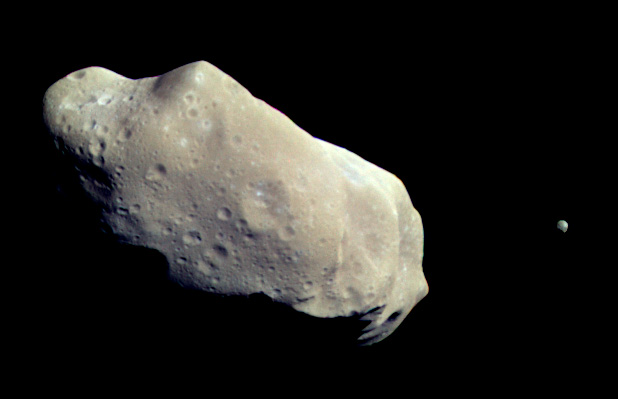
Bianca is a small, irregularly shaped body with an estimated mean radius of roughly 27 km. Photometric measurements indicate a low geometric albedo (about 0.08), which means its surface is relatively dark compared with many icy satellites. Voyager 2 images show Bianca as an elongated or prolate spheroid; analysis of those images gives an axis ratio on the order of 0.7 ± 0.2, with the major axis tending to point toward Uranus. The surface appears grey in the available images, consistent with mixtures of water ice and darker, carbon-rich materials or radiation-processed organics that are common on the inner moons of Uranus.
Orbit and group membership
Bianca orbits close to Uranus and belongs to a compact family of inner satellites often called the Portia group. These moons share similar orbital distances, inclinations, and photometric properties, which suggests a related origin or similar evolutionary processes. Members of this group include:
Discovery and observations
The discovery frames from Voyager 2 resolved Bianca only as a small, elongated spot near Uranus. Subsequent ground-based and space-based observations have confirmed its orbit and refined its brightness, but have not provided high-resolution surface images. There has been no dedicated spacecraft return to Uranus since Voyager 2, so many basic properties of Bianca—such as detailed surface composition, precise shape model, and internal structure—remain poorly constrained.
Origin, dynamics, and significance
Bianca and the other Portia-group moons are thought to be remnants of the early circumplanetary environment or the products of collisional fragmentation and reaccumulation. Their closely packed orbits make them interesting for studies of gravitational interactions, tidal evolution, and potential sources of faint ring material. Like other inner satellites of giant planets, Bianca is expected to be in synchronous rotation, showing the same face to Uranus.
Future study
Improving knowledge of Bianca will require higher-resolution imaging and spectral observations from a future Uranus mission or from advances in ground- and space-based telescopes. Such data would help determine surface composition, better constrain shape and density, detect any small satellites or dust environment, and test hypotheses about the formation and evolution of the Portia group. Until then, Bianca remains a small, dark, and lightly studied member of Uranus's inner satellite system.
Related articles
Author
AlegsaOnline.com Bianca (Uranian moon) Leandro Alegsa
URL: https://en.alegsaonline.com/art/11209
Sources
- adsabs.harvard.edu : "The Orbits of the Inner Uranian Satellites From Hubble Space Telescope and Voyager2 Observations"
- doi.org : 10.1086/300263
- adsabs.harvard.edu : "Voyager's Eleventh Discovery of a Satellite of Uranus and Photometry and the First Size Measurements of Nine Satellites"
- doi.org : 10.1006/icar.2001.6597
- adsabs.harvard.edu : "Comprehensive Photometry of the Rings and 16 Satellites of Uranus with the Hubble Space Telescope"
- doi.org : 10.1006/icar.2001.6596
- cfa-www.harvard.edu : "IAU Circular No. 4168"
- planetarynames.wr.usgs.gov : "Planet and Satellite Names and Discoverers"