
Cressida (Uranian moon)
Cressida is a small inner moon of Uranus discovered in Voyager 2 images in 1986. It is elongated, dark, and a member of the Portia group; most knowledge comes from brief spacecraft imagery and limited telescopic study.
Overview
Cressida is one of the small, inner satellites of Uranus. It was identified in images taken during the Voyager 2 flyby on 9 January 1986 and was provisionally designated S/1986 U 3 before receiving its present name and the catalog number Uranus IX. As an inner moon it orbits close to the planet and is observed to be small, dark and elongated. Most of what is known about Cressida comes from the short-duration Voyager 2 encounter and from follow-up ground- and space-based photometry and astrometry.
Image gallery
5 Images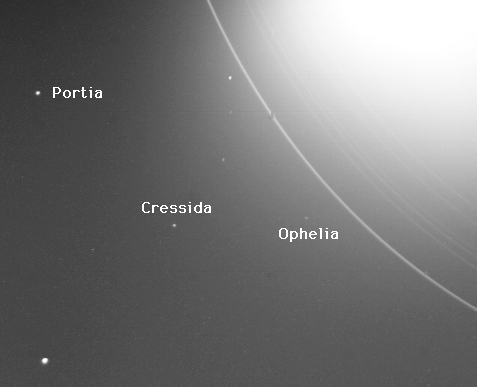



Discovery and name
The discovery was part of Voyager 2's rapid survey of the Uranian system; the mission returned the images that revealed several previously unknown moons and ring structure (Voyager 2). After confirmed detection, the satellite was named Cressida, drawn from classical and literary tradition. Cressida appears in medieval and classical sources and is best known from later literature: she is a tragic figure in Geoffrey Chaucer's writings (Chaucer) and is dramatized by William Shakespeare in the play Troilus and Cressida (Shakespeare). The choice follows the convention of naming Uranian moons after characters from Shakespeare and other works of English literature (name origin).
Orbit and group
Cressida belongs to a cluster of inner moons commonly referred to as the Portia group. These satellites share similar orbital radii, low inclinations and comparable photometric properties, suggesting broadly similar surface materials or a related collisional history. Members of the Portia group include:
Because these moons orbit relatively near Uranus, they are subject to strong tidal forces that affect their shapes and rotational states. Their interactions with each other and with any nearby ring material are topics of ongoing interest in planetary dynamics.
Physical characteristics
Cressida is small by planetary satellite standards. Published estimates from Voyager imagery put its mean radius on the order of a few tens of kilometres, commonly cited near 41 km, and its geometric albedo is low, close to 0.08, making it a rather dark body. Voyager images show Cressida as an elongated, prolate object with the long axis oriented approximately toward Uranus, a configuration consistent with tidal distortion and synchronous rotation (the same face toward the planet). A simple prolate spheroid fit to the available image data gave an axis ratio near 0.8 ± 0.3, but uncertainties are large because of limited resolution.
Surface and geology
At the resolution of the Voyager 2 images Cressida's surface appears grey and relatively featureless. No clear large-scale craters, tectonic features or deposits were resolved in the available imagery. Its low reflectivity and neutral colours are similar to those of other Portia-group moons, which may indicate surfaces dominated by dark, processed ices mixed with non-icy, spectrally neutral material. Without higher-resolution spectroscopy or imaging, conclusions about composition and internal structure remain tentative.
Observations and scientific context
Since Voyager 2, Cressida has not been visited by another spacecraft; most additional information has come from occultations, astrometric tracking and photometric measurements by large ground-based telescopes and space telescopes. These limited observations help refine orbital elements and constrain size and albedo but do not substitute for direct, high-resolution imaging and spectroscopic study. Scientists are interested in inner moons like Cressida because they inform models of satellite formation, collisional evolution in compact systems, tidal heating and ring–moon interactions.
Future study
Cressida remains a candidate for study by future missions to Uranus and by improved Earth-based facilities. Higher-resolution imaging and spectroscopy would permit better determinations of shape, density, surface composition and cratering record, which in turn would clarify its origin and relationship to other small Uranian satellites. Continued astrometric monitoring also helps detect subtle orbital changes driven by mutual perturbations or tidal evolution.
Further reading
For more information about the Voyager 2 encounter and the broader Uranian system consult mission summaries and reviews of inner satellite populations (Voyager 2, name origin, Shakespeare, Troilus and Cressida, Chaucer).
Questions and answers
Q: What is Cressida?
A: Cressida is a moon that orbits Uranus.
Q: When was Cressida discovered and how?
A: Cressida was discovered on January 9, 1986, through images taken by Voyager 2.
Q: Why was Cressida given its particular name?
A: Cressida was named after a character in William Shakespeare's play Troilus and Cressida, as well as in tales by other authors.
Q: What group of moons does Cressida belong to?
A: Cressida belongs to the Portia Group of moons, which includes Bianca, Desdemona, Juliet, Portia, Rosalind, Cupid, Belinda, and Perdita.
Q: What do we know about Cressida?
A: Other than its orbit, radius of 41 km, and geometric albedo of 0.08, almost nothing is known about Cressida.
Q: How does Cressida appear in Voyager 2 images?
A: In Voyager 2 images, Cressida appears as a stretched object, with its major axis pointing towards Uranus.
Q: What is the ratio of axes of Cressida's prolate spheroid?
A: The ratio of axes of Cressida's prolate spheroid is 0.8 ± 0.3.
Related articles
Author
AlegsaOnline.com Cressida (Uranian moon) Leandro Alegsa
URL: https://en.alegsaonline.com/art/24119
Sources
- adsabs.harvard.edu : "The Orbits of the Inner Uranian Satellites From Hubble Space Telescope and Voyager2 Observations"
- doi.org : 10.1086/300263
- adsabs.harvard.edu : "Voyager's Eleventh Discovery of a Satellite of Uranus and Photometry and the First Size Measurements of Nine Satellites"
- doi.org : 10.1006/icar.2001.6597
- adsabs.harvard.edu : "Comprehensive Photometry of the Rings and 16 Satellites of Uranus with the Hubble Space Telescope"
- doi.org : 10.1006/icar.2001.6596
- cfa-www.harvard.edu : "IAU Circular No. 4164"
- planetarynames.wr.usgs.gov : "Planet and Satellite Names and Discoverers"