
Perdita — inner moon of Uranus
Perdita is a small inner satellite of Uranus, discovered in Voyager 2 images and later confirmed by Hubble. It belongs to the Portia group and remains little known beyond its orbit and modest size.
Overview
Perdita is a small, inner natural satellite of the planet Uranus. It is a faint object that orbits relatively close to the planet and is classified among Uranus's inner moons. Because of its small size and low reflectivity it is observable only with spacecraft imaging and the largest space telescopes; many of its physical properties remain uncertain. The moon carries the formal identifier Uranus XXV and was initially catalogued with the provisional designation S/1986 U 10.
Image gallery
6 Images


Discovery and confirmation
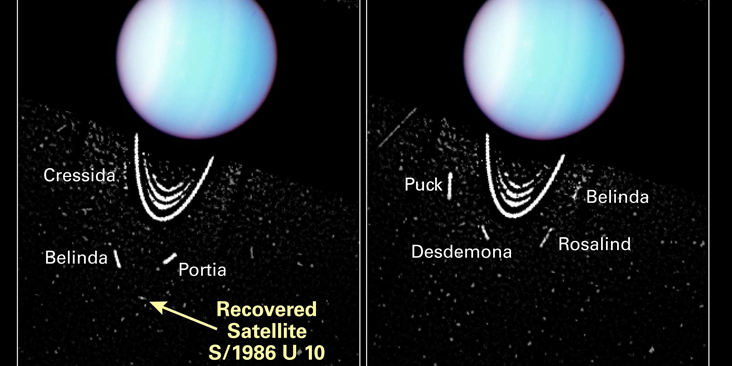
The first images that included Perdita were taken by the Voyager 2 spacecraft during its 1986 flyby of the Uranian system. At the time the object was not recognized among the many small features visible in the raw photographs. More than a decade later, careful reanalysis of the archival Voyager frames led to a reported detection in 1999. The subsequent lack of immediate, new observational data led some to question the identification, and for a period the moon's existence remained debated in the literature. Ultimately the Hubble Space Telescope obtained images that showed an object at the expected location, confirming Perdita's presence and resolving the earlier uncertainty.
Name and cultural origin
After its initial reporting the body received the provisional label S/1986 U 10. It was later given the name Perdita, drawn from classical literature: Perdita is a character in plays by William Shakespeare, specifically the central figure in The Winter's Tale. The choice follows the convention of naming Uranian moons after characters from Shakespeare and Alexander Pope.
Physical characteristics
Perdita is very small compared with major moons: published estimates place its radius on the order of 15 kilometers, and its geometric albedo is low, about 0.08, indicating a dark surface that reflects little sunlight. At this scale the body is almost certainly non-spherical, with an irregular shape produced by a history of impacts and accretion rather than sufficient self-gravity to pull it into a round form. Like most close-in satellites, it is expected to be tidally locked to Uranus (showing the same face to the planet), though direct measurements of rotation have not been made.
Orbit and family
Perdita is grouped with a set of small inner moons that share similar orbital radii and photometric properties; these are often collectively called the Portia group. Members of this group orbit close to Uranus, have relatively low albedos, and show photometric similarities that suggest related compositions or collisional histories. The Portia group includes:
Importance and unresolved questions
Perdita's scientific interest stems mainly from what it can tell us about the population of small inner satellites around giant planets. These moons preserve information on accretion, collisional evolution, and the dynamical interactions that shape ring–moon systems. However, because Perdita is faint and small, detailed data are scarce: its composition, surface geology, precise shape, and any possible ring-related interactions are not well characterized. Continued analysis of archival images and future observations with advanced telescopes or spacecraft would be required to refine its physical and dynamical properties.
Notable facts: Perdita was first imaged in 1986 but only recognized later; it briefly was considered spurious before confirmation. Its name comes from a Shakespearean character, following the naming tradition for Uranian satellites, and it is one of several small moons that make up the closely packed inner satellite system of Uranus.
For more detailed historical records and discovery notes, consult mission archives and observatory reports linked here: Voyager 2 mission pages and Hubble imaging studies; background on the literary name choices is available via references to Shakespeare and The Winter's Tale.
Related articles
Author
AlegsaOnline.com Perdita — inner moon of Uranus Leandro Alegsa
URL: https://en.alegsaonline.com/art/75765
Sources
- adsabs.harvard.edu : "Voyager's eleventh discovery of a satellite of Uranus and photometry and the first size measurements of nine satellites"
- doi.org : 10.1006/icar.2001.6597
- adsabs.harvard.edu : "Comprehensive Photometry of the Rings and 16 Satellites of Uranus with the Hubble Space Telescope"
- doi.org : 10.1006/icar.2001.6596
- cfa-www.harvard.edu : "IAU Circular No. 7171"
- spaceflightnow.com : "Moon of Uranus is demoted"
- sciencemag.org : "The Second Ring-Moon System of Uranus: discovery and dynamics"
- doi.org : 10.1126/science.1122882
- cfa-www.harvard.edu : "IAU Circular No. 8194"
- planetarynames.wr.usgs.gov : "Planet and Satellite Names and Discoverers"