
Puck (moon) — an inner satellite of Uranus
Puck is a small inner moon of Uranus discovered in 1985 by Voyager 2. It is a heavily cratered, low‑albedo body about 81 km in radius, named after Shakespeare's sprite and designated Uranus XV (S/1985 U 1).
Overview
Puck is one of Uranus's inner satellites, orbiting close to the planet and lying between some of the larger inner moons in both size and orbital distance. It was discovered from images taken by the Voyager 2 spacecraft on 30 December 1985 and initially designated S/1985 U 1; it also carries the formal Roman numeral Uranus XV. The name Puck honors the mischievous sprite from English folklore and Shakespeare's A Midsummer Night's Dream.
Image gallery
6 Images


Discovery and name
The moon was identified in photographs returned by the Voyager 2 imaging team and announced soon after the encounter on 30 December 1985. Its eventual name refers to the literary figure Puck; the choice reflects the tradition of naming Uranian satellites after characters in the works of Shakespeare and Alexander Pope. The literary Puck appears in folklore as a nocturnal, mischievous being associated with fairies and sprites, an association noted in early naming citations and commentary about the satellite's name (Shakespeare) and (folklore).
Physical characteristics
Puck is a small, dark satellite with a radius of roughly 81 kilometres and a low geometric albedo of about 0.11, indicating a surface that reflects only a small fraction of incident sunlight. Its overall shape is close to spheroidal but slightly elongated; measurements from resolved images are consistent with a slightly prolate spheroid (reported axis ratio near 0.97 ± 0.04), which indicates the body is not in a perfect equilibrium shape but is nearly rounded (shape). Spectroscopy from space- and ground-based facilities shows water‑ice absorption features in its spectrum, suggesting the presence of water ice mixed with darker, non‑ice material on the surface (spectra).
Surface, geology and appearance
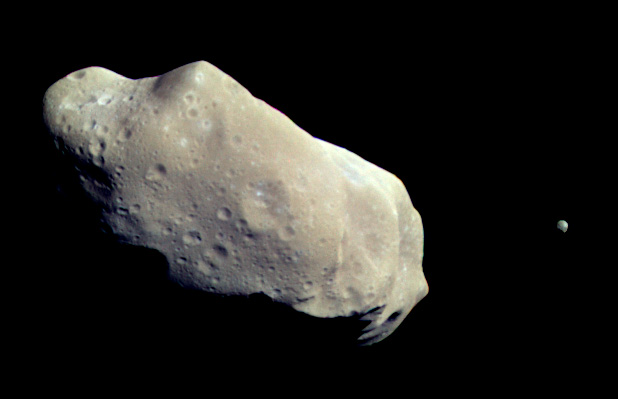
Voyager 2 images captured enough detail to reveal that Puck's surface is heavily cratered and generally grey in color. Several craters have been identified and three of them given names in planetary nomenclature records. The cratered appearance indicates an old surface that has experienced numerous impacts over time, with little evidence for recent resurfacing processes. The low albedo and spectral slope also point to a surface coated by a dark, possibly carbonaceous component mixed with water ice.
Orbit and context among Uranian moons
Puck orbits within the system of inner Uranian satellites and lies between the orbits of some better‑known moons. It is intermediate in size and orbit between bodies such as Portia and Miranda, positioning it among the group of inner moons that are dynamically close to one another. Its orbital and physical properties help to define the architecture of Uranus's inner satellite system and provide comparative data for understanding how small icy satellites evolve around giant planets (Portia) (Miranda).
Observational history and scientific importance
- Voyager 2: The only mission to have flown by Uranus, Voyager 2 produced the discovery images and a set of the highest-resolution views of Puck available from close range (Voyager 2).
- Ground and space telescopes: Follow‑up measurements, including observations from the Hubble Space Telescope and large terrestrial observatories, have refined the moon's orbit, constrained its size and albedo, and detected water‑ice spectral signatures (observations).
- Comparative planetology: Because Puck is one of the larger of Uranus's small inner moons, it serves as a useful point of comparison for understanding impact cratering, surface composition, and dynamical interactions among tightly packed satellite systems.
Although Puck remains a small and relatively dim object in the outer Solar System, its discovery and subsequent observations have contributed to knowledge of the Uranian system and of the diversity of small icy satellites orbiting the giant planets.
References to the discovery, the naming inspiration from literature and folklore, and the key observational sources can be found in mission archives and published summaries of the Voyager encounter and follow‑up telescope studies (discovery date) (naming) (folklore) (albedo).
Further details about the moon’s measured parameters, crater names and spectral results are available through planetary data repositories and mission reports (shape data) (comparative) (context) (mission) (spectroscopy).
Related articles
Author
AlegsaOnline.com Puck (moon) — an inner satellite of Uranus Leandro Alegsa
URL: https://en.alegsaonline.com/art/79930
Sources
- adsabs.harvard.edu : "The Orbits of the Inner Uranian Satellites From Hubble Space Telescope and Voyager2 Observations"
- doi.org : 10.1086/300263
- adsabs.harvard.edu : "Voyager's Eleventh Discovery of a Satellite of Uranus and Photometry and the First Size Measurements of Nine Satellites"
- doi.org : 10.1006/icar.2001.6597
- adsabs.harvard.edu : "Comprehensive Photometry of the Rings and 16 Satellites of Uranus with the Hubble Space Telescope"
- doi.org : 10.1006/icar.2001.6596
- solarviews.com : "Puck Statistics"
- cfa-www.harvard.edu : "IAU Circular No. 4159"
- planetarynames.wr.usgs.gov : "Planet and Satellite Names and Discoverers"
- adsabs.harvard.edu : "Voyager observations of 1985U1"
- doi.org : 10.1016/0019-1035(87)90121-7
- adsabs.harvard.edu : "Hubble Space Telescope NICMOS Multiband Photometry of Proteus and Puck"
- doi.org : 10.1086/375909