
Hubble Space Telescope — overview, design, history and achievements
A concise, neutral overview of the Hubble Space Telescope: its design and instruments, orbit and operations, servicing history, major discoveries, and its role in modern astronomy.
The Hubble Space Telescope is a pioneering optical and ultraviolet observatory placed in Earth orbit to obtain images and spectra without the blurring effects of the atmosphere. Launched in 1990 and named for astronomer Edwin Hubble, the telescope operates continuously above most of Earth’s air, giving astronomers a clearer and more stable view of the cosmos than ground-based instruments can usually achieve. Hubble is a collaboration between agencies including NASA and the European Space Agency, and it is often described as one of the most productive scientific instruments in history. For a general introduction to what a large orbital observatory is, see space observatory resources.
Image gallery
10 Images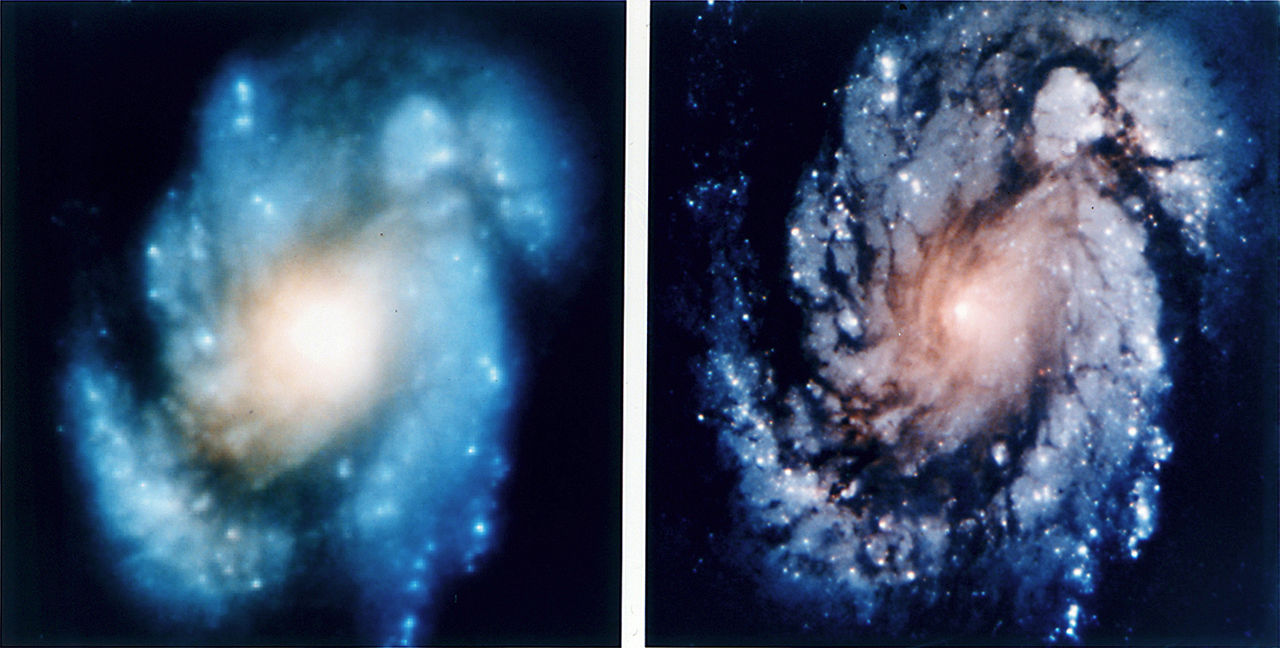



Design, optics and instruments
At the heart of Hubble is a 2.4-metre primary mirror that collects light across ultraviolet, visible and near-infrared wavelengths. The telescope carries a suite of cameras, spectrographs and fine guidance sensors that have been upgraded over time. Early instruments included a wide-field camera and spectrographs; later servicing missions installed and replaced instruments such as the Wide Field and Planetary Camera 2 (WFPC2), the Advanced Camera for Surveys (ACS), the Near Infrared Camera and Multi-Object Spectrometer (NICMOS), the Wide Field Camera 3 (WFC3), the Space Telescope Imaging Spectrograph (STIS) and the Cosmic Origins Spectrograph (COS). These instruments allow both high-resolution imaging and detailed spectral analysis across several bands.
Orbit, operations and scheduling
Hubble operates in low Earth orbit, above most atmospheric disturbance, which eliminates much of the blurring known as "seeing" caused when light passes through air layers. Detailed discussions of atmospheric effects are available through educational links such as atmospheric seeing material. The telescope circles the planet roughly once every 90 minutes in a region often described as low Earth orbit, at an altitude that places it hundreds of kilometres above the surface (orbital altitude summaries discuss typical values). Because it completes a circuit so quickly, planning observations requires careful timing; the observatory also experiences frequent transitions between day and night on its orbital path, and it moves at several kilometres per second—comparable, in popular terms, to the rapid transit from New York to San Francisco in a tiny fraction of an hour when expressed as a thought experiment.
Servicing, repairs and upgrades
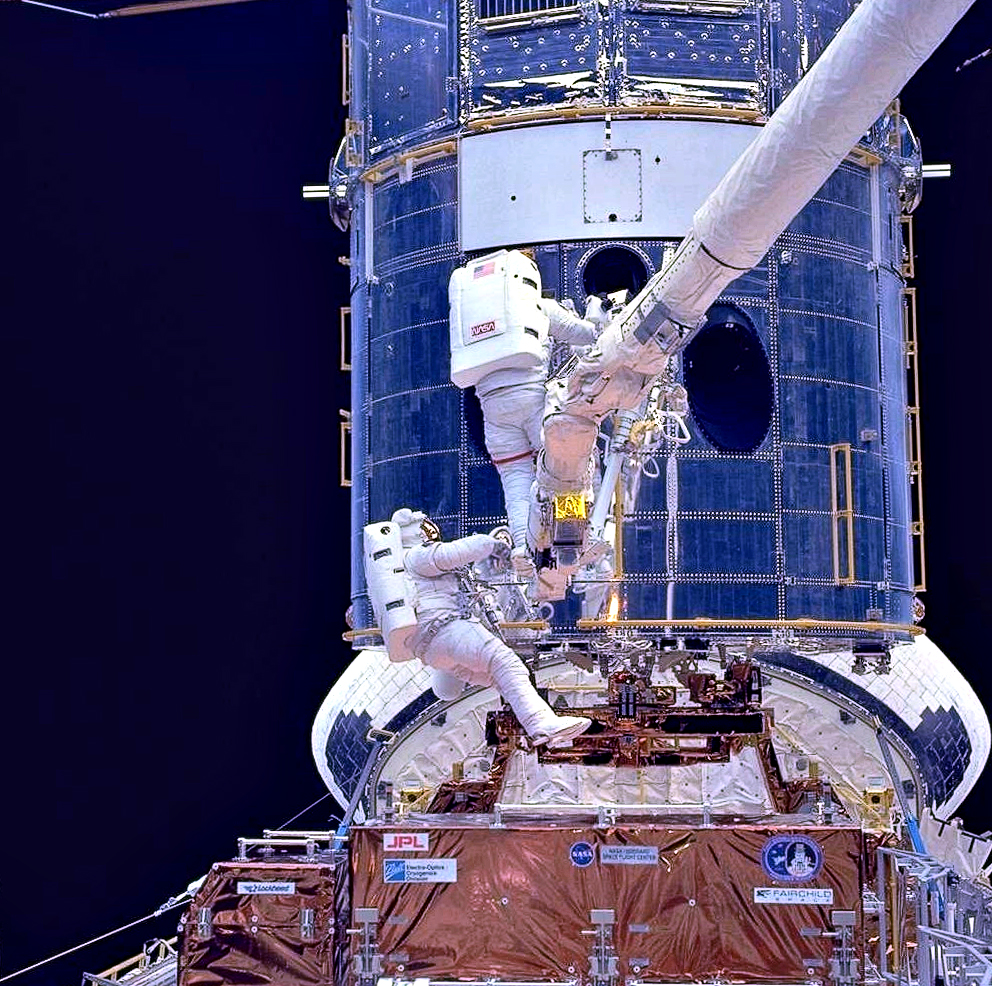
Hubble was designed to be serviced by astronauts, and several shuttle missions carried crews to repair, recalibrate and upgrade instruments. An early and well-known repair corrected an optical flaw that affected image sharpness; that campaign replaced hardware and added corrective optics to restore and improve performance. The physical size of the observatory—comparable to a large bus—allowed it to fit in the Space Shuttle cargo bay for those servicing flights, a logistical detail discussed in historic mission overviews such as shuttle payload pages. Servicing missions extended Hubble’s productive life and introduced modern instruments that kept it scientifically competitive for decades.
Scientific contributions and iconic results
Hubble’s contributions span many areas of astronomy. It produced deep field images that revealed faint galaxies at great distances, refined measurements of the Hubble constant (the rate of cosmic expansion), and provided precise observations of stellar nurseries, planetary atmospheres, and the remnants of exploding stars. Hubble data played a role in studies that characterized dark energy and the accelerating expansion of the universe by enabling accurate supernova observations. Its long-term monitoring capability has also tracked changes in planets, comets and variable stars, and its spectrographs have probed the chemical composition of distant objects.
Legacy, comparison and ongoing role
Hubble remains a reference facility for high-resolution optical and ultraviolet astronomy and has inspired generations of scientists and the public through its striking imagery. It is complemented by ground-based telescopes equipped with adaptive optics and by newer space observatories designed for infrared or other wavelength regimes. For general comparisons of observatory types and capabilities, see introductory links such as sky observation resources. Educational materials and mission histories often cite Hubble as an example of how engineering, international cooperation and repeated upgrades can extend the life and scientific productivity of a major facility.
- Key components: primary mirror, instrument bay, sunshade, pointing systems.
- Major upgrades: replacement cameras and spectrographs that improved sensitivity and wavelength coverage.
- Why it matters: high-resolution, long-term observations across ultraviolet and visible bands.
Further reading and archival materials are available through mission archives and public outreach resources; curated summaries and timelines provide context for Hubble’s launch, its servicing missions and the scientific milestones that followed. For historic mission logistics and public summaries, consult institutional pages such as agency overviews and archived shuttle mission information at mission pages.
Questions and answers
Q: What is the Hubble Space Telescope?
A: The Hubble Space Telescope (HST) is the first big optical space observatory telescope. It was made by both NASA and the ESA working together and it can observe 24 hours a day.
Q: How large is the main mirror of the HST?
A: The main mirror of the HST is 94.5 inches (2.4 meters) across.
Q: What makes it possible to see things from far away with the HST?
A: Being above the atmosphere means it can see the sky more clearly than a telescope on the ground, which allows for observation of objects that would be nearly impossible to see from anywhere else.
Q: When was Hubble launched into space?
A: Hubble was launched into space on April 24, 1990.
Q: How fast does Hubble travel in low Earth orbit?
A: In low Earth orbit, Hubble travels at 5 miles (10 km) per second.
Q: What size is Hubble compared to other objects?
A: The size of Hubble is comparable to that of a large school bus, but still small enough to fit inside a Space Shuttle cargo bay.
Q: Was there ever any repair work done on Hubble after its launch? A: Yes, repairs were done in 1993 due to problems in picture quality.
Related articles
Author
AlegsaOnline.com Hubble Space Telescope — overview, design, history and achievements Leandro Alegsa
URL: https://en.alegsaonline.com/art/45511
Sources
- hubblesite.org : "HubbleSite - The Telescope - Team Hubble"
- hubblesite.org : "Hubble Essentials"
- hubblesite.org : "Hubble Breakthroughs"
- space.com : "Telescopes in Space"