
Desdemona (Uranian moon)
Desdemona is a small inner moon of Uranus discovered by Voyager 2 in 1986. It belongs to the Portia group and is known mainly from brief spacecraft imaging and limited photometry.
Overview
Desdemona is one of the small inner satellites orbiting Uranus. It was identified in images returned by the Voyager 2 spacecraft on 13 January 1986 and temporarily cataloged as S/1986 U 6. It also carries the numerical designation Uranus X and was later given the name Desdemona after the tragic heroine in William Shakespeare's play Othello.
Image gallery
6 Images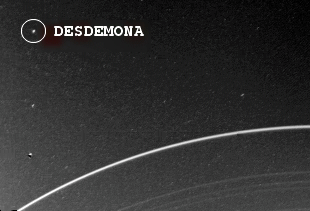



Physical characteristics
Only limited information about Desdemona is available. Voyager 2 imagery indicates an elongated, prolate shape with a reported axis ratio of roughly 0.6 ± 0.3, suggesting the body is stretched along one axis — a form commonly produced by tidal forces on small inner satellites. Its approximate mean radius is often cited as about 34 km, and its surface has a low geometric albedo near 0.08 and appears grey in color. These properties imply a dark, heavily processed surface of water ice mixed with darker material, typical of many small Uranian moons.
Orbit and dynamical context
Desdemona orbits relatively close to Uranus and is grouped with several other inner moons that share similar orbital distances and photometric behavior. This collection is commonly called the Portia group. Members of that group include Bianca, Cressida, Juliet, Portia, Rosalind, Cupid, Belinda and Perdita. Moons in this zone are expected to be tidally locked to Uranus and can interact gravitationally over long timescales, making their long-term evolution a subject of interest for dynamical studies.
Discovery and naming
The discovery of Desdemona was part of the dramatic expansion of knowledge about the Uranian satellite system produced by the brief flyby of Voyager 2. After confirmation and orbital determination, the International Astronomical Union approved the name drawn from Shakespearean literature, following the convention that most Uranian moons bear names from the works of Shakespeare and other classic authors.
Scientific importance and limitations
Desdemona is scientifically interesting because it exemplifies the class of small, inner satellites whose shapes and surfaces record the effects of tidal forces, collisional history, and space weathering. However, knowledge remains fragmentary: apart from the Voyager 2 images and a few photometric measurements, no high-resolution mapping or compositionally diagnostic spectra exist. Future telescopic monitoring or a dedicated mission to Uranus would be required to refine its size, surface properties, rotation state, and collisional history.
Notable facts
Related articles
Author
AlegsaOnline.com Desdemona (Uranian moon) Leandro Alegsa
URL: https://en.alegsaonline.com/art/26822
Sources
- adsabs.harvard.edu : "The Orbits of the Inner Uranian Satellites From Hubble Space Telescope and Voyager2 Observations"
- doi.org : 10.1086/300263
- adsabs.harvard.edu : "Voyager's Eleventh Discovery of a Satellite of Uranus and Photometry and the First Size Measurements of Nine Satellites"
- doi.org : 10.1006/icar.2001.6597
- adsabs.harvard.edu : "Comprehensive Photometry of the Rings and 16 Satellites of Uranus with the Hubble Space Telescope"
- doi.org : 10.1006/icar.2001.6596
- cfa-www.harvard.edu : "IAU Circular No. 4164"
- planetarynames.wr.usgs.gov : "Planet and Satellite Names and Discoverers"