
Juliet (Uranian moon)
Juliet is a small inner satellite of Uranus discovered by Voyager 2 in 1986. A member of the Portia group, it is an elongated, low-albedo moon about 53 km in radius with limited observational data.
Juliet is one of Uranus's inner, small moons. Officially designated S/1986 U 2 and Uranus XI, it was identified in images from the Voyager 2 flyby in early January 1986. Juliet lies close to Uranus and orbits among a cluster of similarly sized satellites. Because it is small, faint and near the planet, most information about Juliet comes from a handful of spacecraft images and limited ground- and space-based photometry.
Image gallery
6 Images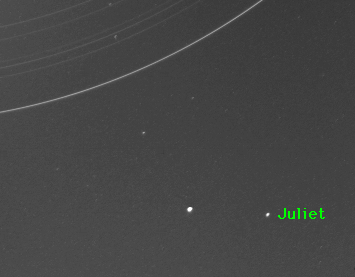



Physical characteristics
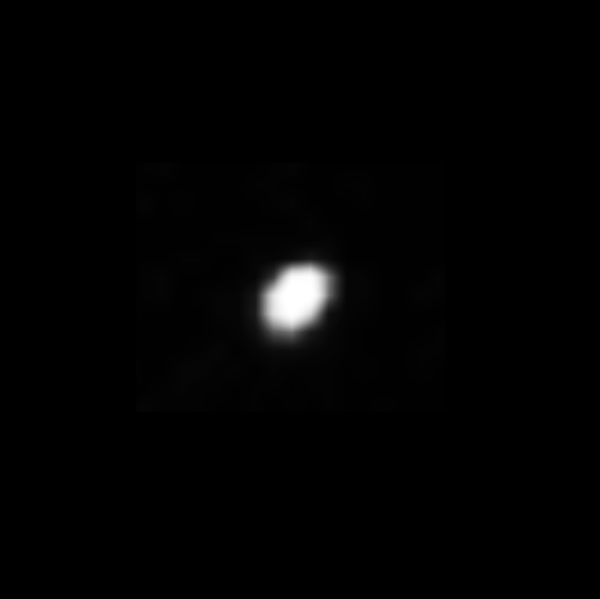
Juliet is estimated to have a mean radius of approximately 53 km and a low geometric albedo of about 0.08, indicating a dark, relatively non-reflective surface. Observations from Voyager 2 showed Juliet as an elongated body, with the long axis pointing toward Uranus; this appearance is consistent with a prolate spheroid deformed by tidal forces. The measured axial ratio is uncertain but has been reported with large error bounds (roughly 0.5 ± 0.3), reflecting the limited quality and viewing geometries of available images. Its surface appears grey in color, typical of many small, inner icy satellites that have been darkened by space weathering or contaminating materials.
Orbit and group membership
Juliet is considered part of the so-called Portia group, a set of closely orbiting inner moons that share similar orbital and photometric properties. The Portia group includes:
Members of this group orbit close to Uranus and are thought to have related origins or a shared collisional history because of their similar sizes, colours and orbital elements. Their proximity to one another and to the planet makes their orbital dynamics complex and of interest for studies of stability and tidal evolution.
Discovery and name
Juliet was discovered in Voyager 2 images taken on 3 January 1986 and initially received the provisional designation S/1986 U 2. When formally named, the moon took the name of Juliet from William Shakespeare, specifically the heroine of his play Romeo and Juliet, following the convention of assigning Uranian satellites names drawn from characters in works by Shakespeare and Alexander Pope.
Observations, uncertainties and scientific interest
Beyond the Voyager 2 encounter, Juliet has not been imaged at high resolution; most subsequent knowledge comes from photometric measurements and indirect inference. Because of limited data, many of Juliet's properties—internal composition, detailed shape, surface geology and rotational state—remain poorly constrained. It is likely tidally locked, presenting the same face to Uranus as expected for close satellites, but direct confirmation is lacking.
Juliet and the other inner moons of Uranus are scientifically important as laboratories for studying tidal interactions, collisional history, and the processes that darken and modify small icy bodies in the outer Solar System. Future spacecraft missions or improved observations from large telescopes could refine their sizes, shapes, compositions and orbital evolution, shedding light on the history and stability of Uranus's inner satellite system.
Questions and answers
Q: What is Juliet?
A: Juliet is a moon of Uranus.
Q: When was Juliet discovered and how?
A: Juliet was discovered on 1986-01-03 through images taken by Voyager 2.
Q: Why is Juliet named Juliet?
A: Juliet is named after the famous character in William Shakespeare's play, Romeo and Juliet.
Q: What group of moons does Juliet belong to?
A: Juliet belongs to the Portia Group of moons which includes Bianca, Cressida, Desdemona, Portia, Rosalind, Cupid, Belinda, and Perdita.
Q: What is known about Juliet?
A: Very little is known about Juliet other than its orbit, radius of 53km, and geometric albedo of 0.08. Its surface is grey in color and appears stretched in the Voyager 2 images.
Q: What is the ratio of axises of Juliet's prolate spheroid?
A: The ratio of axises of Juliet's prolate spheroid is 0.5 ± 0.3, which is an extreme value.
Q: How do the moons in the Portia Group relate to each other?
A: The moons in the Portia Group have similar orbits and photometric properties.
Related articles
Author
AlegsaOnline.com Juliet (Uranian moon) Leandro Alegsa
URL: https://en.alegsaonline.com/art/51509
Sources
- adsabs.harvard.edu : "The Orbits of the Inner Uranian Satellites From Hubble Space Telescope and Voyager2 Observations"
- doi.org : 10.1086/300263
- adsabs.harvard.edu : "Voyager's Eleventh Discovery of a Satellite of Uranus and Photometry and the First Size Measurements of Nine Satellites"
- doi.org : 10.1006/icar.2001.6597
- adsabs.harvard.edu : "Comprehensive Photometry of the Rings and 16 Satellites of Uranus with the Hubble Space Telescope"
- doi.org : 10.1006/icar.2001.6596
- cfa-www.harvard.edu : "IAU Circular No. 4164"
- planetarynames.wr.usgs.gov : "Planet and Satellite Names and Discoverers"