
Praxidike (Jupiter XXVII)
Praxidike is a small, irregular, retrograde moon of Jupiter discovered in 2000. It belongs to the Ananke group, orbits far from Jupiter with a high inclination, and is likely a fragment of a captured asteroid.
Praxidike (Jupiter XXVII) is a small irregular satellite of Jupiter. It was discovered in 2000 and initially designated S/2000 J 7. Praxidike follows a distant, retrograde orbit and has a non-spherical shape and a dark, grey appearance similar to many primitive asteroids. The satellite is one of several members of the Ananke group, thought to be fragments produced when a captured asteroid broke apart.
Image gallery
2 Images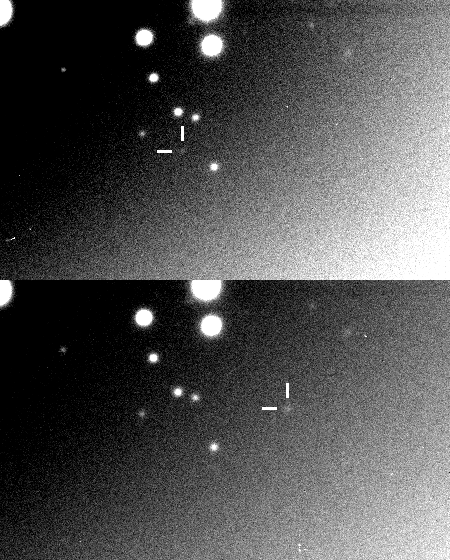

Orbital characteristics
Praxidike orbits Jupiter at a large average distance and with a long orbital period. Its path is notably inclined and eccentric compared with the regular, inner moons. Key orbital parameters include:
- Average orbital radius: about 20,824,000 km from Jupiter.
- Orbital period: roughly 613.9 days.
- Inclination: about 144° to the ecliptic (near 143° relative to Jupiter's equator), indicating a strongly retrograde motion.
- Eccentricity: approximately 0.184, giving a noticeably noncircular orbit.
Because Praxidike moves in a retrograde sense relative to Jupiter's rotation, it is classified among the planet's irregular satellites rather than the regular, prograde inner moons that orbit close to the planet.
Physical characteristics
Praxidike is small and irregularly shaped rather than spherical. Its estimated diameter is near 7 km if an assumed geometric albedo of 0.04 is used; that low reflectivity is common among dark, carbon-rich bodies. Photometric measurements indicate a grey color, reminiscent of C-type asteroids, which supports the idea of an origin from a primitive asteroid rather than a captured icy body.
Origin and group membership
Praxidike is grouped with other moons that share similar orbits and physical traits. The Ananke group consists of retrograde satellites with semi-major axes, inclinations, and eccentricities clustering around values that suggest a common history. The prevailing hypothesis is that a larger captured asteroid fragmented after a collision or tidal disruption, producing many smaller bodies that now orbit as a family. This scenario explains the shared colors and orbital parameters seen among the group.
Discovery, name, and observation
The moon was discovered by a team from the University of Hawaii led by Scott S. Sheppard in 2000 and was first announced under the provisional designation S/2000 J 7. The discovery team and institutional affiliations are often cited in catalogs and summaries of Jovian satellites. In August 2003 it received the name Praxidike, taken from the Greek goddess associated with punishment. Early observational work relied on large ground-based telescopes and sensitive detectors to detect and track such faint, distant satellites.
Scientific significance and comparisons
Though small, Praxidike and other irregular moons are important for understanding Jupiter's capture history and the dynamical evolution of the outer Jovian system. By comparing sizes, colors, and orbits of group members researchers infer whether they share a single progenitor. Praxidike is one of the larger fragments in the Ananke family, second in size to the namesake Ananke when similar albedos are assumed. Continued astrometric and photometric observations refine orbital elements and help test models of collisional fragmentation and long-term orbital stability.
For additional context see entries on irregular satellites, methods of discovery, and asteroid taxonomy: irregular satellite, discovery team, University of Hawaii, Scott S. Sheppard, discovery year 2000, Jupiter, orbital period, ecliptic, orbital eccentricity, Greek mythology, goddess of punishment, estimated diameter.
Related articles
Author
AlegsaOnline.com Praxidike (Jupiter XXVII) Leandro Alegsa
URL: https://en.alegsaonline.com/art/78640
Sources
- cfa-www.harvard.edu : IAUC 7555: Satellites of Jupiter
- cfa-www.harvard.edu : MPEC 2001-A29: S/2000 J 7, S/2000 J 8, S/2000 J 9, S/2000 J 10, S/2000 J 11
- cfa-www.harvard.edu : IAUC 7998: Satellites of Jupiter
- ifa.hawaii.edu : An Abundant Population of Small Irregular Satellites Around Jupiter
- journals.uchicago.edu : Orbital and Collisional Evolution of the Irregular Satellites
- ifa.hawaii.edu : Jupiter's Outer Satellites and Trojans
- arxiv.org : Photometric Survey of the Irregular Satellites
- cfa-www.harvard.edu : IAU-MPC NSES
- ssd.jpl.nasa.gov : NASA JPL