
Procyon (Alpha Canis Minoris)
Procyon is a nearby binary star system in Canis Minor, visible as the eighth-brightest star. It consists of a bright F-type star and a faint white dwarf companion and marks a vertex of the Winter Triangle.
Procyon, officially designated Alpha Canis Minoris, is the brightest star in the small constellation Canis Minor. To the unaided eye it appears single and is ranked among the brightest objects in the sky, commonly cited as the eighth brightest star with an apparent visual magnitude near 0.34. Its prominence in the winter sky is emphasized by its role as one vertex of the Winter Triangle, together with Sirius and Betelgeuse.
Image gallery
5 Images


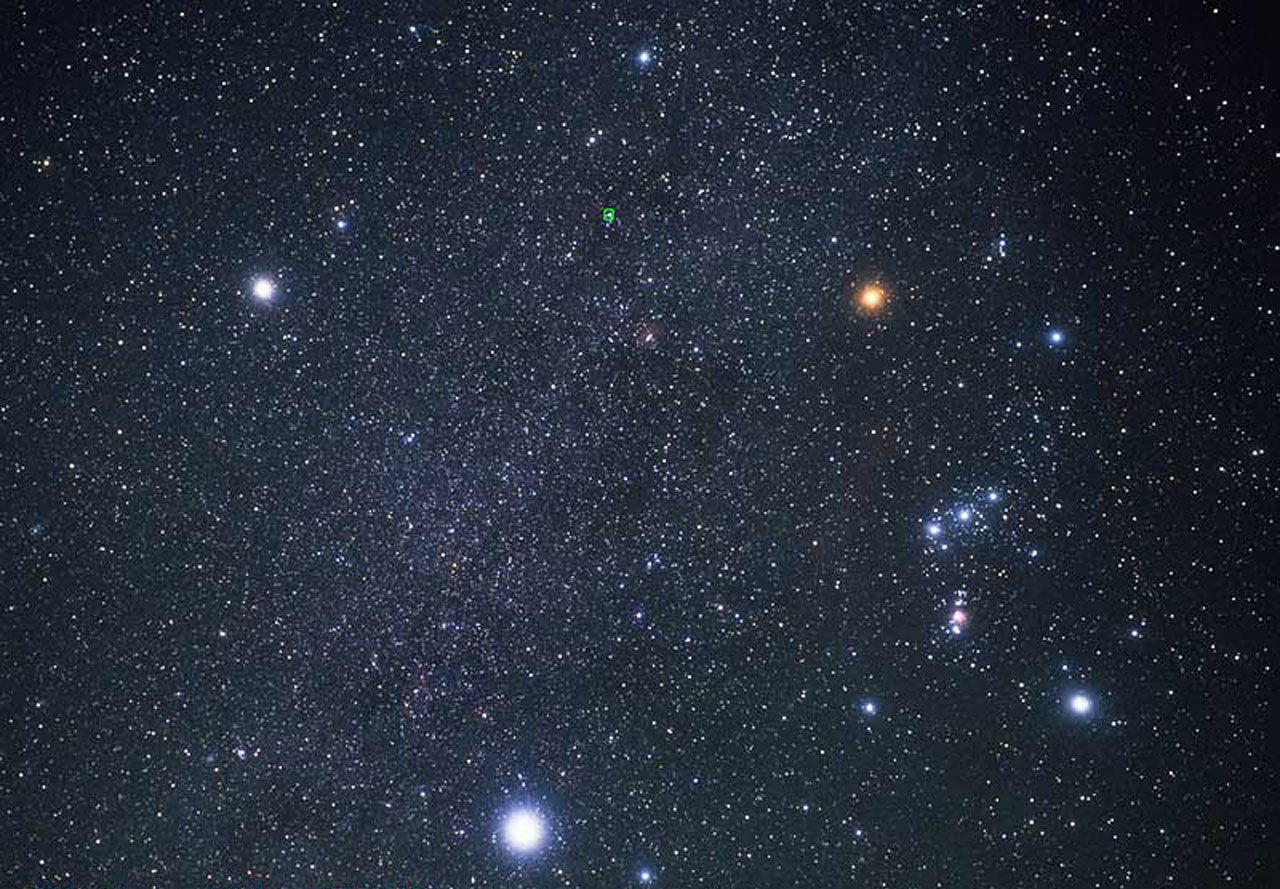

System components and observable properties
Although it looks like a single star, Procyon is a close binary star system. The primary, Procyon A, is a bright F-type star often classified near F5 IV–V, showing characteristics between the main sequence and subgiant stages. Its companion, Procyon B, is a much fainter white dwarf of the DQZ spectral class. The system's overall brightness is influenced less by unusually high intrinsic luminosity than by its proximity to the Sun.
Distance and astrometry
Procyon is one of the Sun's nearest stellar neighbors. High-precision astrometric measurements, including those from the European Space Agency's ESA mission Hipparcos, place it at about 11.46 light-years (roughly 3.51 parsecs) from Earth. Because of this closeness it is an important target for parallax, radial-velocity, and proper-motion studies; it also has physically nearby stars such as Luyten's Star among its immediate neighborhood noted in catalogs of nearest stellar neighbours.
History, naming, and cultural notes
The traditional name "Procyon" derives from the Greek meaning "before the dog," reflecting that it rises shortly before Sirius, the Dog Star. Its pale color has been described through measurements such as a colour index around 0.42 and visually as having a slight yellowish tint. The star has been known and recorded since antiquity and has played a role in celestial navigation and seasonal lore.
Scientific importance and distinguishing facts
Procyon is valuable to astronomers for several reasons: its proximity makes it a laboratory for testing stellar models, and the pair allows measurement of stellar masses and evolutionary states across normal and degenerate objects. The white dwarf companion provides insight into the late stages of stellar evolution and the history of mass transfer in binaries. Its long, multi-decade orbital cycle requires sustained observation to refine orbital parameters and mass estimates.
Quick facts
- Constellation: Canis Minor
- Apparent magnitude: ~0.34 (brightest star in its constellation)
- Main star spectral type: F5 IV–V
- Companion type: white dwarf (DQZ)
- Distance: ~11.46 light-years (~3.51 pc)
- Notable asterism: part of the Winter Triangle with Sirius and Betelgeuse
Observers and students of stellar astrophysics continue to watch Procyon for subtle changes, improved orbital solutions, and spectral studies that refine our understanding of nearby stellar systems and the end states of stars.
Questions and answers
Q: What is Procyon?
A: Procyon is the brightest star in the constellation Canis Minor, and is actually a binary star system of a white main-sequence star named Procyon A, and a faint white dwarf companion named Procyon B.
Q: What is Procyon's visual apparent magnitude?
A: Procyon's visual apparent magnitude is 0.34, making it the eighth brightest star in the night sky.
Q: What is the reason for Procyon's brightness?
A: The reason for Procyon's brightness is not its intrinsic luminosity but its relative closeness to the Sun.
Q: What is Procyon A's spectral type?
A: Procyon A's spectral type is F5 IV-V.
Q: How was Procyon's distance worked out?
A: Procyon's distance was worked out by the European Space Agency Hipparcos astrometry satellite.
Q: What is Procyon's closest neighbour?
A: Procyon's closest neighbour is Luyten's Star, which is about 1.12 light-years (0.34 parsecs) away.
Q: What is the Winter Triangle?
A: The Winter Triangle is a triangle formed by three stars: Sirius, Betelgeuse, and Procyon, and is visible in the winter sky.
Related articles
Author
AlegsaOnline.com Procyon (Alpha Canis Minoris) Leandro Alegsa
URL: https://en.alegsaonline.com/art/79331
Sources
- aanda.org : aanda.org/articles/aa/abs/2004/01/aa4000/aa4000.html
- iopscience.iop.org : iopscience.iop.org/article/10.1086/338769
- aanda.org : aanda.org/articles/aa/abs/2007/41/aa8357-07/aa8357-07.html