
Belinda — an inner moon of Uranus
Belinda is a small, elongated inner moon of Uranus discovered in Voyager 2 images in 1986. It belongs to the Portia group and is known mainly by its orbit, size, low albedo and stretched shape.
Overview
Belinda is one of Uranus's inner, prograde satellites. Discovered in images returned by the Voyager 2 spacecraft in 1986 and provisionally designated S/1986 U 5, it is now also catalogued as Uranus XIV. The moon was later named after the heroine Belinda from Alexander Pope's poem The Rape of the Lock, following the convention of naming Uranian satellites for characters in works by Alexander Pope and Shakespeare.
Image gallery
4 Images


Physical characteristics
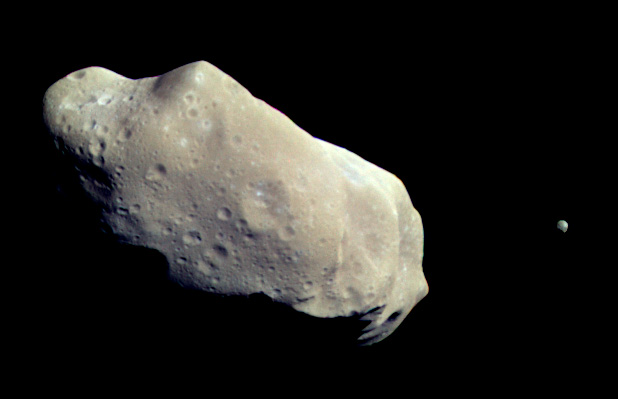
Belinda is small and dark compared with many larger moons. Observations indicate a mean radius on the order of 45 km and a low geometric albedo near 0.08, which means it reflects only a small fraction of incoming sunlight. Images from Voyager 2 show Belinda as markedly elongated: the short axis is about 0.5 ± 0.1 times the long axis, a shape consistent with tidal distortion from Uranus. The surface appears grey in color and, like other inner Uranian satellites, is presumed to consist of a mixture of water ice and darker, non‑ice material.
Orbit and dynamical context
Belinda orbits close to Uranus among the planet's system of inner moons and rings. It is a member of the so‑called Portia group, a collection of satellites with similar, tightly packed prograde orbits and comparable photometric properties. These dynamical neighbors include Bianca, Cressida, Desdemona, Portia, Juliet, Cupid, Rosalind and Perdita. The close packing of these satellites leads to mutual gravitational interactions and raises questions about long‑term stability and collisional history.
Discovery, naming and observations
Belinda was first identified in the high‑resolution frames captured by Voyager 2 during its 1986 flyby. Because these moons are small and faint, Earth‑based telescopes and the Hubble Space Telescope have provided only limited follow‑up information. No dedicated spacecraft has visited Uranus since Voyager 2, so much about Belinda—its detailed composition, surface geology and precise internal structure—remains poorly constrained.
Importance and scientific interest
Despite its modest size, Belinda is scientifically interesting as a representative of tightly packed inner satellites. Studying its shape, surface reflectivity and orbital behavior helps researchers understand tidal effects, satellite collisional evolution, and the processes that shape small moons in giant planet systems. Belinda's similarities to other members of the Portia group make it useful in comparative studies of the Uranian inner system.
Notable facts and limitations
- Designation: S/1986 U 5 and Uranus XIV.
- Estimated radius: about 45 km; geometric albedo around 0.08.
- Shape: significantly elongated, likely due to tidal forces.
- Surface color: generally grey, indicating a mixture of ice and darker material.
- Observational coverage: limited to Voyager 2 imaging and sparse telescopic follow‑up; many details remain uncertain.
Further exploration of Uranus and its moons—through future spacecraft missions or advanced telescopic campaigns—would be required to resolve outstanding questions about Belinda's origin, internal composition and long‑term orbital evolution.
Tags
Related articles
Author
AlegsaOnline.com Belinda — an inner moon of Uranus Leandro Alegsa
URL: https://en.alegsaonline.com/art/10246
Sources
- adsabs.harvard.edu : "The Orbits of the Inner Uranian Satellites From Hubble Space Telescope and Voyager2 Observations"
- doi.org : 10.1086/300263
- adsabs.harvard.edu : "Voyager's Eleventh Discovery of a Satellite of Uranus and Photometry and the First Size Measurements of Nine Satellites"
- doi.org : 10.1006/icar.2001.6597
- adsabs.harvard.edu : "Comprehensive Photometry of the Rings and 16 Satellites of Uranus with the Hubble Space Telescope"
- doi.org : 10.1006/icar.2001.6596
- seasky.org : "Uranus's Moons"
- cfa-www.harvard.edu : "IAU Circular No. 4164"
- planetarynames.wr.usgs.gov : "Planet and Satellite Names and Discoverers"