
Prospero — an irregular retrograde moon of Uranus
Prospero is a small, retrograde, non-spherical irregular moon of Uranus discovered in 1999 and named after Shakespeare's sorcerer; it may belong to a dynamical cluster with Sycorax and Setebos.
Overview
Prospero is one of the irregular satellites of Uranus: a small, distant moon with a retrograde, inclined orbit and an irregular (non-spherical) shape. It was discovered in 1999 and later assigned the permanent name Prospero, after the magician in William Shakespeare's play The Tempest. Like other irregular satellites, Prospero is thought to be a captured object rather than having formed in place around Uranus.
Image gallery
7 Images
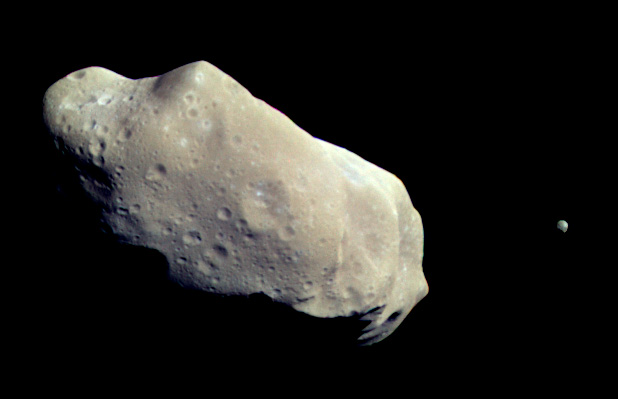


Discovery and name
The object was first identified in images taken during a survey for new outer satellites of Uranus and was provisionally designated S/1999 U 3. Subsequent confirmation led to its numbering as Uranus XVIII and the adoption of the Shakespearean name Prospero. The naming follows the convention for Uranian satellites, which are commonly drawn from characters in the works of William Shakespeare and Alexander Pope. Announcement and catalog entries for the moon are recorded in astronomical circulars and databases referenced in discovery reports, where additional observational details can be found here.
Orbit and classification
Prospero occupies a distant and inclined orbit around Uranus and moves in a retrograde direction relative to the planet's rotation. These characteristics place it among the irregular satellites, a population distinguished from the larger regular moons by their eccentric, inclined, and often distant orbits. Because Prospero shares broadly similar orbital parameters with other outer moons, it has been grouped in dynamical studies with satellites such as Sycorax and Setebos, suggesting the possibility of a common origin or a collisional family. However, interpretation of such clusters remains tentative and depends on both dynamical and physical evidence.
Physical characteristics
Prospero is small and non-spherical: like many irregular moons its surface and shape are irregular, implying a low-gravity body that has not relaxed into a sphere. Photometric observations in visible light show that Prospero has a grey coloration, which is similar to that measured for Setebos but contrasts with the somewhat redder hue observed for Sycorax. Such colour differences are important clues to composition and origin but do not, by themselves, provide definitive proof of a shared history.
Origin and dynamical context
The prevailing hypothesis for irregular moons like Prospero is capture: objects that formed elsewhere in the Solar System were trapped into orbit around Uranus during the planet's early history or through later interactions. Dynamical clustering—similarities in orbital elements among a group of moons—can indicate fragments of a disrupted progenitor, but other processes (such as chaotic capture and subsequent perturbations) can produce similar patterns. The combination of orbital dynamics and surface properties, including colour and albedo, is therefore used to test scenarios for common origin or independent capture.
Observation and scientific importance
Because Prospero is faint and distant, observational data are limited. Continued imaging, photometry, and attempts to measure rotation or surface composition help refine models of its size, shape, and history. Studying Prospero alongside other irregular satellites of Uranus contributes to a broader understanding of how outer planetary systems acquire and evolve small bodies, the collisional history of the outer Solar System, and the processes that deliver captured satellites to giant planets.
- Designation: S/1999 U 3, later Uranus XVIII.
- Orbit: distant, inclined, retrograde (irregular satellite).
- Appearance: non-spherical, grey in visible light.
- Related moons: considered in dynamical studies with Sycorax and Setebos.
For additional context on the naming tradition and the literary origin of the moon's name, see references associated with Shakespearean character-based naming and dedicated satellite lists here and here. Observational updates and dynamical analyses that discuss Prospero in relation to Sycorax and Setebos are available in specialized astronomical literature and databases related to the discovery epoch.
Related articles
Author
AlegsaOnline.com Prospero — an irregular retrograde moon of Uranus Leandro Alegsa
URL: https://en.alegsaonline.com/art/79487