
Orbit (astronomy and mechanics)
An orbit is the regularly repeating path of one body around another under gravity. This article explains definitions, orbital shapes and elements, physical laws, history, and everyday examples.
Overview
An orbit is the path that an object follows around another body in space under the influence of gravity. In astronomy it describes how planets circle stars, moons circle planets, and spacecraft trace trajectories around celestial bodies. In anatomy the term also refers to the eye socket, sometimes discussed in a different context as the eye socket. As a verb, to orbit (or to revolve) means to move repeatedly along such a path; this is distinct from rotation, which means spinning on an axis.
Image gallery
8 Images



Physical principles and orbital elements
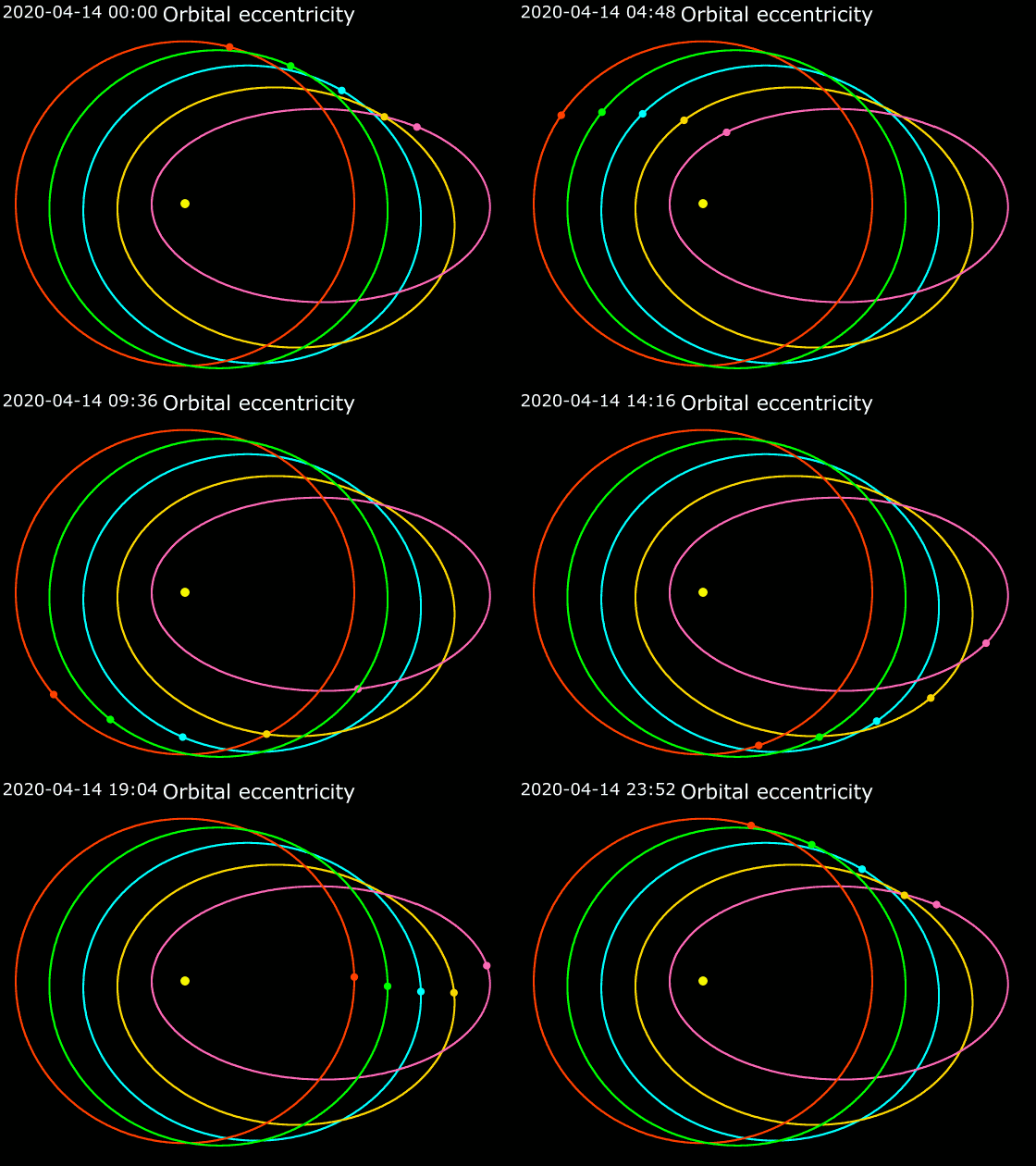
Orbits are governed by gravity and the laws of motion. Historically these ideas were clarified by figures such as Galileo and more completely formulated by Isaac Newton, who showed how mutual attraction produces curved trajectories. The shape and size of an orbit are described by orbital elements: the semi-major axis (a characteristic size), eccentricity (how stretched the path is), inclination (tilt relative to a reference plane), orientation angles, and the orbital period. Perturbations from other bodies, atmospheric drag for low orbits, and non-uniform mass distributions can alter these elements slowly over time.
Common orbit shapes and types
Ideal two-body motion produces conic sections: circular and elliptical orbits are closed and repeat indefinitely, while parabolic and hyperbolic paths represent one-time escape trajectories. Early thinkers assumed celestial paths were perfect circles—an idea linked to the geometric ideal of the circle (circle)—but observations showed that most natural orbits are elliptical to some degree. Practical classifications include geostationary orbits, low Earth orbits, polar orbits, and heliocentric orbits for bodies around the Sun.
History and development
Human models of orbital motion evolved from geocentric systems, where the Sun and planets were presumed to circle the Earth, to heliocentric models that place the Sun near the center of the Solar System. Copernicus and later observers challenged older views; precise observations and mathematical laws refined the understanding of orbital motion, culminating in Newtonian gravity and later refinements from celestial mechanics.
Uses, examples, and importance
Natural orbits host planets, moons, asteroids, and comets; a satellite is any object that orbits another, so the Moon is a natural satellite of Earth and Earth is a satellite of the Sun in the astronomical sense (satellite). Human-made satellites perform communications, navigation, weather monitoring and scientific observation; these artificial satellites occupy carefully chosen orbits to serve specific functions. Gravity (gravity) controls orbital motion and energy exchanges, which engineers exploit when planning launch, orbital transfer, and re‑entry maneuvers.
Distinctions and notable facts
Common confusions include orbit vs rotation (orbit is the path around another body; rotation is spin about one’s own axis) and revolution vs revolution usage differences in everyday language. Some orbits are synchronous, appearing to keep a fixed position relative to a planet’s surface; others decay over time and require station-keeping. Regions of dynamical balance, such as Lagrange points, allow objects to remain near equilibrium positions relative to two large bodies. Understanding orbits is fundamental to astronomy, space exploration, and satellite technology and continues to be refined as our measurements and missions grow more precise. For basic concepts and further reading, consult introductory resources and educational sites using the links provided above (eye socket note, Galileo, Newton, gravity, satellite, artificial satellites, circle).
Questions and answers
Q: What is an orbit?
A: An orbit is the path that an object takes in space when it goes around a star, a planet, or a moon.
Q: How was the Sun's orbit viewed many years ago?
A: Many years ago, people thought that the Sun orbits in a circle around the earth. Every morning the Sun came up in the east and went down in the west. It just seemed to make sense that it was going around the earth.
Q: Who discovered gravity controls orbits?
A: Isaac Newton discovered that gravity controls the orbit of planets and moons.
Q: Is Earth a satellite of any other object?
A: Yes, Earth is a satellite of the sun, just like how Moon is a satellite of Earth!
Q: How many satellites does Sun have orbiting it?
A: The sun has lots of satellites orbiting around it, like planets, and thousands of asteroids, comets, and meteoroids.
Q: What did Copernicus and Galileo think about orbits? A: When people first began to think about orbits, they thought that all orbits had to be perfect circles, and they thought that circle was "perfect" shape. Copernicus and Galileo believed this too.
Q: Are all planetary orbits perfect circles? A:No , when people began to study motions of planets carefully they saw not all planetary orbits were perfect circles; some were almost perfect circles while others were more oblong (egg shaped).
Related articles
Author
AlegsaOnline.com Orbit (astronomy and mechanics) Leandro Alegsa
URL: https://en.alegsaonline.com/art/72975