
Main sequence (stellar evolution and observational significance)
The main sequence is the long-lived band of hydrogen-fusing stars on the Hertzsprung–Russell diagram, spanning hot, massive O-types to cool, low-mass M-types and defining stellar lifetimes and properties.
Overview
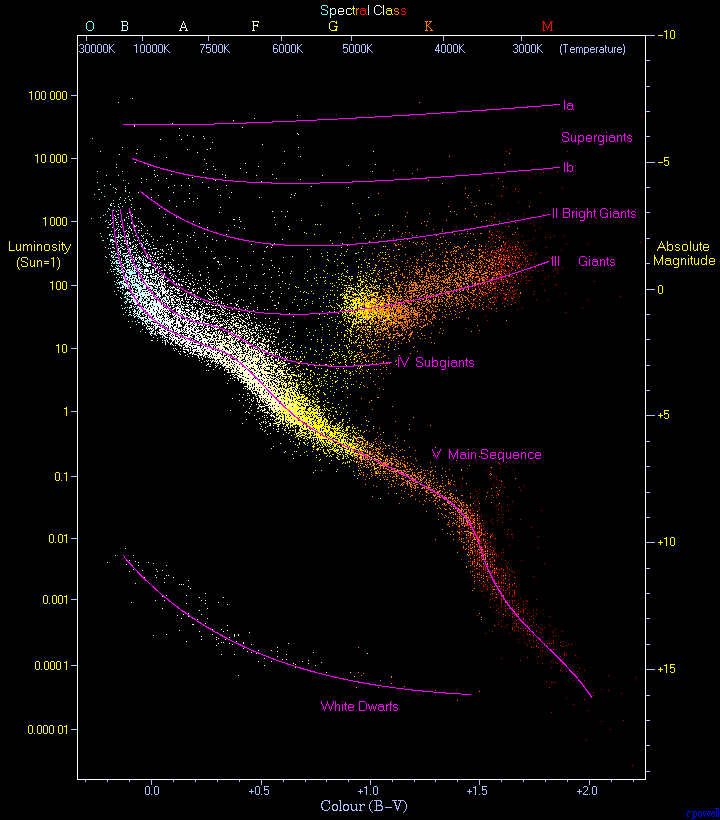
The term main sequence denotes the continuous, diagonal band of stars that dominates the Hertzsprung–Russell (H–R) diagram, the standard plot of stellar luminosity versus surface temperature or color. Most stars observed in the sky and in galaxies lie on that band because it corresponds to the stable phase in which a star fuses hydrogen into helium in its core. The Sun is one example of a main-sequence star and sits among the cooler, middle part of the band; many other stars across the Milky Way and beyond also occupy various positions along the sequence. For a general introduction to star placement on an H–R diagram see H–R diagrams and surveys of stellar populations such as those of our galaxy at the Milky Way.
Image gallery
10 Images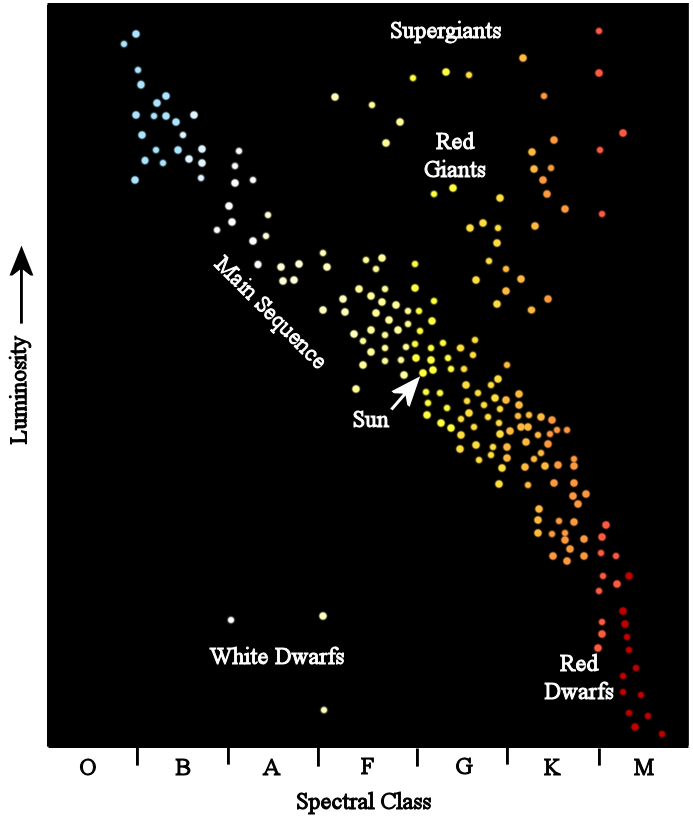




Physical characteristics and classification
On an H–R diagram the main sequence extends from the upper-left (very hot, very luminous stars) to the lower-right (cool, faint stars). Spectral types across the sequence are commonly ordered O, B, A, F, G, K, M, with O and B being massive and short-lived and K and M being small and long-lived. Astronomers often denote main-sequence stars with luminosity class V in spectral classification. The position of a star on the band reflects key physical parameters—mass, radius, surface temperature and intrinsic brightness—and these are linked by approximate relations such as the steep mass–luminosity dependency: more massive main-sequence stars are disproportionately more luminous and hotter than less massive ones.
Key characteristics
- Energy source: sustained hydrogen fusion in the core (nuclear fusion), converting hydrogen to helium (H to He).
- Stability: hydrostatic and thermal equilibrium maintain a long, steady phase compared with later evolutionary stages; many stars spend most of their lifetimes here.
- Range: includes very massive, hot stars in the upper main sequence and low-mass, cool stars in the lower main sequence; some texts approximate a dividing mass near about 1.3–1.5 times the Sun for different fusion regimes.
- Observational label: main-sequence stars of a given color show a narrow range of absolute magnitudes, a property used in distance measurements.
Formation and evolutionary role
Stars form in cold dense regions of interstellar clouds (nebulae) and settle onto the main sequence after contracting and igniting core hydrogen fusion. Once core hydrogen is exhausted or the balance between pressure and gravity is upset, a star leaves the main sequence and evolves into later stages such as red giants or supergiants. The timescale on the main sequence depends strongly on mass: high-mass stars exhaust fuel quickly and may live only millions of years, while low-mass M-type stars can remain on the main sequence for tens to hundreds of billions of years in theory. The Sun, a G-type main-sequence star, has an estimated main-sequence lifetime of order ten billion years and is currently about halfway through that phase.
Nuclear fusion regimes
Two principal fusion chains dominate hydrogen burning in main-sequence stars. In lower-mass stars the proton–proton chain converts hydrogen to helium directly, while in higher-mass stars the CNO (carbon–nitrogen–oxygen) cycle uses heavier nuclei as catalysts. The efficiency and temperature sensitivity of these processes differ, which influences internal structure: lower-mass stars tend to be convective or radiative in different zones than higher-mass stars, and these differences affect surface activity, winds and lifespan. For basic descriptions of the fuel cycles and catalytic elements see reference summaries at CNO cycle and element entries such as carbon, nitrogen and oxygen.
Observational importance and practical uses
Because main-sequence stars of a given color have predictable intrinsic brightness, astronomers use the main sequence for distance estimation (main-sequence fitting) and for determining ages of star clusters by locating the turnoff point. Photometric and spectroscopic surveys that measure temperature, color and luminosity place stars onto the H–R diagram and reveal population structure in galaxies. Large catalogs and educational resources often link to survey data and stellar models; general resources include observational guides at star catalogs, model comparisons at solar analog studies and galactic context at galaxy evolution summaries.
Distinctions and notable facts
- The upper main sequence is populated by very luminous O and B stars that shape their environments through strong radiation and winds; see studies at star-forming regions.
- Lower main-sequence stars, especially M dwarfs, are numerous and long-lived and are prime targets in searches for planets and habitable-zone studies.
- Stellar lifetimes, mass divisions and exact boundaries are approximate and depend on composition and rotation; for further technical detail consult theoretical references at stellar evolution, mass studies, and lifetime discussions at atomic number effects, age estimates and short-lived massive stars.
Together, these properties make the main sequence a central concept in astrophysics: it encapsulates where stars spend the bulk of their radiative lives, links observable traits to physical structure, and provides practical tools for measuring cosmic distances and histories.
Related articles
Author
AlegsaOnline.com Main sequence (stellar evolution and observational significance) Leandro Alegsa
URL: https://en.alegsaonline.com/art/60790