
Red giant (stellar evolution stage)
A red giant is an evolved star that has exhausted core hydrogen and expanded; this article explains its properties, formation, notable examples, and observational significance.
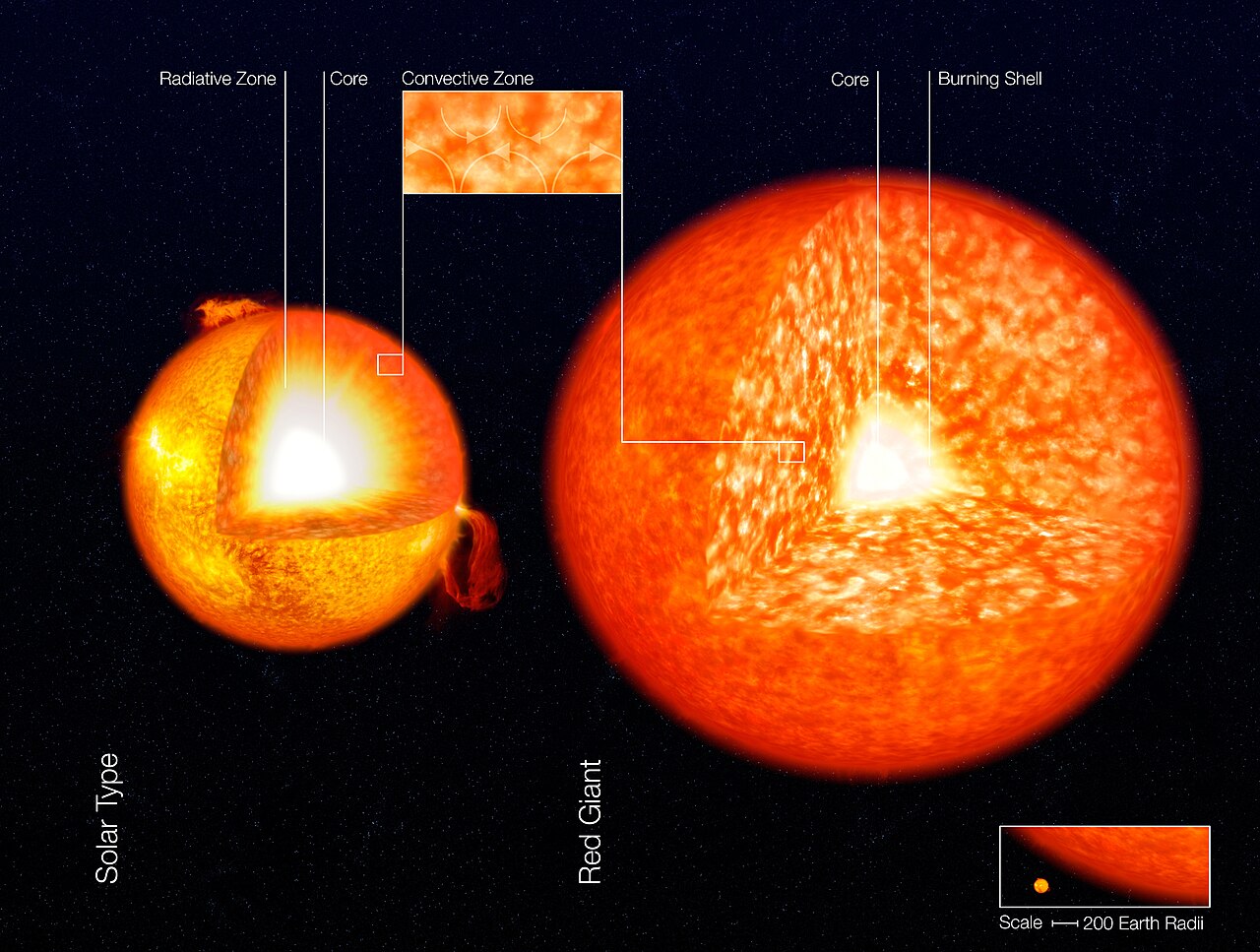
A red giant is a luminous, cool, evolved star that has left the main sequence after using the hydrogen fuel in its core. Compared with main-sequence stars of similar mass, red giants have much larger radii and lower surface temperatures, which give them a characteristic orange to deep red hue (red). The class covers a range of masses — roughly from about one-half to ten times the mass of our Sun — and includes both single stars and components of binary systems.
Image gallery
5 Images


Key characteristics
Red giants display a number of defining features that follow from their internal structure and energy generation mechanisms:
- Extended envelope: The outer layers expand dramatically, often making the star tens to hundreds of times wider than when it was on the main sequence.
- Cooler surface temperature: Photospheric temperatures drop (typically 3,000–5,000 K), producing the orange-red colors observers see.
- Shell burning: After core hydrogen is exhausted, hydrogen fusion continues in a shell surrounding an inert helium core; later stages may ignite helium in the core.
- High luminosity: Although cooler, the much larger surface area makes red giants far more luminous than the Sun.
Formation and evolution
Stars become red giants as a normal phase of stellar evolution. When hydrogen in the core is depleted the core contracts and heats while the envelope expands. If the core reaches the conditions for helium fusion, the star moves into the horizontal-branch or red-clump phase; more massive giants follow more complex paths, possibly undergoing thermal pulses on the asymptotic giant branch. These processes change surface composition through convective mixing and can drive strong stellar winds that return material to the interstellar medium.
Examples and observation
Some bright red giants are familiar to naked-eye observers. Well-known examples include Aldebaran, Arcturus, Betelgeuse, and the long-period variable Mira. Their relative proximity and brightness make them important targets for studying stellar atmospheres, pulsations, and mass loss. Professional astronomers and amateur observers both monitor these stars for variability and surface changes.
Relevance to the Solar System
Our Sun is currently a main-sequence star but is expected to expand into a red giant in several billion years. Many scientists model that its radius will increase substantially: models suggest the expanding envelope could reach the orbits of the inner planets. As a result, Mercury, Venus, and possibly Earth may be engulfed or experience dramatic changes in surface conditions, though precise outcomes depend on mass loss rates and tidal interactions.
Notable facts and distinctions
Red giants should be distinguished from red supergiants, which are evolved massive stars with far greater masses and larger radii. Red giants are important contributors to galactic chemical evolution because their winds and eventual planetary nebulae return enriched material to space. They also provide observational tests for stellar evolution theories through measured luminosities, radii, pulsation periods, and surface abundances.
Questions and answers
Q: What is a red giant?
A: A red giant is a giant star that has the mass of about one-half to ten times the mass of our Sun.
Q: Where do red giants get their name from?
A: They get their name because they appear to be colored red and they are very large.
Q: Can many red giants fit thousands and thousands of suns like ours inside of them?
A: Yes, that is correct.
Q: Which stars are considered red giants?
A: Some red giants include Aldebaran, Arcturus, Betelgeuse, and Mira.
Q: Is our Sun currently a red giant?
A: No, our sun is a main-sequence star right now.
Q: What do scientists believe will happen to our Sun in five billion years?
A: Scientists believe that our Sun will become a red giant.
Q: How big will our Sun be when it becomes a red giant?
A: Our Sun will be about 200 times bigger in diameter than it is now when it becomes a red giant. It will become so big that it will swallow up Mercury, Venus, and possibly the Earth.
Related articles
Author
AlegsaOnline.com Red giant (stellar evolution stage) Leandro Alegsa
URL: https://en.alegsaonline.com/art/81655