
Carbon — the element central to life, materials, and climate
Overview of carbon: its properties, common forms (allotropes), role in chemistry and biology, major uses, and environmental and historical notes.
Overview
Carbon is a chemical element with the symbol C and atomic number 6. The most common isotope has mass number 12. As a nonmetal with four valence electrons, carbon can form stable covalent bonds with many elements and with itself, a versatility that underpins organic chemistry and the molecular basis of life.
Image gallery
10 Images



Key physical and chemical properties
Carbon participates in single, double and triple bonds and shows a unique ability called catenation — the formation of long chains and rings of atoms. It is chemically diverse: in some structures it is extremely hard and transparent, while in others it is soft and electrically conductive. Carbon compounds range from simple gases like carbon dioxide to complex polymers and biomolecules.
Allotropes and forms
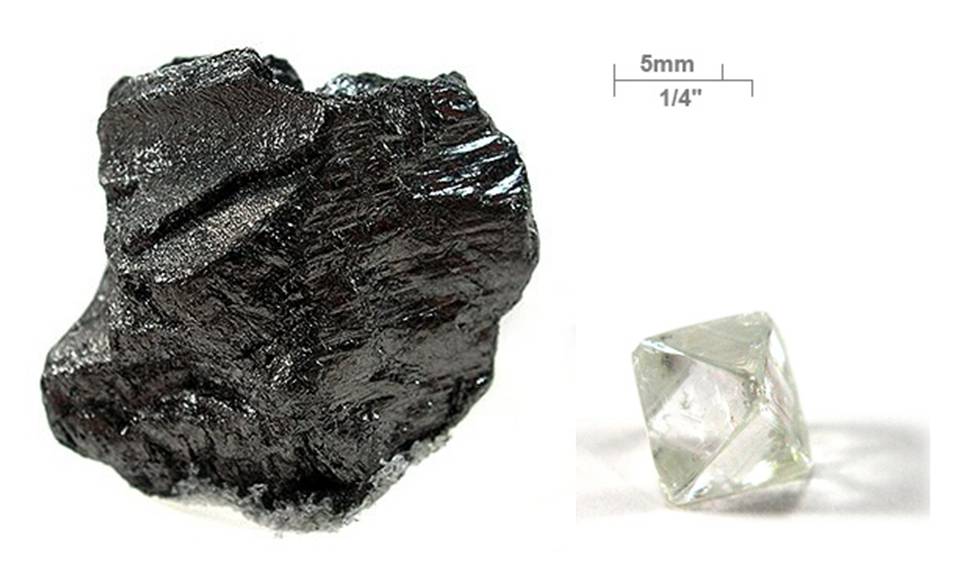
Carbon exists in several allotropes with distinct structures and properties. Major forms include:
- Diamond — a three-dimensional tetrahedral network, known for hardness and optical clarity.
- Graphite — layered sheets that slide past one another, used as a lubricant and conductor.
- Graphene and fullerenes — single-atom-thick sheets and spherical cages with novel electronic and mechanical properties.
- Amorphous carbon — including coal, charcoal and soot, with disordered atomic arrangements used as fuel or pigment.
Uses and importance
Carbon is central to many industries and natural processes. Organic chemistry and biochemistry are built on carbon backbones. Fossil fuels (coal, oil, natural gas) are carbon-rich energy sources; carbon dissolved and stored as carbonates and organic matter plays a key role in the global carbon cycle. Alloying carbon with iron produces steels with a wide range of mechanical properties, and modern materials such as carbon fibers and graphene are important in aerospace, electronics and composites.
History, occurrence and environmental role
Human use of carbon dates to prehistoric times in the form of charcoal and soot, and high-quality diamonds and graphite have long been valued. Carbon atoms are formed in stars by nuclear fusion processes and cycle through the atmosphere, biosphere, oceans and geosphere on timescales from days to millions of years. Carbon dioxide and methane are important greenhouse gases; changes in their concentrations influence Earth’s climate.
Notable distinctions and practical notes
In chemistry, a practical distinction is made between organic compounds (carbon-based molecules, usually with hydrogen) and inorganic carbon species (such as carbonates and carbon oxides). Isotopes of carbon, notably carbon-14, are used for dating archaeological and geological samples. Because of its versatility and abundance, carbon remains one of the most studied and applied elements in science and technology.
Further reading
- General properties of carbon
- Chemical symbol and atomic data
- Carbon and life
- Carbon on Earth
- Isotopes and atomic mass
- Atomic number and electron configuration
- Nonmetal classification
- Metals contrasted with carbon
- Carbon in metallurgy
- Alloying and steel
- Hardening of steels
- Coal and fossil fuels
- Carbon and energy resources
Questions and answers
Q: What is the chemical symbol for carbon?
A: The chemical symbol for carbon is C.
Q: What is the atomic mass of carbon?
A: The atomic mass of carbon is 12.
Q: What is the atomic number of carbon?
A: The atomic number of carbon is 6.
Q: Is carbon a metal or nonmetal?
A: Carbon is a nonmetal, meaning it is not a metal.
Q: How does iron and carbon form hard steel when alloyed together?
A: When iron and carbon are alloyed together, they form hard steel.
Q: What type of fuel can be created from coal, which contains high levels of carbon?
A: Coal, which contains high levels of carbon, can be used to create an important fuel source.
Related articles
Author
AlegsaOnline.com Carbon — the element central to life, materials, and climate Leandro Alegsa
URL: https://en.alegsaonline.com/art/16892
Sources
- doi.org : 10.1016/0008-6223(76)90010-5
- doi.org : 10.1016/j.carbon.2004.12.027
- bernath.uwaterloo.ca : "Fourier Transform Spectroscopy of the Electronic Transition of the Jet-Cooled CCI Free Radical"
- bernath.uwaterloo.ca : "Fourier Transform Spectroscopy of the System of CP"
- webelements.com : "Carbon: Binary compounds"
- ioffe.ru : Properties of diamond
- nde-ed.org : "Material Properties- Misc Materials"
- www-d0.fnal.gov : Magnetic susceptibility of the elements and inorganic compounds
- caer.uky.edu : "History of Carbon and Carbon Materials - Center for Applied Energy Research - University of Kentucky"
- antoine.frostburg.edu : "Who discovered carbon?"