
Makemake: A Trans-Neptunian Dwarf Planet in the Outer Solar System
Makemake is a distant dwarf planet in the Kuiper belt, discovered in 2005. This article summarizes its discovery, composition, orbit, known moon, and scientific significance.
Overview

Image gallery
10 Images





Discovery and name
Makemake was discovered on March 31, 2005 by astronomers Michael E. Brown, Chad Trujillo and David Rabinowitz. The discovery was announced publicly after follow-up observations, and the object was formally recognized as a dwarf planet in June 2008. Because it was found shortly after the Easter holiday, the detection team initially used an informal nickname, "Easterbunny". The International Astronomical Union (IAU) later approved the name Makemake, taken from the creator deity of the Rapa Nui people of Easter Island (Makemake, Easter Island), preserving the connection with the season of discovery.
Physical characteristics
Makemake is composed primarily of a mixture of ices and rock. Spectroscopic observations indicate that volatile ices such as methane and possibly ethane are present on its surface, while underlying material is likely rock and more refractory ices; at the extremely low temperatures found in the outer Solar System, even some ices can be as hard as rock (ice, rock). Its surface is relatively bright and reddish in color, reflecting chemical processing of methane and other simple hydrocarbons by sunlight and cosmic rays. Temperatures on Makemake remain far below the freezing points familiar on Earth (very low temperature), so any atmosphere would be tenuous and temporary, driven by seasonal sublimation of surface ices.
Orbit and classification
Makemake follows an elliptical path around the Sun typical of Kuiper belt objects. Its distance from the Sun varies, and it completes one orbit in many centuries, characteristic of objects in the distant outer Solar System. Its orbit places it beyond the orbit of Neptune, which is why it is grouped with other trans-Neptunian bodies and considered when discussing the architecture and evolution of the Kuiper belt.
Satellite
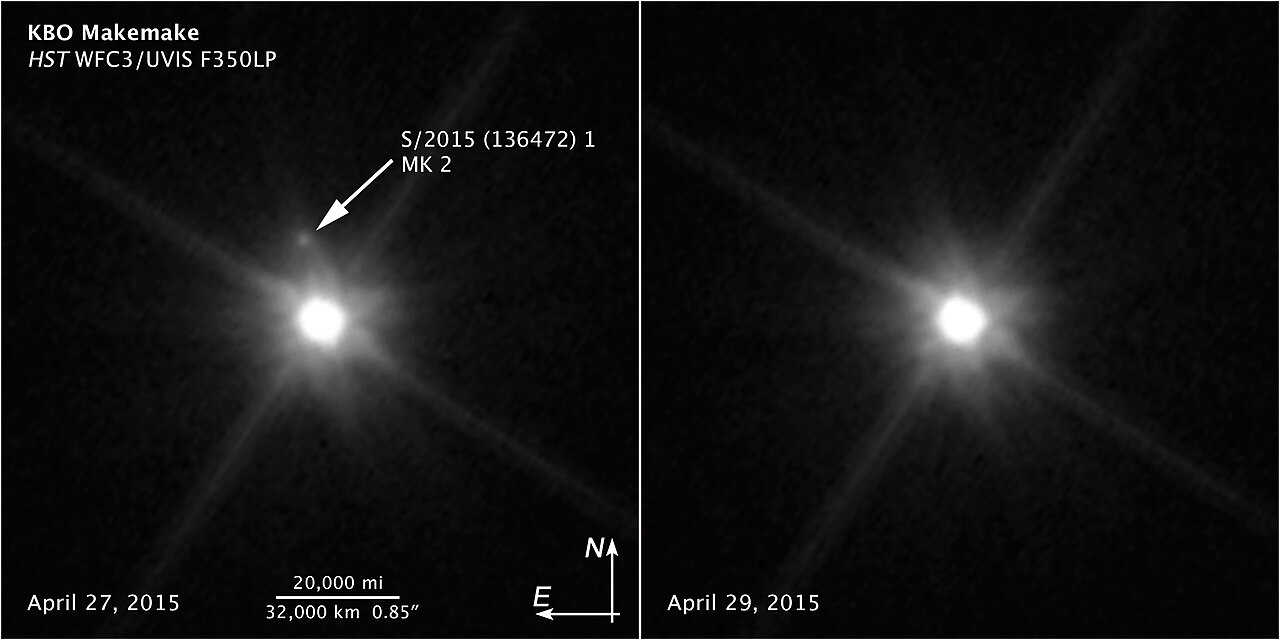
In 2016 astronomers announced the discovery of a small moon orbiting Makemake. The satellite is provisionally designated S/2015 (136472) 1 and has an estimated diameter on the order of a few hundred kilometers (reported values place it near 175 km). Its orbital period around Makemake is greater than twelve days. The moon's presence helps scientists determine Makemake's mass more accurately and offers clues about the system's formation.
Scientific importance and observations
Makemake is one of the larger known dwarf planets in the Kuiper belt and therefore a key object for studying the outer Solar System. Observations from ground-based telescopes and space observatories have characterized its surface composition and reflectivity, and occultation events (when Makemake passes in front of a distant star) have been used to constrain its size and the presence or absence of a significant atmosphere. Continued study of Makemake and its moon contributes to understanding planetary formation, the distribution of volatiles, and the diversity of small worlds beyond Neptune.
Key facts
- Discovery: March 31, 2005 by Brown, Trujillo and Rabinowitz.
- Classification: Dwarf planet, Trans-Neptunian object.
- Naming: After the Rapa Nui creator god Makemake, linked to Easter Island.
- Composition: mixtures of ices and rock, with surface methane and related compounds.
- Satellite: provisional designation S/2015 (136472) 1, discovered 2016.
For further background on how bodies like Makemake are categorized and studied, consult resources about dwarf planets, the Kuiper belt, and observational techniques for distant Solar System objects (Neptune and beyond, IAU naming conventions).
Related articles
Author
AlegsaOnline.com Makemake: A Trans-Neptunian Dwarf Planet in the Outer Solar System Leandro Alegsa
URL: https://en.alegsaonline.com/art/60888
Sources
- mikebrownsplanets.com : "Planets, whats in a name?"