
Mariner 10: NASA's First Mission to Mercury
Mariner 10 was a NASA robotic probe launched in 1973 that performed flybys of Venus and Mercury, returning the first close-up images and many of the first scientific measurements of Mercury.
Overview
NASA launched the robotic space probe Mariner 10 on November 3 1973. Designed to study inner planets, the mission used a flyby of Venus to reach Mercury, and it completed three close flybys of Mercury while remaining in orbit around the Sun. Mariner 10 was the first spacecraft to visit Mercury and the final mission in the Mariner program.
Image gallery
10 Images




Design and instruments
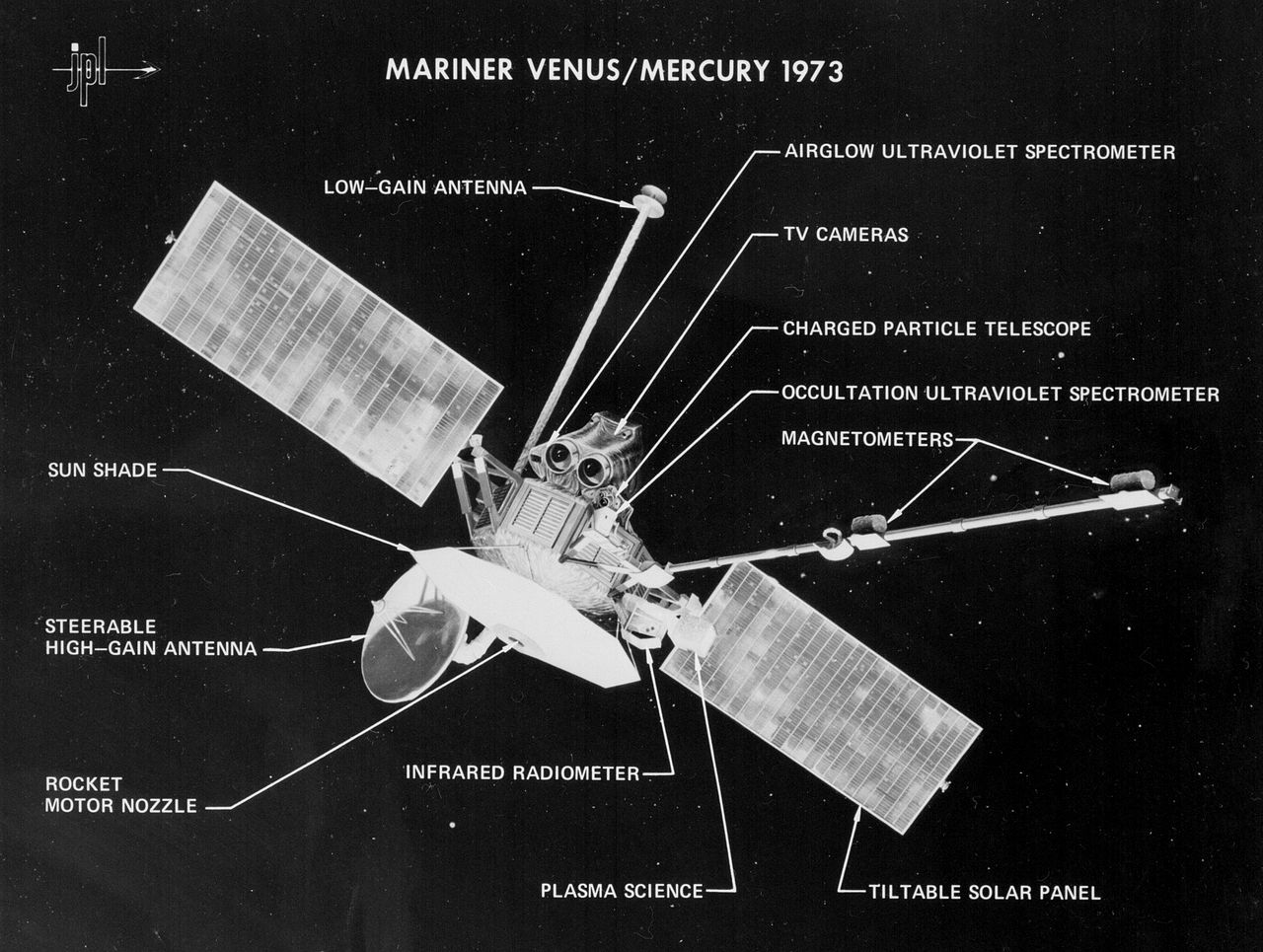
Mariner 10 was built as a compact, solar-powered probe carrying a suite of experiments to image and analyze planetary environments. Its principal systems included thermal control, communications and attitude control to point cameras and sensors. Scientific instruments were chosen to characterize surface, atmospheric, and magnetic properties.
- Imaging: television cameras to photograph surfaces and atmospheric features.
- Spectrometry and radiometry: instruments for ultraviolet and infrared measurements.
- Plasma and fields: magnetometer and charged-particle detectors to study the solar wind interaction.
- Radio science: experiments using the spacecraft's radio link to probe atmospheres and measure gravity effects.
Mission history
The flight profile used a gravity assist at Venus to bend the trajectory inward toward Mercury, an early and effective use of the gravity-assist technique. After the Venus encounter the probe encountered Mercury three times, returning the first close-up views of the planet. Operational contact with Mariner 10 ended after the Mercury encounters and the craft remains in a heliocentric orbit.
Key discoveries and importance
Mariner 10 transformed knowledge of Mercury. It photographed a large fraction of the planet's surface, revealing a heavily cratered terrain and long lobate scarps that indicate planetary contraction. The mission detected a global magnetic field and an extremely tenuous exosphere, and it documented how solar wind interacts with Mercury's magnetosphere. These results established a baseline for later missions and reshaped ideas about the smallest terrestrial planet.
Legacy and notable facts
Mariner 10 is remembered for several firsts: the inaugural mission to Mercury, an early practical demonstration of gravity-assist navigation, and a model for compact planetary probes. It closed the Mariner era and paved the way for later explorers such as MESSENGER and BepiColombo. Although no longer operational, investigators still refer to Mariner 10 data when studying Mercury and inner solar system dynamics.
Notable distinctions:
- First spacecraft to visit Mercury.
- One of the first deep-space missions to use a planetary gravity assist.
- Returned the earliest high-resolution images and many of the first in situ measurements of Mercury's environment.
For additional technical summaries and archival material see mission pages and repositories indexed by agencies and scientific archives.
Related articles
Author
AlegsaOnline.com Mariner 10: NASA's First Mission to Mercury Leandro Alegsa
URL: https://en.alegsaonline.com/art/61945
Sources
- solarsystem.nasa.gov : "Mariner 10: In Depth"