
Sun (Sol): The star at the center of the Solar System
Overview of the Sun: its structure, energy source, activity (sunspots, flares, solar wind), role for Earth, life cycle and key facts. Includes further reading links.
The Sun, also called Sol, is the star that defines the center of our Solar System and supplies the light and heat that make life on Earth possible. It is classified as a G-type main-sequence star (G2V) and is an ordinary, middle-aged star by cosmic standards. Its energy output, generated by nuclear fusion in the core, dominates the dynamics and climate of the planets and drives the local space environment known as the heliosphere.
Image gallery
10 Images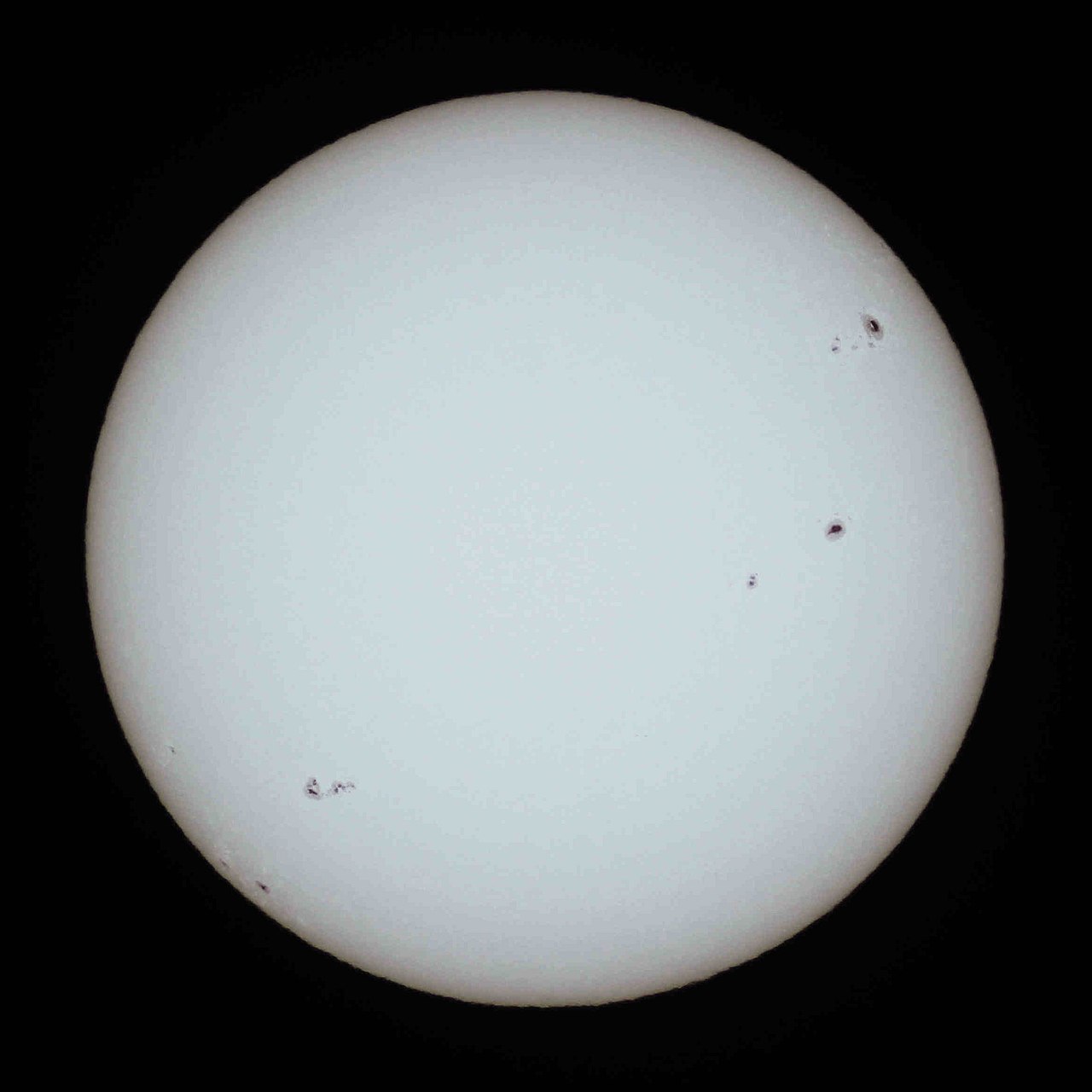



Structure and energy production
The Sun's internal structure is organized into concentric layers. The core, where temperatures reach millions of degrees Celsius, is the site of the proton–proton chain of nuclear fusion that converts hydrogen into helium and releases enormous energy. Surrounding the core are the radiative zone and the convective zone, through which energy moves outward by radiation and then by convection. The visible surface is the photosphere, above which lie the chromosphere and the extended corona — a million-degree outer atmosphere that becomes the solar wind, a continuous flow of charged particles that influences Earth and the other planets.
Observable phenomena
The Sun exhibits a variety of magnetic and plasma-driven phenomena. Sunspots are relatively cooler, magnetically active regions on the photosphere. Solar flares are sudden releases of magnetic energy that emit energetic radiation, and coronal mass ejections (CMEs) expel large amounts of plasma into space. These events can interact with Earth's magnetic field to produce auroras and, in strong cases, disrupt satellites, radio communications and power grids.
History, age and future
Formed about 4.6 billion years ago from the gravitational collapse of a region within an interstellar molecular cloud, the Sun has burned hydrogen in its core for most of its life. It will continue fusing hydrogen for several billion more years. In the distant future it will exhaust core hydrogen, expand into a red giant, shed its outer layers, and end its active life as a cooling white dwarf surrounded by a planetary nebula.
Importance to Earth and human life
Solar radiation provides the energy that drives Earth's weather, climate and photosynthesis in plants. The Sun's magnetic and particle emissions shape near-Earth space weather and can affect modern technological systems. Studying the Sun also helps astronomers understand other stars and the processes that govern stellar evolution.
Key facts and distinctions
- The Sun's mass is roughly 1.99 × 1030 kilograms, more than 300,000 times the mass of Earth; about 1.3 million Earths could fit inside by volume.
- Energy produced in the core can take thousands to hundreds of thousands of years to reach the surface, then minutes to travel to Earth as sunlight.
- Solar activity follows an approximately 11-year cycle in which the number of sunspots and the frequency of eruptions wax and wane.
Further information
- Types of solar radiation
- Radio emissions from the Sun
- Solar energetic particles
- Solar wind overview
- Nuclear fusion in stars
- Hydrogen in stellar cores
- Helium production
- The Milky Way galaxy
- Galactic context of the Sun
- G-type main-sequence stars
- Stellar spectral classification
- Age and evolution of the Sun
This article summarizes broadly verified facts about the Sun and its role in the Solar System. For technical details, observational data and ongoing research, consult specialized resources and mission results linked above.
Questions and answers
Q: What type of star is the Sun?
A: The Sun is a G-type main-sequence star based on its spectral class.
Q: How long has the Sun existed?
A: The Sun has existed for a little over 4.5 billion years.
Q: How wide is the Sun compared to Earth?
A: The Sun is about a hundred times as wide as the Earth.
Q: What is the mass of the Sun?
A: The mass of the Sun is 1.9891×1030 kg, which is 333,000 times the mass of Earth.
Q: How many Earths can fit inside the Sun?
A: 1.3 million Earths can fit inside the Sun.
Q: What type of energy does the sun give off?
A: The sun gives off different types of energy such as infra-red energy (heat), ultraviolet light, radio waves and light. It also gives off a stream of particles, which reaches Earth as "solar wind".
Q: How long does it take for energy in core of sun to escape?
A: It can take between 10,000 and 170,000 years for energy in core of sun to escape.
Related articles
Author
AlegsaOnline.com Sun (Sol): The star at the center of the Solar System Leandro Alegsa
URL: https://en.alegsaonline.com/art/94860
Sources
- doi.org : "Proposals for the masses of the three largest asteroids, the Moon-Earth mass ratio and the Astronomical Unit"
- doi.org : 10.1007/s10569-009-9203-8
- worldcat.org : 1572-9478
- nssdc.gsfc.nasa.gov : "Sun Fact Sheet" · web.archive.org
- ads.harvard.edu : Handbook of Space Astronomy and Astrophysics 2nd edition
- ui.adsabs.harvard.edu : 2006CoAst.147...76A
- doi.org : 10.1553/cia147s76
- education.gsfc.nasa.gov : "Eclipse 99: Frequently Asked Questions"
- arxiv.org : 0803.0732
- ui.adsabs.harvard.edu : 2009ApJS..180..225H
- doi.org : 10.1088/0067-0049/180/2/225
- arxiv.org : 1510.07674
- arxiv.org : astro-ph.SR