
Mariner 3 - NASA's early Mars probe and its mission failure
Mariner 3 was a 1964 NASA planetary probe intended to image Mars and study interplanetary space. A protective shroud failed to separate, the spacecraft lost power and entered heliocentric orbit without returning Mars data.
Overview
Mariner 3 was an early American robotic spacecraft built and operated by NASA as part of the Mariner program. Launched in 1964, it was intended to travel to the planet Mars and to study the environment between the planets during its cruise phase. The mission was designed to return the first close-up images of the Martian surface and to collect measurements of particles and radiation in interplanetary space.
Image gallery
7 Images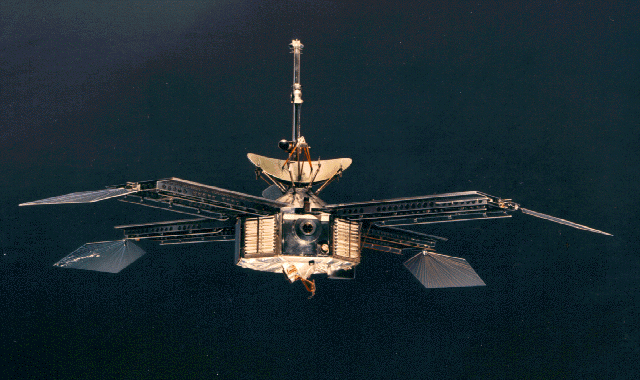


Design and planned instruments
The spacecraft combined basic telecommunications and power systems with a small suite of scientific instruments. Planned capabilities included a television imaging system for photographic observations, detectors to measure charged particles and radiation, and engineering hardware such as solar arrays and batteries. During ascent the probe was protected by a nose shroud intended to separate once the vehicle reached space; after separation the craft would deploy antennas and solar panels to maintain power and communications.
Launch sequence and failure
Shortly after launch the mission suffered a critical mechanical malfunction: the protective shroud failed to jettison as intended. The intact shroud prevented full deployment of the solar arrays and antenna, causing thermal and power problems. Contact with the spacecraft was lost about eight hours after launch, and it was unable to execute the burns and maneuvers required to place it on the correct Mars-bound trajectory. Loss of power prevented the planned cruise-phase science and any imaging of the Martian surface.
Fate and orbital outcome
Because Mariner 3 could not complete its post-launch operations, it missed the Mars flyby opportunity and did not return scientific data. Instead, it remained on a path around the Sun and became an inactive object in heliocentric (Sun-centered) space. The mission therefore ended in a solar orbit rather than achieving a planetary encounter; more on orbital context and dynamics is available in introductory materials about the heliocentric orbit and the role of the Sun in solar system trajectories.
Consequences, lessons learned and legacy
The failure highlighted the importance of reliable separation mechanisms and ground test procedures for protective shrouds. Engineering changes and careful review of separation hardware and procedures were applied to the follow-on flight, which successfully returned the first close-up images of Mars. More broadly, the Mariner effort contributed practical experience in long-distance telecommunications, mission planning and spacecraft reliability that informed later planetary programs.
Further reading
For technical summaries and program context consult a spacecraft overview and historical program resources: spacecraft overview, planetary context, and historical accounts of mission analysis and trajectory planning: interplanetary science, trajectory reports and general Mars mission pages about Mars.
- Key fact: Mariner 3 failed to return data because its protective shroud did not separate and the probe lost power.
- Impact: The incident led to design and test improvements applied to subsequent missions in the Mariner series.
- Context: Although unsuccessful, Mariner 3 is part of the early history of robotic planetary exploration and of lessons that enabled later successes.
Related articles
Author
AlegsaOnline.com Mariner 3 - NASA's early Mars probe and its mission failure Leandro Alegsa
URL: https://en.alegsaonline.com/art/61947
Sources
- solarsystem.nasa.gov : "Mariner 3"