
Milky Way — the galaxy that contains the Solar System
Overview of the Milky Way: its structure, size, contents, history of study, neighbors in the Local Group, and its future interactions — including the expected encounter with Andromeda.
The Milky Way is the spiral galaxy that hosts the Solar System and most of the stars visible from Earth. As our cosmic home it is studied at many wavelengths and serves as a nearby laboratory for understanding galaxy formation and dynamics. Readers will encounter varying numerical estimates for its size and population because different methods and definitions (stellar disk, gaseous halo, dark-matter envelope) measure different components; authoritative summaries emphasize ranges rather than single exact values. For a general introduction see Milky Way overview.
Image gallery
10 Images



Structure and main components
The galaxy is classified as a barred spiral: a central elongated bar of stars funnels material into the inner region and connects to several curved spiral arms. Its principal structural elements are the thin disk, the central bulge, and a more diffuse halo. The thin disk contains most of the galaxy's gas and ongoing star formation, while the bulge is a dense concentration of older stars. Surrounding both is an extended halo made up of old stars, globular clusters and a large reservoir of dark matter that dominates the total mass.
- Disk: contains the Sun and the majority of visible stars and interstellar gas; not perfectly flat but mildly warped.
- Bulge: dense inner region with older, metal-rich stars and a compact, massive object at the center.
- Halo: spheroidal population of ancient stars, globular clusters, and dark matter that extends well beyond the luminous components.
Estimates of the total number of stars vary; astronomers typically quote a broad range from roughly 100 to 400 billion, with many modern studies clustering near two hundred billion. The galaxy's visible diameter is often given in the range of about 100,000 to 200,000 light-years, depending on whether one measures the bright stellar disk or the more extended stellar and gaseous outskirts — see diameter estimates. Individual nearby objects of interest include the Sun itself, our reference star (Sun), embedded in a minor spiral arm sometimes called the Orion or Local Spur.
History of understanding
Ideas that the Milky Way is made of stars date back to ancient thinkers and observers; fragments of this idea survive in early Greek natural philosophy and in the writings of thinkers such as Democritus, and later scholars refined the picture with telescopic observation. Modern mapping of the galaxy expanded greatly in the 18th–20th centuries, as star counts, radio observations of neutral hydrogen, and infrared surveys revealed spiral structure, the central bar and distant satellite systems. The discovery that rotation speeds do not fall as expected from visible mass led to the inference of a dominant dark matter component, a major development of 20th-century astronomy.
Historical and conceptual resources on the subject include discussions of Ancient Greek thought about the heavens and modern synopses of stellar population work; introductory resources are collated under stellar population estimates and observational surveys of stars.
Local Group, neighbors and future
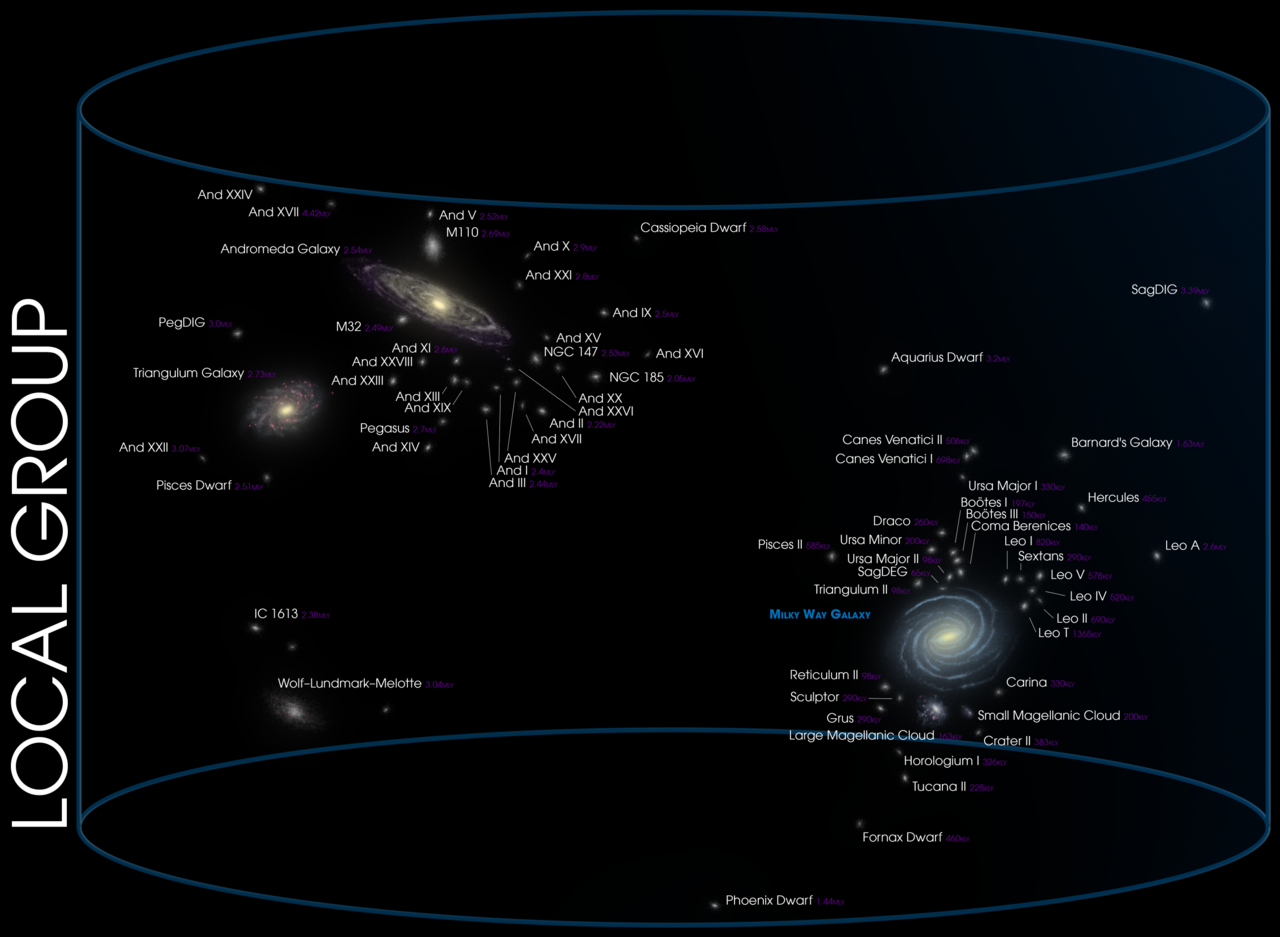
The Milky Way is a principal member of the Local Group of galaxies, a small gravitationally bound collection that also contains the Andromeda Galaxy and the Triangulum Galaxy. For context, see Local Group. It is orbited by dozens of dwarf satellite galaxies, such as the Large and Small Magellanic Clouds and candidate satellites including the Canis Major Dwarf. The nearest large neighbour is the Andromeda Galaxy, which is approaching on a timescale of billions of years and is expected to interact or merge with the Milky Way in roughly four billion years. Our planet occupies a position inside the disk; basic orientation and sky-based descriptions are anchored to observations from Earth.
Key observational targets inside the Milky Way include the compact radio source Sagittarius A* in the central bulge, widely accepted as a supermassive black hole with a mass of several million solar masses, and numerous star-forming regions and remnants that trace the life cycles of stars. Contemporary research uses a mix of optical, infrared, radio and high-energy observations combined with astrometric surveys to refine the galaxy's map, measure motion of its components, and constrain its dark-matter halo. For current survey projects and technical summaries consult specialized resources and mission pages linked from general overviews such as Milky Way overview and survey compilations like Sun and local environment.
Because the Milky Way is large, nearby and well resolved, it remains a primary target for testing theories of galaxy evolution and for understanding the environments that produce planetary systems. Its band across the night sky—the Milky Way as seen by unaided eyes—is both a scientific object and a powerful cultural symbol in many human societies.
Questions and answers
Q: What is the Milky Way?
A: The Milky Way is our home galaxy.
Q: How many stars are there in the Milky Way?
A: The Milky Way contains over 200 billion stars.
Q: What is the diameter of the Milky Way?
A: The Milky Way has a diameter of about 170,000 or 200,000 light years.
Q: What is the structure of the Milky Way?
A: The Milky Way is a barred spiral galaxy with three main parts: a disk, a bulge at the core, and an outer halo all around it.
Q: What is the Local Group?
A: The Local Group is a group of three large galaxies and over 50 smaller galaxies that the Milky Way belongs to.
Q: What is the closest neighbor to the Milky Way?
A: The Canis Major Dwarf Galaxy, which is about 25,000 light years away from the Earth, is the closest neighbor to the Milky Way.
Q: When will the Andromeda Galaxy collide with the Milky Way?
A: The Andromeda Galaxy will collide with the Milky Way Galaxy in about 3.75 billion years.
Related articles
Author
AlegsaOnline.com Milky Way — the galaxy that contains the Solar System Leandro Alegsa
URL: https://en.alegsaonline.com/art/64999
Sources
- commons.wikimedia.org : Milky Way Galaxy
- arxiv.org : 0810.4674
- ui.adsabs.harvard.edu : 2009ApJ...692.1075G
- doi.org : 10.1088/0004-637X/692/2/1075
- authors.library.caltech.edu : "AN IMPROVED DISTANCE AND MASS ESTIMATE FOR SGR A* FROM A MULTISTAR ORBIT ANALYSIS"
- arxiv.org : 1607.05726
- ui.adsabs.harvard.edu : 2016ApJ...830...17B
- doi.org : 10.3847/0004-637X/830/1/17
- arxiv.org : 1611.09144
- ui.adsabs.harvard.edu : 2017ApJ...837...30G
- doi.org : 10.3847/1538-4357/aa5c41
- arxiv.org : astro-ph/0203110
- ui.adsabs.harvard.edu : 2002SSRv..100..129G
- doi.org : 10.1023/A:1015818111633
- messier.seds.org : "Classification of the Milky Way Galaxy"