
Mariner 2: NASA’s First Successful Planetary Flyby
Mariner 2 was NASA’s first spacecraft to successfully fly past another planet (Venus) in 1962. Its observations established Venus as extremely hot and provided early measurements of the solar wind and interplanetary space.
Overview
Mariner 2 was an early interplanetary spacecraft developed by NASA and the Jet Propulsion Laboratory as part of the Mariner program. Launched in 1962, it became the first spacecraft to complete a successful mission from Earth to another planet, providing the first close-up scientific observations of Venus. The mission followed an earlier failed attempt in the same program and demonstrated reliable deep-space navigation and communications.
Image gallery
10 Images


Design and instruments
The spacecraft was a spin-stabilized probe equipped with solar panels and a radio transmitter to send science data back to Earth. Its instrument complement focused on remote sensing and space-environment studies. Key instruments included:
- Microwave and infrared radiometers to measure thermal emission from Venus.
- Charged-particle and plasma detectors to study the solar wind.
- Cosmic dust and micrometeoroid detectors to characterize particle flux in interplanetary space.
Mission profile and findings
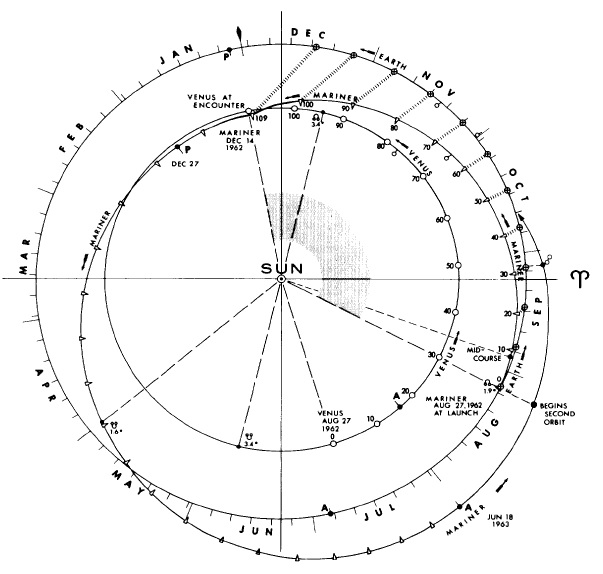
After launch, Mariner 2 coasted to Venus and performed a close flyby, returning continuous telemetry during the encounter. Its radiometers measured very high temperatures consistent with a hot, dense atmosphere and surface, overturning earlier speculative ideas about a temperate Venus. Instruments also detected a steady stream of charged particles — evidence of the solar wind — and found no strong global magnetic field around Venus. For mission details and archived data see flyby datasets.
Importance and legacy
Mariner 2 proved that routine interplanetary missions were feasible and established measurement techniques used by later probes. Its results shaped our understanding of Venus as a hostile, greenhouse-warmed world and provided some of the first in situ information about the space environment between planets. The mission influenced spacecraft engineering, navigation, and instrument design for subsequent planetary exploration within the Mariner program and beyond.
Notable facts
Mariner 2’s success came after an earlier Mariner failure, illustrating rapid learning in early space exploration. The mission remains a milestone in demonstrating that robotic probes can travel between planets and return useful scientific information to Earth-based teams.
Related articles
Author
AlegsaOnline.com Mariner 2: NASA’s First Successful Planetary Flyby Leandro Alegsa
URL: https://en.alegsaonline.com/art/61946
Sources
- planet4589.org : "Launch Log"
- nasa.gov : nasa.gov/connect/ebooks/beyond_earth_detail.html