
Karakoram: geography, peaks, glaciers, passes and historical significance
The Karakoram is a major mountain range in Central and South Asia, noted for its high peaks, extensive glaciers, strategic passes and role in regional geography, climate and mountaineering history.
Overview
The Karakoram is a vast mountain range in Central and South Asia whose name derives from a Turkic phrase often translated as "back gravel" or similar Turkic origins. It lies primarily within the modern states of China, India and Pakistan, with peripheral reaches into Afghanistan and Kyrgyzstan. Many of its highest massifs fall inside the administrative regions of Gilgit-Baltistan, Ladakh and Xinjiang. Geographically and tectonically it forms one element of a greater complex that includes the Himalaya, the Hindu Kush and the Pamirs.
Image gallery
6 Images



Physical features and major peaks
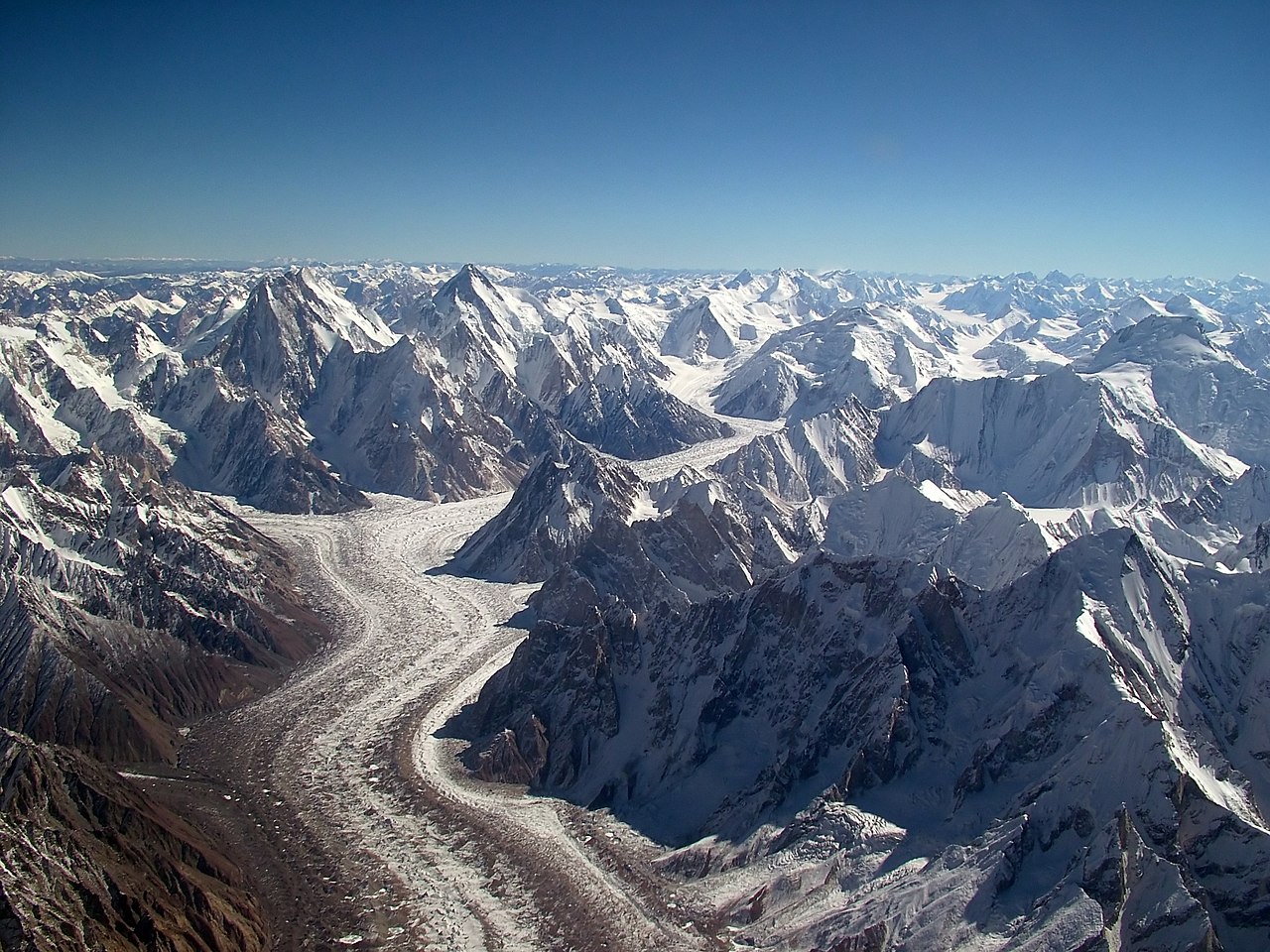
Extending for roughly 500 kilometres with an average width measured in tens of kilometres, the Karakoram contains some of the highest mountains outside the Himalaya. It hosts eight peaks taller than about 7,500 metres and four summits exceeding 8,000 metres, including the world-famous K2 (the second highest mountain on Earth), Gasherbrum I, Broad Peak and Gasherbrum II. These peaks rise from heavily glaciated plateaus and steep ridgelines that challenge climatology, geology and high-altitude mountaineering.
Glaciers, rivers and landscape
The Karakoram is among the most glaciated regions outside polar areas, with a far greater glacier cover than the average Himalayan flank. Estimates vary, but glaciers in the range cover a substantial fraction of the terrain and feed many of the region's streams and major rivers. Notable ice bodies include the long Siachen Glacier and the Biafo Glacier, important both for their length and for sustaining downstream water supplies that join the Indus River. The geography produces numerous cirque lakes, riverside wetlands and geothermal springs, and the elevation range of peaks spans from modest foothills to summits known for perpetual snow and ice (elevation, glaciation).
Passes, travel and human use
Several historic mountain passes cross the Karakoram, linking plateaus and valleys and shaping trade and cultural contact. The high Karakoram Pass has long been a transcontinental route, and other routes such as the Khunjerab Pass continue to serve modern transportation and border roles. The range acts as a climatic barrier between areas such as Kashmir and the interior of China, shielding certain valleys from cold continental winds originating near Siberia. Local economies have traditionally included pastoralism, seasonal agriculture in lower valleys, trade along caravan corridors and, more recently, tourism and high-altitude expeditions.
History, science and contemporary importance
The Karakoram has long been a crossroads of cultures, languages and imperial ambitions, and its passes figured in ancient and medieval trade routes connecting South and Central Asia. In the modern era the range is significant for issues of water resources, border demarcation and environmental research. Scientists study Karakoram glaciers for what they reveal about regional climate variability and river-fed irrigation systems downstream. Mountaineers regard the range as among the most demanding in the world, prized for its technical routes and objective hazards. Conservationists and policymakers increasingly focus on how glacier change, shifting snowfall patterns and human activity will affect the many communities that depend on rivers and valley ecosystems.
Selected facts and distinctions
- Ranking: Often described as the world's second-highest mountain range in terms of peak elevations.
- Prominent summits: K2, Gasherbrum I, Broad Peak, Gasherbrum II.
- Glaciers: Home to major non-polar glaciers such as Siachen and Biafo, which contribute to the Indus river system.
- Regional links: Serves as a natural frontier between Kashmir and parts of China, and connects to broader Central Asian geography including links to Afghanistan and Kyrgyzstan.
For travelers, researchers and policymakers, the Karakoram remains a region of high physical drama, complex human geography and considerable strategic and environmental importance.
Related articles
Author
AlegsaOnline.com Karakoram: geography, peaks, glaciers, passes and historical significance Leandro Alegsa
URL: https://en.alegsaonline.com/art/52276
Sources
- books.google.com : Exploration of the Shaksgam Valley and Aghil ranges, 1926
- britannica.com : "Karakoram Range"
- icimod.org : "Hindu Kush Himalayan Region"
- earthobservatory.nasa.gov : "The Eight-Thousanders"
- mountainprofessor.com : "The Karakoram Mountains"
- whc.unesco.org : "Karakorum-Pamir"
- commons.wikimedia.org : Karakoram
- wikidata.org : wikidata.org/wiki/Q5469
- d-nb.info : 4073227-7
- id.loc.gov : sh85071593
- aleph.nkp.cz : ge143955
- viaf.org : 247643385
- worldcat.org : 247643385