
Gasherbrum I (Hidden Peak): overview of the Karakoram eight-thousander
Gasherbrum I, also called Hidden Peak or K5, is an 8,080 m summit in the Karakoram on the China–Pakistan border. Noted for its remote, glaciated ridges and mountaineering history since 1958.
Overview
Gasherbrum I is an eight-thousand metre mountain reaching about 8,080 metres above sea level. It lies in the central Karakoram and forms part of a compact group of high summits. Long known to surveyors as K5, it is commonly called "Hidden Peak" and is counted among the world's highest mountains, ranked near the 11th highest.
Image gallery
3 Images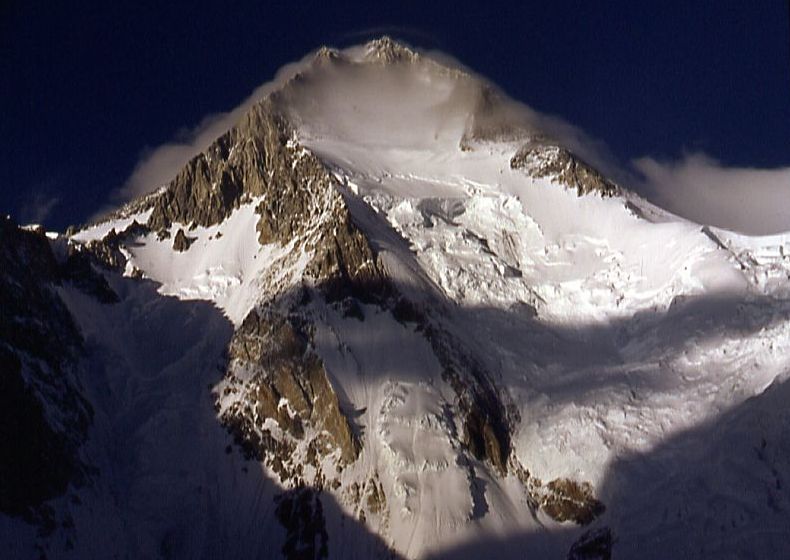


Location and physical characteristics
The mountain occupies a high, glaciated section of the Karakoram range, straddling the border region between China and Pakistan. Like its neighbours in the Gasherbrum massif, it is carved by steep snow and ice slopes, long ridges and hanging glaciers. Approaches from the Pakistani side typically cross the Baltoro Glacier and lower icefields; from either side, climbers face extreme altitude, crevasse fields and avalanche-prone seracs.
History and naming
The name "Gasherbrum" derives from local Balti words commonly interpreted as meaning "beautiful mountain" (though other translations such as "shining wall" appear in older sources). Early British surveyors assigned the K-numbering (K5) during 19th-century mapping of the Karakoram. The first recorded ascent of Gasherbrum I was achieved by members of an American expedition in 1958, marking the mountain's entry into high-altitude mountaineering history.
Mountaineering and routes
Gasherbrum I is prized by experienced alpinists for its remote setting and technically demanding ice and mixed routes. Unlike some eight-thousanders that see heavy commercial traffic, it receives fewer attempts but remains serious and hazardous. Established lines require prolonged high-altitude climbing, glacier travel and careful avalanche assessment. Climbs are organized from base camps accessed via long treks or helicopter drops into the glaciated valleys.
Significance and notable facts
- Part of the Gasherbrum group, it sits near other major peaks such as Gasherbrum II and Broad Peak.
- Its dual names—K5 and Hidden Peak—reflect both survey history and local reputation.
- It contributes to regional research on glaciology and climate because its glaciers feed rivers that supply downstream communities.
- Climbing Gasherbrum I remains an objective that combines technical difficulty, logistical complexity and remote wilderness experience.
For further reference on routes, expedition logs and regional guides consult specialist mountaineering resources and national park authorities that manage access in the Karakoram. Photographs and climbing reports frequently show the mountain's steep faces and the broad icefields of the surrounding massif.
Related articles
Author
AlegsaOnline.com Gasherbrum I (Hidden Peak): overview of the Karakoram eight-thousander Leandro Alegsa
URL: https://en.alegsaonline.com/art/37677
Sources
- peakbagger.com : "Gasherbrum I"
- wikidata.org : wikidata.org/wiki/Q187138
- d-nb.info : 4024831-8
- id.loc.gov : sh85053411
- aleph.nkp.cz : ge271688
- viaf.org : 315522440
- worldcat.org : 315522440