
Turkic languages: overview, characteristics, history and distribution
A concise encyclopedic overview of the Turkic language family: its structure, major branches, history, writing systems, geographic spread and cultural significance.
Overview
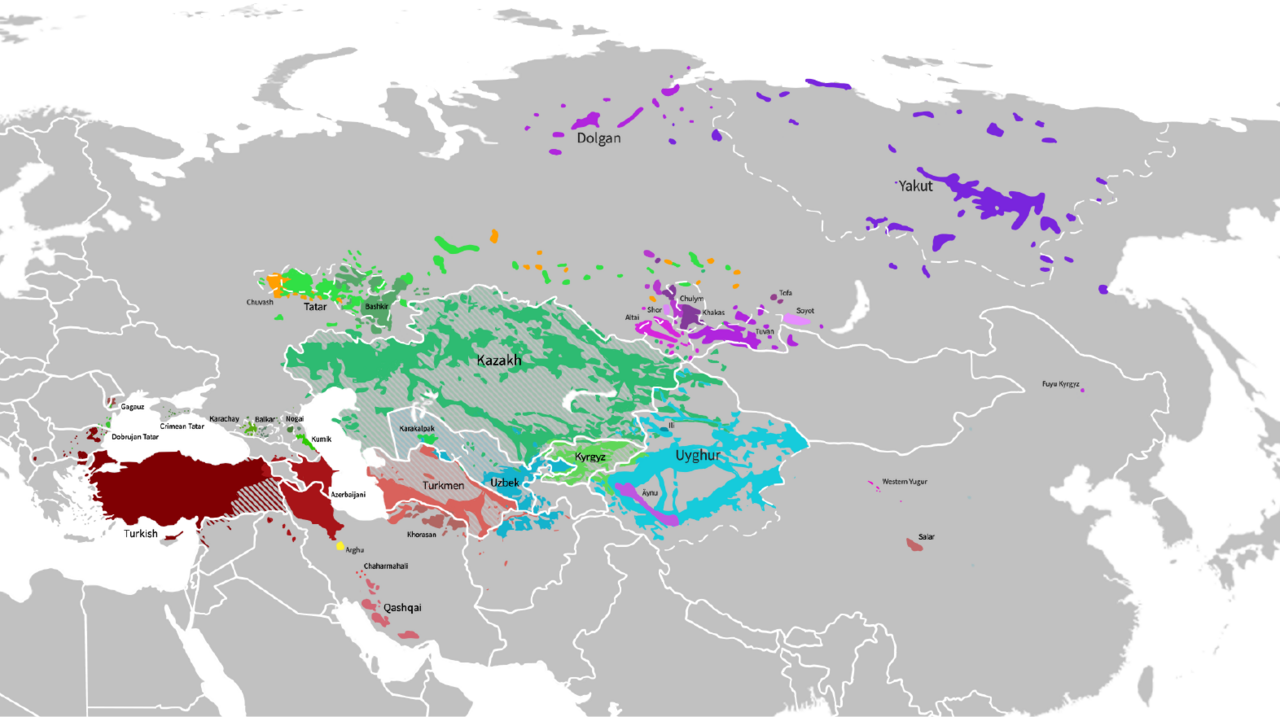
The Turkic languages form a family of related languages spoken by Turkic peoples across a vast area of Eurasia. The grouping is widely recognized as a single family of closely related tongues; see a general classification map here. Speakers are concentrated in the region from Eastern Europe to Siberia and from the eastern Mediterranean to western China; communities of Turkic origin and language are often identified together as Turkic peoples. Major geographic reference points include parts of Eastern Europe and the Mediterranean, highlighting the long reach of these languages.
Image gallery
10 Images


Distribution and numbers
Turkic languages are native to populations across Central Asia, the Caucasus, Siberia and parts of eastern Europe and China. Substantial speech communities exist in Siberia (Siberia) and in the Xinjiang and other western regions of China (Western and Northern China). The total number of native speakers is commonly estimated to be around 200 million, with additional second-language speakers bringing broader figures higher; some sources quote totals near 230 million when second-language use is included (second-language counts). The language family was historically compared with neighboring families in the controversial Altaic hypothesis (Altaic), though that connection is not generally accepted today.
Major languages and branches
Within the family a handful of major languages dominate in terms of speakers and cultural influence. The largest single language is Turkish (often called Anatolian or Turkish in linguistic descriptions), which accounts for a substantial share—commonly cited at about 40%—of all Turkic speakers; it is sometimes referred to specifically as Anatolian Turkish. Other important languages include Azerbaijani, Uzbek, Kazakh, Uyghur, Kyrgyz, Turkmen, Tatar and Bashkir.
Characteristics
Despite regional variation, Turkic languages share a number of structural traits. Most are agglutinative: grammatical relations and meaning are conveyed by adding a sequence of suffixes to stems. Vowel harmony is a widespread phonological rule, which conditions which suffix forms may attach to a root. Typical word order is subject–object–verb (SOV). Many Turkic languages have rich case systems, no grammatical gender, and systems for evidentiality or aspect expressed through suffixes.
Classification and history
Linguists divide the family into several branches such as Oghuz (Turkish, Azerbaijani, Turkmen), Kipchak (Kazakh, Kyrgyz, Tatar), Karluk (Uzbek, Uyghur), Siberian Turkic groups and the distinct Chuvash branch. The earliest securely attested Turkic inscriptions date from early medieval Central Asia (notably the Orkhon inscriptions), and the family is thought to have spread from the Eurasian steppe through migrations and state formations over many centuries.
Writing systems, literature and modern importance
Historically Turkic languages have used a variety of scripts: Old Turkic runiform alphabets, Arabic-based scripts after the Islamic period, Cyrillic in many Soviet contexts, and Latin alphabets in various modern reforms. Modern literatures and media in Turkic languages are important for national identity in several countries. Turkic languages have influenced and been influenced by neighboring Iranian, Slavic, Mongolic and Arabic-language cultures through loanwords and bilingualism.
Notable facts
- Mutual intelligibility varies: some neighboring Turkic languages (for example Turkish and Azerbaijani) are highly mutually comprehensible, while others are more distant.
- Chuvash is the most divergent member of the family and represents a separate branch with older differences.
- Script reforms and language planning in the 20th and 21st centuries have reshaped orthographies across the family.
For more general resources and introductory material see regional language surveys and comparative grammars (map, ethnographic notes, regional overviews, historical context, Siberian groups, Chinese Turkic, Altaic debate, statistics, major languages, Anatolian Turkish).
Questions and answers
Q: How many Turkic languages are there?
A: There are around thirty Turkic languages.
Q: Where are the Turkic languages spoken?
A: The Turkic languages are spoken by Turkic peoples across an area from Eastern Europe and the Mediterranean to Siberia and Western and Northern China.
Q: Are the Turkic languages part of the Altaic language family?
A: Traditionally, it is believed that the Turkic languages form part of the Altaic language family.
Q: How many people speak a Turkic language as their native language?
A: Approximately 200 million people speak a Turkic language as their native language.
Q: What is the most widely-spoken among all the Turkicspeaking populations?
A: The most widely-spoken among all the Turcspeaking populatiosn is Turkish (Anatolian Turkish), with approximately 40% of all speakers of Turksih being native speakers of it
Related articles
Author
AlegsaOnline.com Turkic languages: overview, characteristics, history and distribution Leandro Alegsa
URL: https://en.alegsaonline.com/art/102096
Sources
- turkiclanguages.com : turkiclanguages.com
- britannica.com : britannica.com/topic/Turkic-languages