
Hermes and the Infant Dionysos (marble group from Olympia)
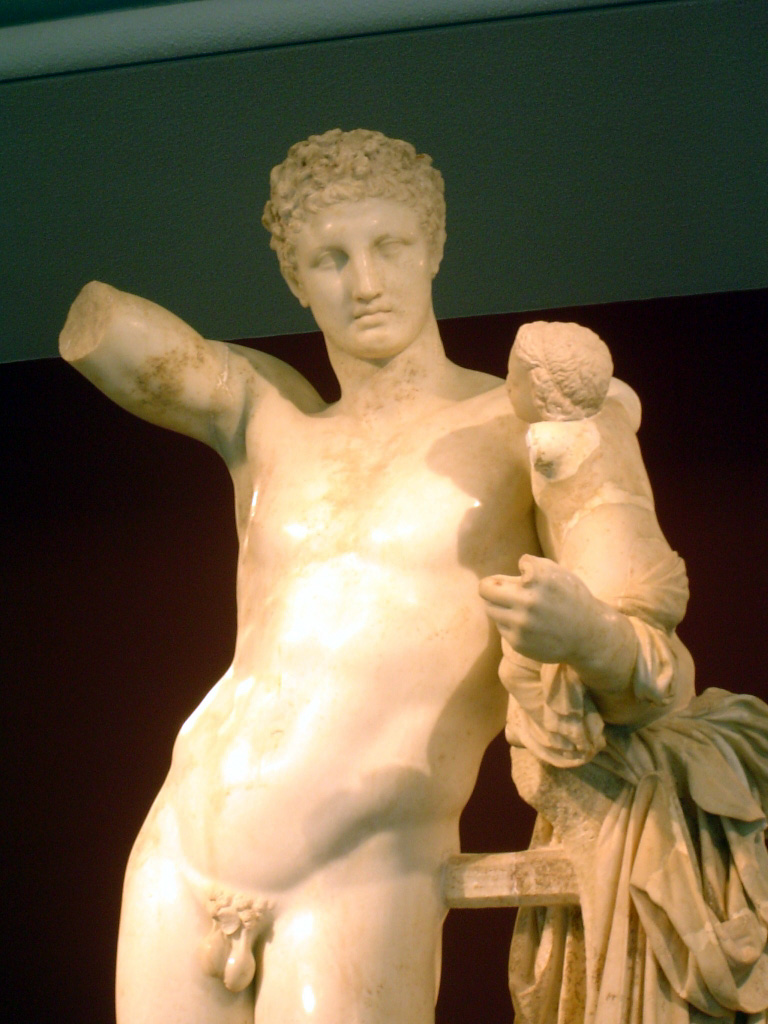
Late Classical Greek marble statue group, probably 4th century BC, showing Hermes supporting the infant Dionysos. Found at Olympia in 1877; famed for Parian marble, polished surfaces and debated attribution to Praxiteles.
Overview
Hermes and the Infant Dionysos is an important ancient Greek marble group discovered in 1877 among the ruins of the Temple of Hera at Olympia. The composition shows the god Hermes supporting or holding the infant Dionysos in an intimate and naturalistic pose. It is commonly dated to the 4th century BC and has long been associated, by some scholars, with the Athenian sculptor Praxiteles; however, the attribution remains debated and is not universally accepted.
Image gallery
10 Images





Discovery and archaeological context
The group was found during excavations at Olympia and was recorded into the local archaeological museum collection. An ancient limestone base was recovered with the group, consisting of a grey limestone block set between two marble blocks, which helps clarify aspects of the original installation. Pausanias, the 2nd-century traveller and writer, makes a remark that has been interpreted to support a classical date for a famous statue of Hermes at Olympia; this literary note is one factor used in dating the work.
Physical description and measurements
The surviving figure of Hermes stands around two metres in height (variously measured at about 2.10–2.15 m), with the complete group, including its base, rising higher. The child Dionysos is shown perched on Hermes' arm in a relaxed pose. The sculpture is carved from Parian marble, a fine-grained white stone prized in antiquity for large-scale statuary. Many of the smaller supports and parts have been lost: both forearms are damaged, Hermes' left foot and portions of the right foot are broken, the phallus is missing, and the infant's arms survive only in part. Much of the tree trunk used as a support and part of the plinth are also lost.
Materials and technique
The group was executed in Parian marble, selected for its translucent quality and suitability for high polishing. The most visible surfaces of the figure, notably the face and torso of Hermes, were finished to a high degree and display a polished, soft modelling characteristic of late Classical sculpture. By contrast, the back of the statue retains rasp and chisel marks, indicating that the sculptor left less visible surfaces more roughly worked. The right foot of Hermes remains integral with a portion of the base, a practice that helped stabilise tall marble figures.
Polychromy, gilding and surface traces
At the time of discovery conservators noted traces of pigment and metal finish. Slight traces of cinnabar, a red mercury sulfide pigment, were found in the hair and on the sandal straps, and there is evidence that parts of the statue had been prepared for gilding. Such remains confirm that many ancient marble sculptures were originally polychrome or partly gilt, a fact that alters modern perceptions of classical statuary as purely white marble.
Dating and attribution
The conventional dating to the 4th century BC rests on combined evidence from ancient literary references and stylistic comparison with securely dated works of the late Classical period. Praxiteles, who is known from ancient authors for works that favour gentle modelling and sensuous anatomy, has been proposed as the creator by some early scholars. Modern scholarship is more cautious: proposals range from a high-quality original by Praxiteles, to a work from his workshop, to a later copy made in the Roman period after a classical prototype. The absence of a signed inscription and the fragmentary state complicate a definitive attribution.
Iconography and influence
The subject—an approachable, youthful deity in a tender interaction with a child—illustrates a move in Greek art toward more relaxed poses and intimate, everyday gestures in divine representation. The style and emotional tone of the group were influential in later Hellenistic and Roman art, and the piece is often discussed as exemplary of the so-called Praxitelean manner: soft modelling, contrapposto stance and an emphasis on naturalism over heroic rigidity.
Conservation and display
Today the group is on display in the Archaeological Museum of Olympia. Conservation work has concentrated on stabilising fractures, documenting and preserving traces of pigment and gilding, and protecting fragile surfaces from further deterioration. The statue remains a central object for visitors, and it continues to attract scholarly attention because of its quality, state of preservation and questions about provenance and authorship.
References and further reading
- Catalogue entry and object record
- Parian marble and quarrying
- Praxiteles: biography and works
- Temple of Hera at Olympia: excavation report
- Ancient sources on dating classical sculptures
- Hermes in Greek religion and art
- Conservation notes on fragmentary statues
- Armature and missing elements in ancient sculpture
- Techniques for joining marble pieces
- Footwear and iconography in Greek statuary
- Representation of nudity in Greek art
- Child figures in classical sculpture
- Use of tree trunks as supports in marble groups
- Plinths and pedestal constructions
- Limestone bases and ancient installation methods
- Block selection and carving sequence
- Integration of statue and base
- Facial modelling and portraiture in the Classical age
- Torso modelling and anatomy in sculpture
- Surfaces: polishing and tool marks
- Rasp and chisel traces as evidence of workshop practice
- Cinnabar and ancient pigments
- Mercury compounds in antiquity
- Red pigments and preparatory layers for gilding
- Decorative motifs: the Heraclean knot
Related articles
Author
AlegsaOnline.com Hermes and the Infant Dionysos (marble group from Olympia) Leandro Alegsa
URL: https://en.alegsaonline.com/art/43817