
Hand (anatomy, function, and evolution)
A hand is the prehensile structure at the end of the arm used for grasping, sensation, communication and manipulation. Article covers anatomy, mechanics, evolution, common uses, and notable variations.
Overview
The hand is the terminal portion of the upper limb found in humans and many other animals. As a visible and functional part of the body, it plays central roles in everyday tasks. Most modern humans possess two hands, each adapted for a wide range of actions from forceful gripping to very precise movements.
Image gallery
10 Images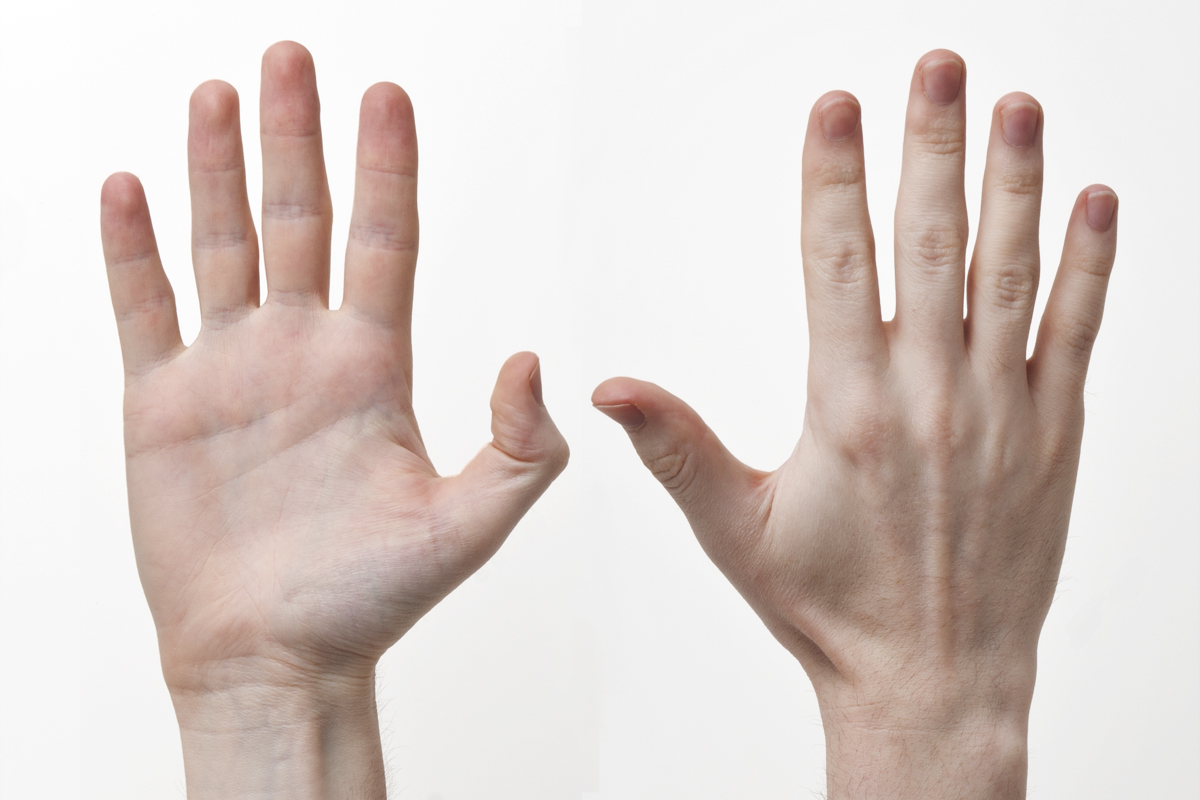




Anatomy and parts
Structurally, an adult human hand contains 27 bones: the five long bones in the palm called metacarpals, the proximal and distal phalanges of the fingers and thumb, plus the carpal bones of the wrist. Typical external regions include the palm, the dorsum (back of the hand), fingers and thumb. Each hand usually has four fingers and an opposable thumb, giving humans a large repertoire of grips.
- The wrist links the hand to the forearm and contains the carpal bones (wrist).
- Individual finger segments meet at articulations commonly called joints.
- When the digits are tightly closed the hand forms a fist, and the most prominent joints on that surface are often called knuckles.
Function and common uses
Hands serve several overlapping functions: mechanical manipulation (grasping, lifting, tool use), sensory exploration (touch, temperature, proprioception), and nonverbal communication (gestures, sign language). Fine motor control enables activities such as writing, threading, or using instruments, while power grips enable tasks requiring strength.
Evolution and comparative anatomy
Hands evolved as part of the mammalian and primate lineage and vary across species. Many primates have hands capable of powerful grasping and arboreal locomotion; human hands are distinguished by a highly mobile thumb and refined neural control allowing precision grips and complex tool manufacture. Comparative study links hand form to habitat and behavior.
Notable facts and variations
Hands show considerable individual variation in size, proportion, and dexterity. They are also frequent subjects of study in medicine, ergonomics and robotics. Injuries, congenital differences, and conditions like arthritis affect hand function and are major topics in clinical practice and rehabilitation. For further general information consult additional resources: general anatomy, human biology, finger structure, wrist mechanics, common gestures, joint health, knuckle anatomy, primate hands.
Related articles
Author
AlegsaOnline.com Hand (anatomy, function, and evolution) Leandro Alegsa
URL: https://en.alegsaonline.com/art/42171