
Face (anatomy, function and social role)
The face is the front part of the head that bears sensory organs and the mouth. It serves feeding, sensing, expression and identity roles across animals, with distinctive structures and social importance in humans.
Overview
The face is the forward-facing part of the body located at the front of the head. It concentrates several sensory organs and the feeding apparatus so that an animal meets the world with sight, smell, sound and taste near one point of contact. In social species, and especially in humans, the face also functions as a primary medium for nonverbal communication and personal identification.
Image gallery
9 Images






Primary components and structure
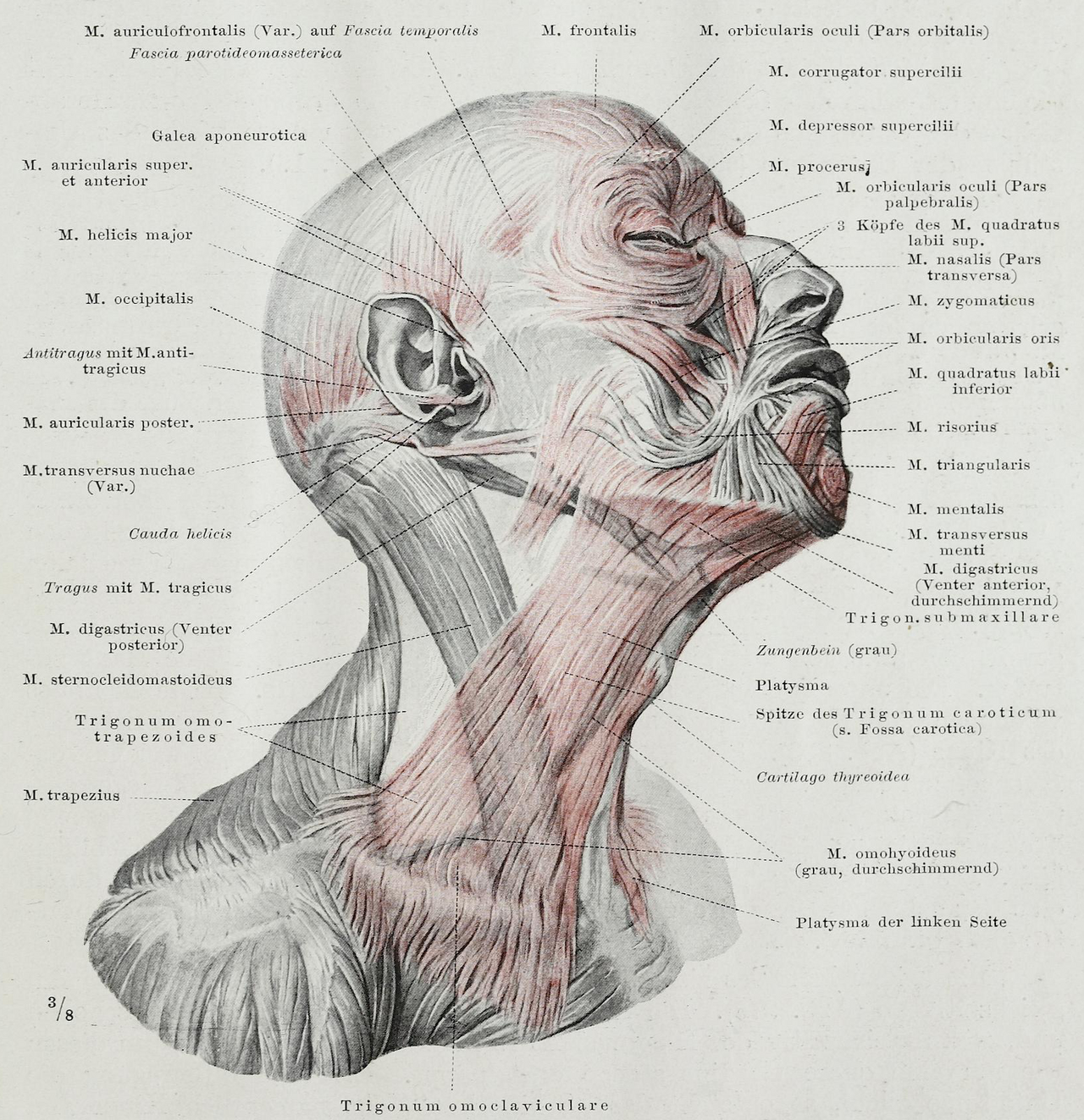
Major external features of a typical human face include hair such as the scalp and facial hair, the forehead, eyebrows and eyelashes, the eyes, the nose, the mouth and associated structures. The cheeks, lips, teeth and the chin sit on a framework of facial bones and are moved by a complex set of muscles. The outer covering of these parts is skin, which varies in texture and pigmentation between individuals and populations.
Senses and feeding
Sensory organs positioned on or near the face include those for sight, housed in the eyes; smell, centered in the nose; and aspects of hearing, where outer ears and ear openings sit laterally. The mouth performs ingestion, articulation for speech in humans, and participates in facial expressions. Together these features allow rapid detection and interaction with the immediate environment.
Development and variation
Faces develop from embryonic tissue that differentiates into bones, muscles, cartilage and skin. Across species and within human populations, faces vary in proportion, hair distribution and soft-tissue contours. Evolutionary pressures—such as diet, climate and social signaling—help explain some of this diversity, while cultural practices modify appearance through grooming, adornment and medical alteration.
Social, clinical and cultural importance
Faces play a central role in recognition, emotion and social exchange. Facial expression is a key channel for conveying feelings, intentionality and attention. Clinically, the face is important in many medical specialties (dentistry, otolaryngology, plastic surgery and dermatology) because it houses vital functions and visible markers of health. Cultural practices attach meaning to features and influence ideals of beauty and identity.
Key facts and distinctions
- The face unites sensory input and motor output near the point of environmental contact.
- Facial muscles allow subtle expressions that support communication across many species, especially humans.
- Variation in skin, hair and bone structure underlies much of individual and population differences.
- Facial features often serve as cues for age, sex and health in social judgments.
For further reading about anatomy and social aspects of the face, see dedicated references on head and sensory systems: Anatomy overview, Head structure, and specific topics such as vision, olfaction, hearing, feeding function and human-specific studies of human faces. Additional entries cover facial hair (hair), the forehead, eyebrows, eyelashes, eyes, nose, cheeks, lips, teeth, skin and the chin.
Questions and answers
Q: Where is the face located on the body?
A: The face is located at the front of the head.
Q: What are some of the organs found on the face?
A: Organs of sight, smell, and hearing are found on the face.
Q: Why is the face particularly important in four-legged animals?
A: The face is important in four-legged animals because it is the part that goes first into the world, and therefore the sense organs and mouth are located there.
Q: What body parts are included in the human face?
A: The human face includes the hair, forehead, eyebrow, eyelash, eyes, nose, ears, cheeks, mouth, lips, teeth, skin, and chin.
Q: What is the function of the hair on the face?
A: The text does not specify a function for hair on the face.
Q: Why is the face important in social interactions?
A: The face is important in social interactions because it is the part of us that others interact with.
Q: What is the importance of the mouth on the face?
A: The mouth is important on the face because it is the location of one of the sense organs and is used for communication and eating.
Related articles
Author
AlegsaOnline.com Face (anatomy, function and social role) Leandro Alegsa
URL: https://en.alegsaonline.com/art/33189