
Integral (calculus): concepts, notation, and applications
An integral is a foundational calculus concept that accumulates quantities — areas, volumes, and totals — and serves as the inverse operation to differentiation with many extensions and applications.
An integral is a central idea in calculus that formalizes the accumulation of quantities. Informally, one often describes a definite integral as the area between a curve and an axis, but the notion is broader: it measures net accumulation of a variable quantity over an interval. Integrals are mathematically linked to the derivative, and together they form the two pillars of continuous change in mathematics. The connection is made precise by the fundamental theorem of calculus, which relates definite integrals to antiderivatives.
Image gallery
6 Images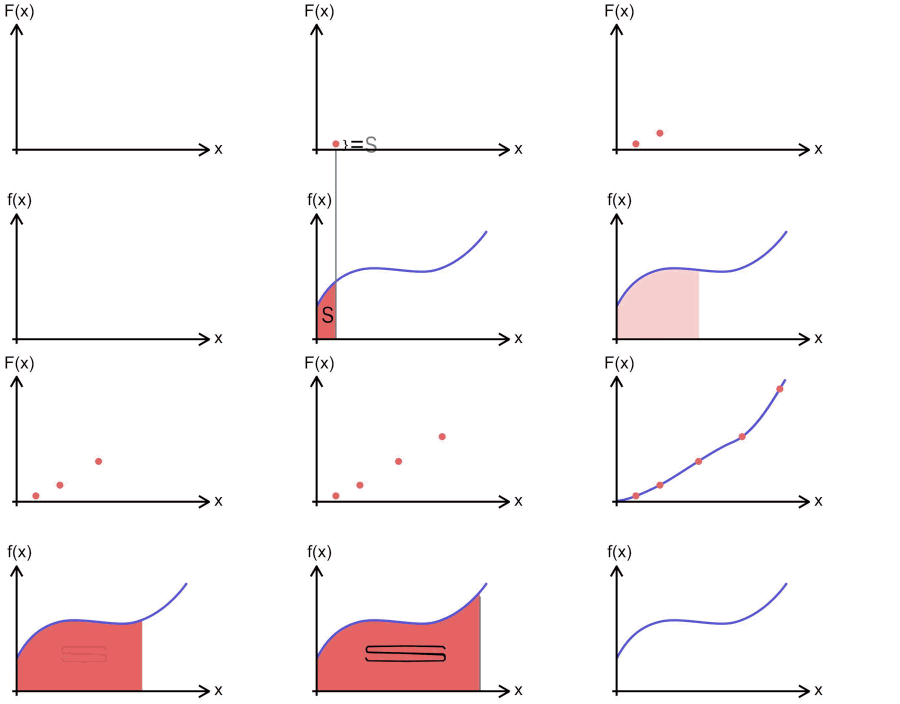


Notation and basic types
The standard symbol for integration is the elongated "S" written as ∫; this integral symbol denotes a limit of sums. Two principal meanings of the word integrity appear in calculus: the definite integral, which assigns a number to a function over a closed interval, and the indefinite integral, which denotes a family of antiderivatives plus an arbitrary constant. A typical definite integral is written ∫_a^b f(x) dx and represents the limit of Riemann sums of slices under a graph. The indefinite integral is written as ∫ f(x) dx and describes all functions whose derivative is f. Integrals may be proper or improper when limits or unbounded behavior are involved.
Riemann sums, limits, and the fundamental theorem
Definite integrals originate from approximating accumulation by adding many small contributions. A Riemann sum partitions an interval, evaluates the function at sample points, multiplies by slice widths and adds the results. Sending the partition width to zero yields the integral. The fundamental theorem of calculus states, in one form, that if F is an antiderivative of f on [a,b], then ∫_a^b f(x) dx = F(b) − F(a). This principle makes definite integrals computable by finding antiderivatives rather than evaluating limits of sums. The operational idea — multiplying a rate of change by a small time to recover a total — appears across physics and engineering.
Basic properties and techniques
- Linearity: ∫(af + bg) = a∫f + b∫g for constants a, b.
- Monotonicity and additivity across adjacent intervals.
- Integration techniques: substitution (change of variables), integration by parts, partial fractions, and trigonometric substitutions help compute antiderivatives.
- Numerical methods such as the trapezoid rule, Simpson's rule, or more sophisticated quadrature approximate integrals that lack elementary antiderivatives.
In practice, integrals play the role of continuous summation: instead of adding discrete terms like 1 + 2 + 3 + ... + n, an integral adds contributions across a continuum, including all intermediate values such as decimals and fractions.
Extensions, distinctions and advanced viewpoints
The basic Riemann integral is not the only formalism. The Lebesgue integral extends the idea to a wider class of functions and rearranges the limiting process to measure sets of values rather than intervals; it is central in modern analysis. Multiple integrals generalize accumulation to higher dimensions (double and triple integrals) and are used to compute volume and mass. Other integral concepts include line integrals and surface integrals in vector calculus, which accumulate quantities along curves or surfaces rather than over intervals or regions. The adjective "integral" can also mean "relating to integers" in number theory; this is a distinct usage from the calculus concept and should not be confused with the operation of integration (integral (adjective)).
Applications and examples
Integrals are widely used to compute areas beneath curves, surface areas, volumes of solids of revolution (using disk, washer, or shell methods), and physical quantities: displacement from a velocity function, work from a force applied over a distance, and total charge from a charge density. In probability, expected values and cumulative distribution functions are expressed by integrals. For instance, to find the displacement when velocity v(t) is known, one computes ∫_{t1}^{t2} v(t) dt, effectively multiplying a rate by an interval to recover a net change. This conversion — from rate to total — exemplifies the core utility of integration across sciences and engineering.
History and notable facts
The calculus of integration developed in the late 17th century through the independent work of Isaac Newton and Gottfried Wilhelm Leibniz. Leibniz introduced the integral symbol ∫ as an elongated letter "S" for summation; Newton developed fluxions and fluents, an alternative notation and approach. Over subsequent centuries the concept was made rigorous via limits and later expanded by measure theory. Today, integrals remain indispensable in analysis, applied mathematics, physics and statistics, and they continue to be generalized in many directions, from abstract measure spaces to differential forms used in geometry.
For further reading on practical techniques, formal definitions, and historical context see resources on equation representations, visualizations of two-dimensional regions, computational guides to the differential calculus connections, and online expositions of the volume methods. Additional materials cover rigorous constructions of integrals, comparisons between Riemann and Lebesgue approaches, and the role of integrals in modern mathematics. Other topical entries explore the symbol and notation history (integral symbol), proofs of the fundamental theorem of calculus, and applied examples that illustrate the idea of accumulation and rate of change in real-world problems.
Questions and answers
Q: What is an integral?
A: An integral is the space under a graph of an equation, also known as "the area under a curve". It is the reverse of a derivative and part of a branch of mathematics called calculus.
Q: What does the symbol for integration look like?
A: The symbol for integration in calculus looks like a tall letter "S": ∫ {\displaystyle \textstyle \int _{\,}^{\,}}.
Q: How are integrals related to derivatives?
A: Integrals and derivatives are linked by the fundamental theorem of calculus which states that an integral can be reversed by a derivative, similar to how an addition can be reversed by subtraction.
Q: When might one use integration?
A: Integration can be used when trying to multiply units into a problem or when finding the volume of a solid. It helps add two-dimensional slices together until there is width, giving the object three dimensions and its volume.
Q: How is integration similar to summation?
A: Integration is similar to summation in that it adds many tiny things together but with integration we have to add all decimals and fractions in between as well.
Q: What does Riemann sum mean?
A: A Riemann sum refers to adding small slices of the rate graph together until they add up to make up one whole equation.
Related articles
Author
AlegsaOnline.com Integral (calculus): concepts, notation, and applications Leandro Alegsa
URL: https://en.alegsaonline.com/art/47531