
Elbow: anatomy, function, development and clinical significance
The elbow is the hinge region joining the upper arm and forearm, enabling flexion, extension and rotation. This article covers its bones, ligaments, muscles, movements, evolution and common clinical problems.
Overview
The elbow is the joint complex that connects the upper arm to the lower arm and allows the hand to be positioned in space. It is formed where the bones of the arm meet: the humerus of the upper arm and the two forearm bones, the radius and the ulna. More generally it is part of the limbs' bone system that transmits forces between shoulder and hand. In everyday language people often refer simply to the elbow as the bending point of the arm; medically it comprises several articulations working together.
Image gallery
10 Images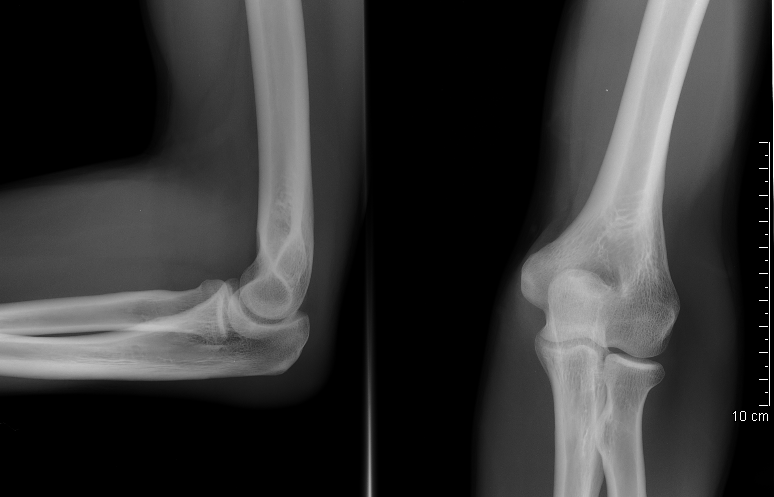




Structure and components
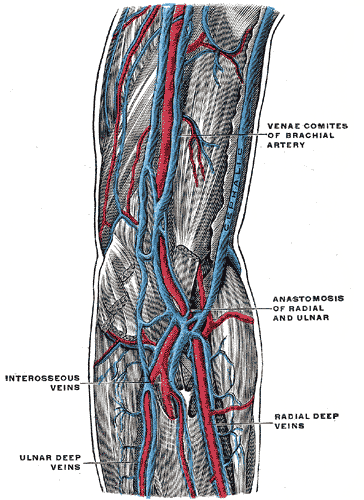
The elbow includes three adjacent joints: the humeroulnar and humeroradial joints (which mainly permit bending and straightening) and the proximal radioulnar joint (which allows rotation of the forearm). Key elements are:
- Bones: humerus, radius, ulna and their articular surfaces.
- Ligaments and capsule: the joint capsule and stabilizing bands such as the ulnar collateral and radial collateral ligaments and the annular ligament that encircles the head of the radius — collectively described by anatomy texts and clinical sources as the primary soft-tissue stabilizers (ligaments).
- Muscles and tendons: flexors (biceps brachii, brachialis), extensors (triceps brachii) and muscles that rotate the forearm (pronator teres, supinator).
Movement and mechanics
The elbow acts mainly as a hinge, producing flexion (bending) and extension (straightening). Rotation of the forearm — pronation and supination — occurs at the proximal radioulnar joint and permits the palm to face down or up. Typical human motion spans from full extension to substantial flexion, enabling precise hand placement for manipulation, lifting and many daily tasks. The joint also has a small built-in carrying angle that affects how the forearm hangs when the arm is extended.
Development and evolutionary context
During embryonic growth the elbow joints form from precursor cartilage that ossifies into the three bones, with ligaments and muscles maturing to provide stability and control. From an evolutionary perspective the elbow is a conserved hinge in tetrapods, adapted in various species for digging, climbing, running or manipulating objects. Comparative anatomy highlights differences in mobility and robustness depending on locomotor and behavioral needs of an animal.
Clinical importance and common conditions
The elbow is susceptible to injuries and overuse disorders. Fractures around the distal humerus or the proximal radius/ulna, dislocations, tendon inflammation (epicondylitis, often called tennis or golfer's elbow), bursitis and nerve compression (cubital tunnel syndrome affecting the ulnar nerve) are commonly managed in primary care and orthopedics. Treatment ranges from rest, splints and rehabilitation to surgical repair in more severe cases. Proper ergonomics and conditioning reduce risk in sport and work.
Notable facts and distinctions
Each person has two elbows, one on either arm, and their function is central to virtually all activities that use the hands. In medicine and biomechanics the elbow is studied both for its simple hinge-like action and its more complex interplay with forearm rotation. Prosthetic and reconstructive advances continue to improve outcomes after trauma or arthritis, and rehabilitation focuses on restoring both strength and the fine control needed for daily tasks involving the forearm and hand.
For diagrams, clinical guidelines and further reading see anatomy references and specialty resources (bones overview, humerus, radius, ulna, ligaments, forearm).
Author
AlegsaOnline.com Elbow: anatomy, function, development and clinical significance Leandro Alegsa
URL: https://en.alegsaonline.com/art/30624