
Limestone: composition, formation, varieties, and uses
Limestone is a common sedimentary rock composed mainly of calcium carbonate (calcite). It forms from biological activity and chemical precipitation and is important as a building material, soil amendment, and industrial resource.
Overview
Limestone is a widespread sedimentary rock composed largely of calcium carbonate. Its dominant mineral is calcite, a crystalline form of CaCO3 often written as calcium carbonate (CaCO3). Many limestones also contain substantial amounts of shell fragments, organic debris and secondary mineral cement. In classification and field guides it is commonly described simply as a sedimentary rock made up of carbonate material.
Image gallery
10 Images


Characteristics and common types
Limestones vary in texture, color and grain size. Some are fine‑grained and uniform while others are coarse and composed of easily seen fossils or shell fragments. Typical named varieties include chalk (soft, porous), coquina (made of shell fragments), fossiliferous limestone (rich in recognizable fossils) and crystalline varieties produced by recrystallization. Chemical terms used by geologists such as micrite and sparite describe the matrix and cement textures found in many deposits.
How limestone forms
Much limestone begins as accumulated carbonate produced by living organisms — marine plankton, corals, mollusks and algae — whose shells and skeletons are comprised of calcium carbonate. Some carbonate also precipitates directly from sea water. Over time, burial and diagenetic processes compact and cement these sediments into rock. The rock record preserves limestones that formed in shallow, warm marine environments as well as deposits associated with reefs and lagoons.
Varieties and notable features
- Chalk: very fine, white and porous, often formed from microscopic plankton.
- Coquina: loosely cemented shell fragments.
- Fossiliferous limestone: contains visible remains of organisms.
- Recrystallized limestone and marble: limestone altered by heat or pressure can develop coarser crystals.
Uses and practical importance
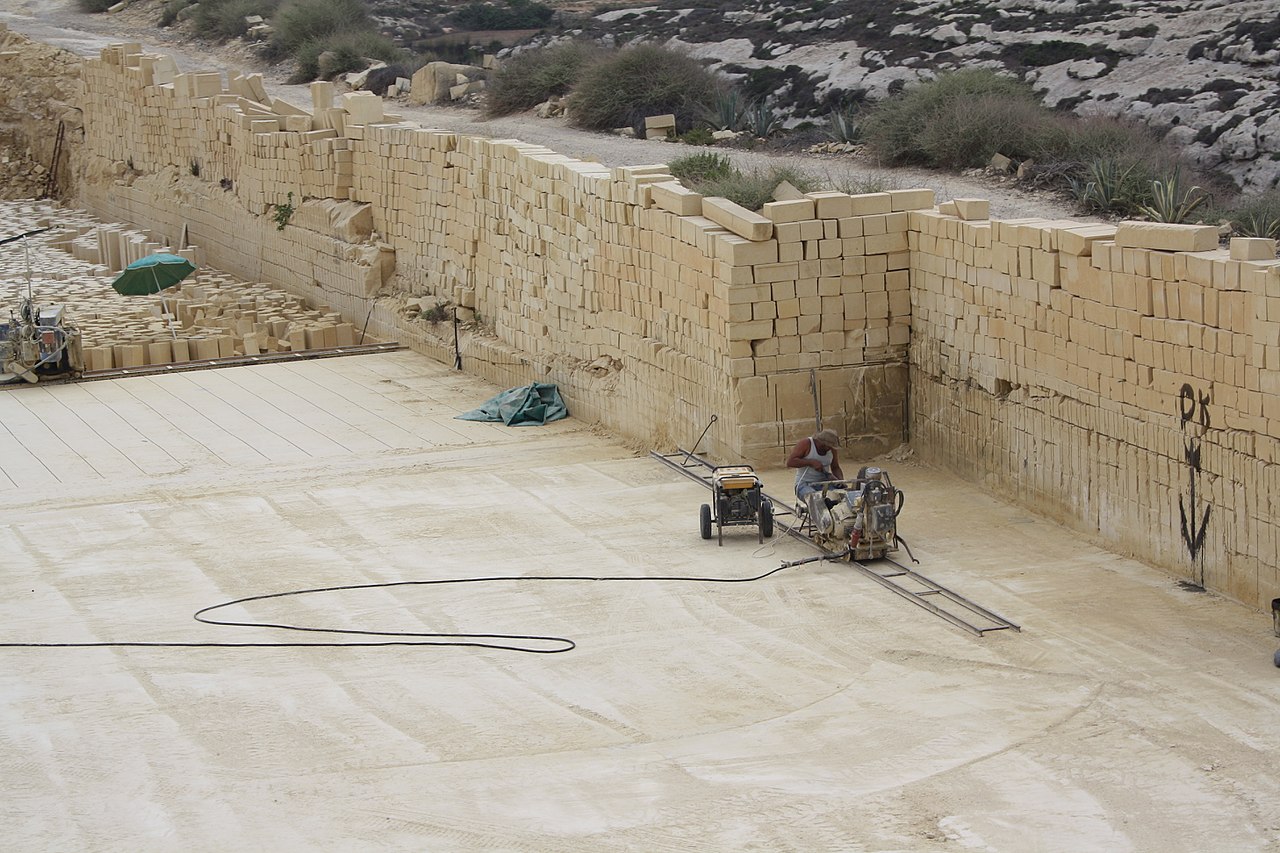
Limestone is a versatile resource. Crushed stone serves as construction aggregate and road base; dimension stone is used for building facades and monuments; and limestone is an essential raw material in producing lime and cement. Ground limestone is applied to neutralize acidic soils in agriculture and to treat industrial effluents. Small quantities are used in glassmaking, metallurgy and chemical processes.
Distinctions, hazards and environmental notes
One characteristic chemical behavior of limestone is its reactivity with weak acids, which causes dissolution and leads to karst landscapes with caves, sinkholes and springs. Speleothems such as stalactites and stalagmites grow from drip waters carrying dissolved carbonate. Quarrying and cement production have local environmental impacts, including habitat loss, dust and CO2 emissions associated with lime manufacture. Geologists note that carbonate rocks account for a significant fraction of the sedimentary rock record and that carbonate platforms and reefs have played a major role in Earth history; some limestones represent nearly pure biological accumulation while others reflect chemical precipitation and later alteration (precipitated carbonate).
For introductory technical descriptions and field identification, see resources on sedimentary rocks and carbonate minerals such as calcite identification guides and regional geologic surveys (regional sedimentary rock guides). These sources outline common tests, textures and depositional settings used to distinguish limestone from other rock types.
Questions and answers
Q: What is limestone?
A: Limestone is a type of sedimentary rock made up mostly of the mineral calcite, which is a form of calcium carbonate.
Q: How is calcium carbonate produced in limestone?
A: Calcium carbonate in limestone is originally produced by living organisms.
Q: What happens to some of the calcium carbonate in limestone?
A: Some of the calcium carbonate in limestone goes into solution in sea water.
Q: What are the main components of limestone rocks?
A: Limestone rocks mainly include organic remains and precipitated carbonate.
Q: What percentage of all sedimentary rocks is limestone?
A: Limestone is about 10% of the total volume of all sedimentary rocks.
Q: What is calcite?
A: Calcite is a mineral that makes up the majority of limestone.
Q: What is the chemical formula for calcium carbonate?
A: The chemical formula for calcium carbonate is CaCO3.
Related articles
Author
AlegsaOnline.com Limestone: composition, formation, varieties, and uses Leandro Alegsa
URL: https://en.alegsaonline.com/art/58084
Sources
- watersheds.org : "Limestone"
- mine-engineer.com : "Calcite" · webcitation.org
- encarta.msn.com : encarta.msn.com/encyclopedia_761565838/Limestone_(mineral).html
- soton.ac.uk : Soton.ac.uk
- commons.wikimedia.org : Limestone