
Glenn T. Seaborg: Nobel Laureate and Architect of the Modern Actinide Concept
Biography of Glenn T. Seaborg, his discoveries of transuranium elements, the actinide concept, work on isotopes and nuclear chemistry, and his scientific and institutional legacy.
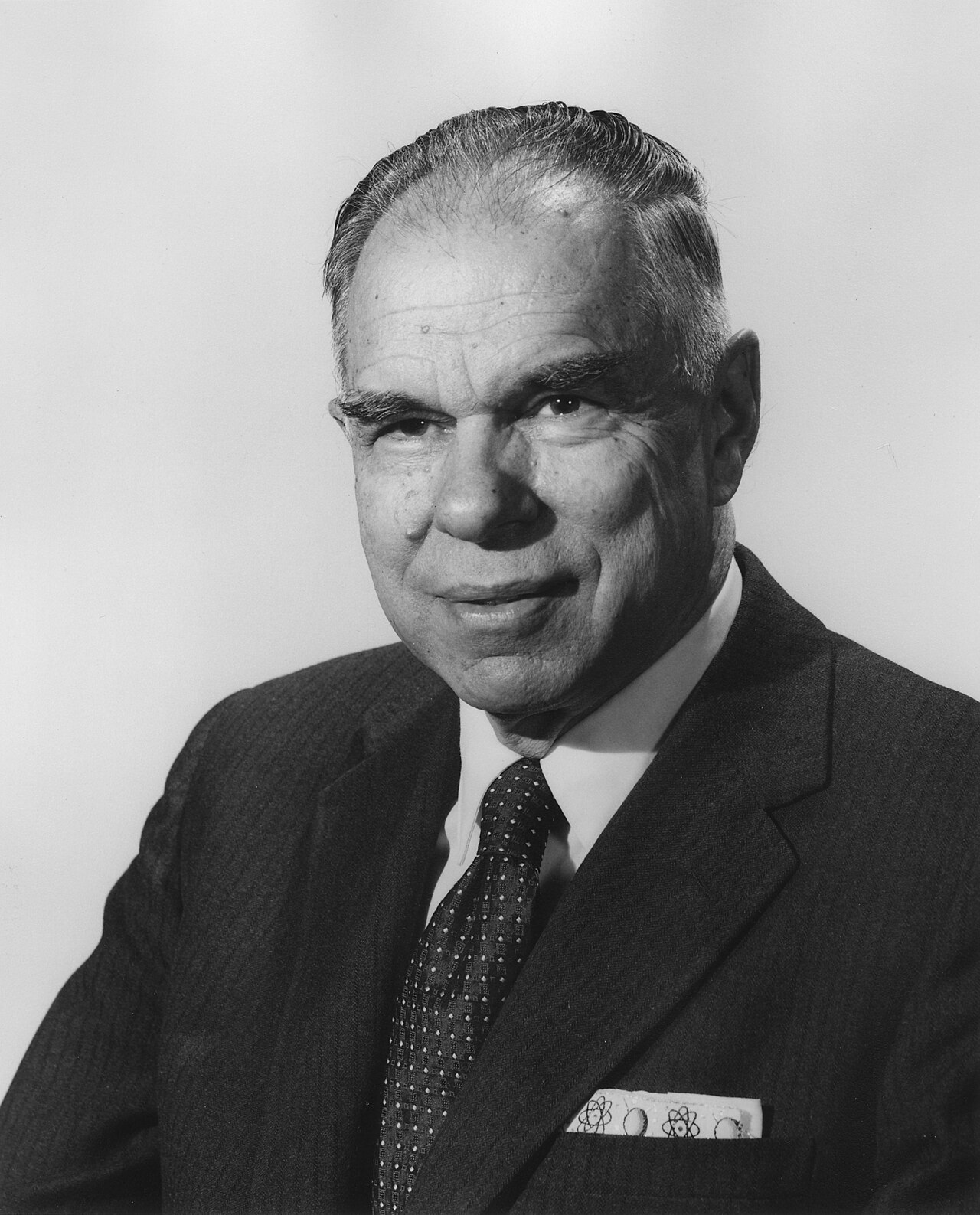
Glenn Theodore Seaborg (April 19, 1912 – February 25, 1999) was an American chemist and educator whose research transformed the understanding of heavy elements. Born in Ishpeming, Michigan, he combined experimental skill and theoretical insight to map a large portion of the periodic table and to shepherd nuclear science into practical applications. His long career brought public service, laboratory leadership and international recognition, including the 1951 Nobel Prize in Chemistry he shared with Edwin M. McMillan.
Image gallery
8 Images


Scientific contributions and discoveries
Seaborg was a central figure in mid-20th century nuclear chemistry. During World War II he worked on the Manhattan Project and studied the chemistry of newly produced elements such as plutonium. He and his teams at the University of California and the Lawrence Berkeley Laboratory co-discovered a string of transuranium elements and produced dozens of radioisotopes used in research and medicine. Early in his career he helped establish the medical use of isotopes such as iodine-131, which became important for diagnosing and treating thyroid disease. He also served as a professor at UC Berkeley and as a laboratory leader whose mentoring influenced generations of chemists (academic roles).
Actinide concept and the periodic table
One of Seaborg's most enduring theoretical achievements is the actinide concept, a reorganization of the periodic table that places the actinide series beneath the lanthanides. This proposal clarified the placement and chemical behavior of heavy, f-orbital elements and guided the search for new members of the series. The framework also underpins proposals for extending the table into the transactinide and proposed superactinide regions. New elements produced in his laboratories were given systematic study so that chemists could compare their properties with lighter analogues such as berkelium, californium, einsteinium and fermium.
Elements credited to Seaborg's group
- Plutonium
- Americium
- Curium
- Berkelium
- Californium
- Einsteinium
- Fermium
- Mendelevium
- Nobelium
- Seaborgium (element 106)
The list above reflects elements for which he was principal or co-discoverer; many of these discoveries involved collaboration with physicists and cyclotron teams who provided the necessary particles and detection methods. His laboratory also developed over a hundred isotopes that became valuable in both basic research and applied fields.
Transmutation experiments and public service
Seaborg remained active as an experimentalist into later decades. In a notable demonstration at the Lawrence Berkeley Laboratory he and colleagues used particle bombardment to convert minute amounts of bismuth into atoms of gold; the process illustrated nuclear transmutation but was not practical for production due to its cost and scale. The work depended on careful experimental procedures and an understanding of nuclear physics, including how to remove or alter protons and neutrons in a nucleus. Seaborg sometimes noted the analogy to the legendary Philosopher's Stone while stressing the technical limits of such transformations.
Beyond the laboratory, Seaborg served in government and policy roles. He was chairman of the Atomic Energy Commission, advised presidents and participated in national and international forums on nuclear science and arms control. His leadership combined scientific authority with an ability to communicate complex topics to policymakers and the public (technique in outreach).
Seaborg's legacy is both practical and conceptual: practical in the isotopes and elements his teams produced and conceptual in the way chemists now visualize the heaviest portions of the periodic table. His work bridged pure and applied chemistry, influenced nuclear medicine, and left an institutional imprint through mentorship, publications and the institutions he guided.
Further reading and archival materials are available for those who wish to explore his laboratory notebooks, oral histories and the scientific papers that document the era of discovery he helped lead (biographical sources, wartime history, element studies, nomenclature debates, collaborative projects, isotope applications, heavy element chemistry, laboratory reports, naming citations, career summaries, periodic table context).
For concise summaries and selected primary sources see technical reviews, university archives, and dedicated collections of papers and memorabilia (campus holdings, project histories, element profiles, nuclear data, particle techniques, medical isotope references, economic notes, cultural perspectives, policy records, transmutation experiments).
Related articles
Author
AlegsaOnline.com Glenn T. Seaborg: Nobel Laureate and Architect of the Modern Actinide Concept Leandro Alegsa
URL: https://en.alegsaonline.com/art/39185
Sources
- nobelprize.org : "Glenn T. Seaborg - Biography"
- www-cms.llnl.gov : Seaborg Institute website. Retrieved November 9, 2006.