
Planetarium: domes, projection systems, uses and terminology
A planetarium is a theater or device that recreates the night sky for education, training and entertainment. This article covers domes, projection technologies, sizes, uses, history and related terms.
Overview
A planetarium is a venue or instrument designed to present simulated views of the heavens for instruction and entertainment. Typical programs include guided tours of constellations, demonstrations of planetary motion, explanations of astronomical phenomena and immersive shows that combine narration, music and visual effects. Institutions use planetaria to teach educational material and to stage entertaining presentations; the events themselves are often called presentations and draw on the science of astronomy.
Image gallery
10 Images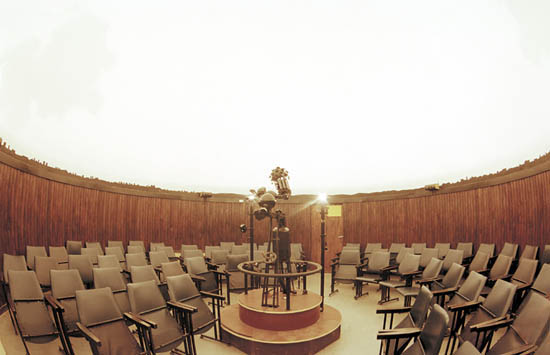


Main components and technologies
The defining architectural element is the large dome-shaped screen on which images of the sky are projected. Early and some continuing systems use mechanical “star balls” that combine precision optics and electromechanical components to depict the fixed stars and to simulate the apparent daily and annual motions of the sky. Modern installations commonly mix several technologies to achieve high fidelity and creative effects. These include traditional optical–mechanical projectors and more recent digital systems and are often combined into hybrid configurations that leverage the strengths of both.
- Optical–mechanical projectors, often called star projectors, render accurate star fields and are valued for photometric fidelity; they use lenses, internal lamps and precision masks to represent stellar brightness and positions (optical systems).
- Slide and still-image projectors are used to display high-resolution photographs or illustrations on sections of the dome (slide projector examples).
- Full-dome digital video systems use multiple projectors and software stitching to cover the entire dome with moving imagery; these systems enable immersive movies and real-time simulations (video and full-dome displays).
- Laser systems and synchronized lighting enhance shows with color effects and animations (lasers and lighting rigs).
Projection approaches and software
Projection control is typically handled by specialized computers running planetarium software. That software calculates celestial positions for any chosen date and time and for different observing locations, allowing the display to show the sky from a given latitude or to illustrate historical or future configurations of the heavens. Many control suites provide a two-dimensional user interface while producing convincing three dimensional impressions on the dome. The same term, planetarium software, also applies to desktop or mobile applications that simulate the sky on a conventional screen.
Capabilities and uses
Planetarium systems can reproduce the night sky as seen from a wide range of points on Earth, at different latitudes, and for any calendar date and time. They are used for public education, curriculum-aligned school visits, outreach programs, specialist training such as celestial navigation, research visualization and for public events tied to astronomical occurrences (eclipses, planetary alignments, comet appearances). Some installations also support live demonstrations, documentary-style full-dome films and planetarium-hosted planet-watching sessions.
Sizes, formats and portability
Planetaria vary widely in scale and format. Large, permanent domes in major museums and science centers may be many meters in diameter and seat hundreds of visitors, while smaller community or school planetaria have modest domes and fixed seating. Portable or inflatable domes are compact enough to take into classrooms or gymnasiums and are used in outreach and temporary exhibitions. These mobile setups allow educators to bring dome experiences to audiences who cannot visit permanent venues and to collaborate with institutions such as museums and science centers.
Construction, materials and accessibility
Dome surfaces are typically made from plaster, composite panels, aluminum or stretched fabric designed to provide a smooth projection surface with controlled reflectivity. Seating is arranged so audiences can recline slightly and view a large portion of the dome without neck strain; designs account for sightlines, acoustic treatment and accessibility. Modern installations also consider lighting, HVAC and emergency egress to meet safety codes for public assemblies.
Maintenance, calibration and staffing
Projection systems require routine maintenance, lamp replacement, optical alignment and digital calibration to ensure accurate star positions and color balance. Full-dome systems must be geometrically aligned and color-matched when multiple projectors are used. Planetarium staff—often called planetarians—manage programming, public events, pedagogy and the technical operation of the facility. The role of the planetarian may combine educator, presenter and technician responsibilities.
History and related devices
The lineage of planetaria includes centuries-old mechanical models such as orreries that demonstrate planetary motion and earlier apparatus built to illustrate cosmological ideas. Modern planetaria developed in the 20th century as optical and projection technologies advanced and as museums and academic institutions invested in public science facilities. The term “planetarium” is sometimes applied broadly to software simulations or to physical demonstration devices like an orrery. A related distinction is between a building dedicated to dome projection and other educational tools that represent the solar system.
Notes on terminology and plural forms
Writers use both planetariums and planetaria as plural forms. The word can refer to the theatre, to the projection equipment, to dedicated software or, informally, to devices that recreate the solar system. For technical references on dome imaging, projection vendors and research groups publish materials on imaging geometry, dome-filling techniques and immersive content production; many institutions post program guides and educational resources online (educational portals and technology pages).
Further reading and resources
Those seeking more detail can consult specialist literature on optical–mechanical projection, digital fulldome production, outreach program design and the history of public astronomy facilities. Institutional pages often list schedules, show descriptions and outreach opportunities. For practical demonstrations and software tools, hobbyist and professional communities share resources and tutorials (dome design, star catalogs, planet models, projection technologies, presentation media, video workflows, laser safety, astronomy basics, entertainment programming, science center partnerships).
Historically notable public planetaria and modern science centers host permanent domes of varying diameters; some famous institutions are also home to outreach programs that circulate smaller domes for schools and community groups. Technical, educational and outreach aspects together define the planetarium as a flexible tool for communicating the scale and motions of the cosmos to diverse audiences worldwide.
Related articles
Author
AlegsaOnline.com Planetarium: domes, projection systems, uses and terminology Leandro Alegsa
URL: https://en.alegsaonline.com/art/77257