
Pleiades (M45): the Seven Sisters open star cluster
The Pleiades (M45) are a nearby open star cluster in Taurus, dominated by hot blue stars. Visible to the naked eye worldwide, they are roughly 100 million years old and important in astronomy and many cultures.
Overview
The Pleiades, commonly called the Seven Sisters and cataloged as M45, are a bright open cluster found in the constellation Taurus. The cluster is dominated by hot B-type stars and is one of the closest such groups to Earth. On clear nights the cluster is easily seen without optical aid and has been recorded in astronomy and folklore since antiquity. Charles Messier included it in his catalog as M45.
Image gallery
10 Images






Structure and principal members
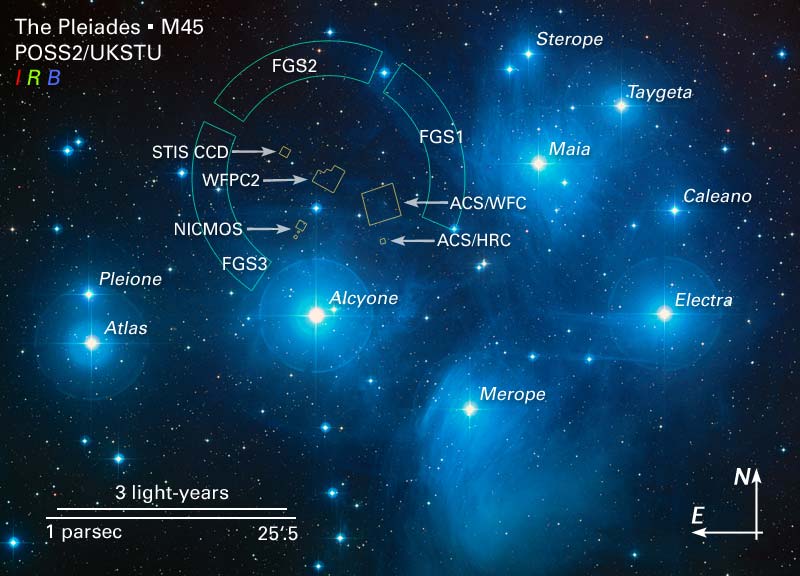
The Pleiades contains hundreds to a few thousand stars bound loosely by gravity; the number depends on how faint a member is counted. The most conspicuous members are bright blue-white stars traditionally named after the mythological sisters. Prominent examples include:
- Alcyone — the brightest star in the cluster
- Atlas and Pleione — a visual pair associated with the cluster's origin myth
- Electra, Maia, Taygete, Celaeno, Merope — other well-known members
The cluster is surrounded by a faint reflection nebula caused by interstellar dust scattering the starlight; this nebulosity was once thought to be leftover material from the stars' formation but is now considered mostly a swept-up cloud the group is passing through.
Age, distance and appearance
Modern parallax measurements place the Pleiades at roughly 440 light-years (about 135 parsecs) from the Sun. Stellar properties and theoretical models indicate an age near 100 million years, which explains the presence of hot, relatively young B-type stars. The cluster appears compact to the naked eye with several bright points, and through binoculars or a small telescope dozens more stars become visible.
History, cultural importance and astronomy
The Pleiades have strong cultural resonance across the world: in Greek myth they are the Seven Sisters, in Japan the group is called Subaru (a name adopted by an automobile maker and its logo), and in Māori tradition the cluster is Matariki, marking a new year. Other cultures, from Native American to ancient Near Eastern, also attached calendars and navigation roles to the cluster.
Astronomically, the Pleiades serve as a nearby laboratory for studying stellar evolution, dynamics of open clusters, and the interaction of young stars with dust. Surveys and space missions continue to refine the cluster's member list and distances; historical debates about parallax measurements led to improved techniques used in missions such as those referenced by modern astrometric studies.
Related articles
Author
AlegsaOnline.com Pleiades (M45): the Seven Sisters open star cluster Leandro Alegsa
URL: https://en.alegsaonline.com/art/77447