
Computer Software: Types, History, and Development
An accessible overview of computer software: what it is, main categories (system, application, firmware), historical development, common uses, development models and key distinctions from hardware.
Overview
Computer software is the collection of programs, instructions and associated documentation that directs a computer or electronic device to perform tasks. Software is distinct from the physical components of a machine and typically exists as source code written by developers, compiled binaries executed by processors, and user-level documentation. Everyday examples include applications such as a word processor and larger frameworks such as an operating system. Common consumer operating systems include Mac OS, Microsoft Windows, Android and many Linux distributions.
Image gallery
7 Images




Types and characteristics
Software is often grouped by role and scope. System software provides the basic functions that allow hardware and higher-level programs to interact; examples are kernels, device drivers and operating systems. Application software performs specific user-oriented tasks such as office productivity, media playback, or games. Middleware connects separate components or services. Firmware is specialized software embedded on hardware devices to control low-level functions; it is frequently stored on non-volatile storage such as Flash memory and can be found in devices like a modem. Key properties of software include immateriality, changeability (it can be updated), and conformity (it must correctly match logical specifications and hardware interfaces).
History and storage
The distinction between software and hardware became widely used in the mid-20th century to emphasize that program logic was separate from physical machines. Early software distribution and storage used physical media and mechanical methods: programs were recorded on paper punch cards, magnetic tapes and magnetic discs. Later formats included optical media such as compact discs (CDs). The rise of networking and the Internet shifted most delivery and updates to networked distribution, while fundamental concerns about reliable data storage and compatibility remain central to software practice.
Development and lifecycle
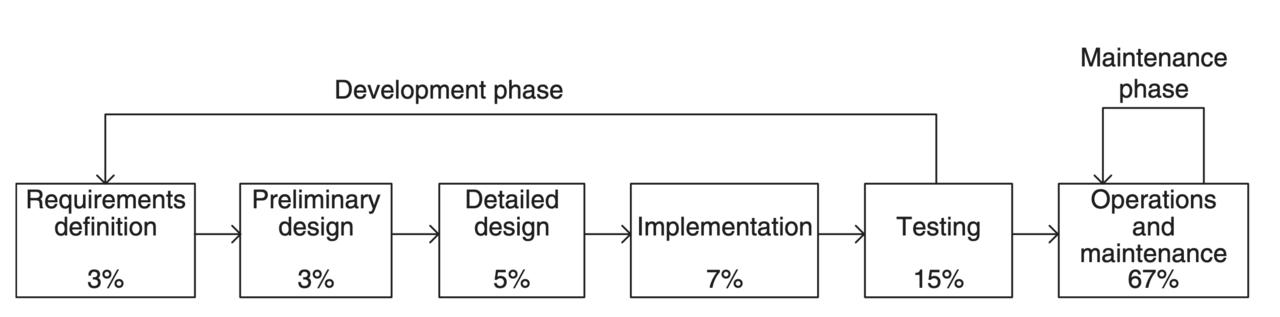
Creating software is an organized engineering activity: teams gather requirements, design architectures, write code, test systems, deploy releases and maintain software through updates and fixes. Several process models guide this work: the simple Build-and-Fix approach, the sequential Waterfall model, and iterative frameworks such as Agile and DevOps that emphasize frequent feedback and delivery. Quality assurance, automated testing and configuration management are routine elements intended to reduce defects; however, complexity makes complete elimination of faults difficult, so maintenance and upgrades are ongoing activities.
Uses, examples and importance
Software underpins almost every modern task: it runs smartphones, controls industrial equipment, supports healthcare systems, enables scientific simulation, and drives financial transactions. Because software mediates human interaction with machines, it also raises practical concerns such as security, privacy, accessibility and long-term preservation. Industries rely on both custom-built software and commercial off-the-shelf products; many organizations combine proprietary components with open-source libraries to balance cost, control and community support.
Distinctions and notable facts
Software differs from hardware in that it is intangible and more readily changed, but it often depends on specific hardware interfaces to function. The term firmware sits between software and hardware, since it is software tightly coupled to a device's electronics. Licensing and distribution vary: some software is open source and freely modifiable, while other software is proprietary and licensed under commercial terms. Educational pathways and professional roles include programming, systems design, testing and maintenance, and many practitioners describe software engineering as a discipline that balances technical skill with systematic process. For further reading about specific software categories and tools, see resources on applications, operating systems and device-level firmware.
- Examples of application types: productivity suites, web browsers, media players, and games (word processing, spreadsheets, etc.).
- Popular consumer operating systems: Mac OS, Windows, Android, and Linux variants.
- Historic storage media and methods: punch cards, magnetic tape, magnetic disk, and CDs; modern distribution often uses the Internet and networked repositories.
- Hardware interplay: software instructs hardware components and may be embedded on Flash or ROM; device controllers such as a modem rely on embedded firmware.
The study and practice of software continues to evolve as devices, networks and user expectations change. Despite its intangibility, software has measurable effects on productivity, safety and culture, making clear design, testing and governance essential parts of modern technology development.
Questions and answers
Q: What is computer software?
A: Computer software is a set of instructions and documentation that tells a computer what to do or how to perform a task. It includes all different programs on a computer, such as applications and the operating system.
Q: What are applications?
A: Applications are programs that are designed to perform a specific operation, such as a game or a word processor.
Q: What is an operating system?
A: An operating system (e.g. Mac OS, Microsoft Windows, Android and various Linux distributions) is a type of software that is used as a platform for running the applications, and controls all user interface tools including display and the keyboard.
Q: How was software used before CDs or the Internet age?
A: Before compact discs (CDs) or development of the Internet age, software was used on various computer data storage media tools like paper punch cards, magnetic discs or magnetic tapes.
Q: What does firmware refer to?
A: The word firmware is sometimes used to describe a style of software that is made specifically for a particular type of computer or an electronic device and is usually stored on Flash memory or ROM chip in the computer. Firmware usually refers to piece of software that directly controls hardware.
Q: How has software become important in our lives today?
A: Today, software has become an important part of our lives; it's used everywhere and responsible for producing fault-free software which has literally become an essential part of our daily lives.
Q: What are some processing models for designing software?
A: Some processing models for designing software include Build and Fix, Waterfall and Agile Software Processing Design Methods
Related articles
Author
AlegsaOnline.com Computer Software: Types, History, and Development Leandro Alegsa
URL: https://en.alegsaonline.com/art/91587