
Latitude (geographic coordinate)
Latitude measures how far north or south a point lies from the Equator in degrees. Used with longitude to fix positions, it influences climate, daylight, navigation and map projection.
Latitude is the angular distance of a location on the surface of the Earth north or south of the equator. It is measured in degrees (°), normally represented by the Greek letter phi (ϕ). Values range from 0° at the equator to 90° at the poles and are qualified as north or south latitude. In practice latitude is quoted in degrees, minutes and seconds or as decimal degrees and is paired with longitude to form geographic coordinates.
Image gallery
4 Images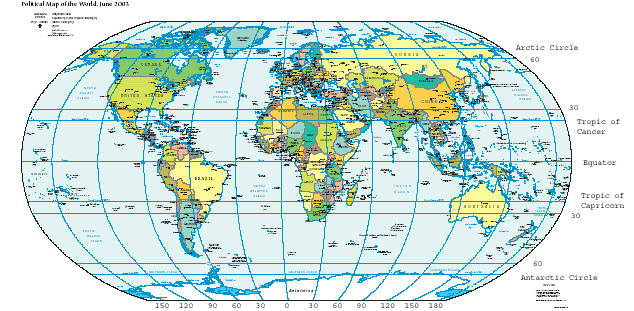


Characteristics and measurement
Lines of constant latitude, called parallels, are circles that run east–west. Except for the equator, parallels are not great circles because they lie on planes that do not pass through the Earth's center. Latitude can be measured astronomically (by the angle of celestial bodies above the horizon), by surveying, or by modern satellite systems. On an oblate spheroid like the Earth there is a technical distinction between geodetic and geocentric latitude: the two definitions differ slightly because of the planet's equatorial bulge.
Important parallels
- Antarctic Circle and Arctic Circle: near the poles, marking regions of at least one day of midnight sun and one day of polar night each year.
- Tropic of Cancer and Tropic of Capricorn: the northern and southern limits (about 23.5°) of the Sun's direct overhead position at the solstices.
History and development
The concept of measuring north–south position is ancient. Early navigators and astronomers used stellar observations to estimate latitude. Greek and later Islamic scholars refined methods for calculating angles of the Sun and stars; these techniques evolved into sextant and astrolabe navigation. The arrival of chronometers and accurate marine instruments improved position fixing, and today's satellite systems give latitude with high precision.
Uses and significance
Latitude is central to mapping, navigation, meteorology and ecology. It helps determine climate zones, typical temperatures, and seasonal daylight patterns: generally, solar angle and day length vary more with latitude than with longitude. Map projections and global datasets often treat latitude specially because scale and distortion change toward the poles. Practical applications include charting courses at sea, locating sites with GPS, and defining legal or administrative boundaries tied to parallels.
Because latitude is a simple angular measure, it remains one of the fundamental descriptors of geographic position and a starting point for understanding how location affects weather, daylight and human activity across the planet.
Related articles
Author
AlegsaOnline.com Latitude (geographic coordinate) Leandro Alegsa
URL: https://en.alegsaonline.com/art/56225
Sources
- satsig.net : "Explanation of Latitude and Longitude"
- nationalgeographic.org : "latitude"