
Colony of Virginia (Virginia Colony)
The Colony of Virginia was the first permanent English colony in North America, founded at Jamestown in 1607. It became a royal colony in 1624 and shaped early American government, economy and territorial claims.
Overview
The Colony of Virginia, often called the Virginia Colony, was the earliest enduring English settlement in what later became the United States. After unsuccessful early attempts on the Atlantic coast, the Virginia Company of London established Jamestown in 1607. Over the 17th and early 18th centuries Virginia evolved from a private corporate venture into a royal possession and then a province of the Kingdom of Great Britain after 1707.
Image gallery
10 Images


Settlement, government and institutions
Jamestown began as a small, vulnerable outpost but became the model for English colonial institutions. In 1619 the colony convened the House of Burgesses, one of the first representative assemblies in English America, and that year also saw the arrival of the first recorded Africans in English North America. The Virginia Company�s early policies — including headrights and land grants designed to attract settlers — helped shape social structure and patterns of landholding. Following difficulties and changing royal priorities, the company's charter was revoked in 1624 and Virginia became a crown colony under direct royal administration.
Economy, society and conflict
Tobacco cultivation proved the colony's most important economic foundation. A strain of cash tobacco exported to Europe generated wealth and encouraged plantation agriculture, which increasingly relied on indentured labor and, over time, enslaved Africans. Relations with Indigenous peoples were central and often fraught: early diplomacy with the Powhatan Confederacy alternated with violent conflict, and events such as Bacon's Rebellion in 1676 exposed deep tensions over land, governance and frontier security.
Territorial claims and legacy
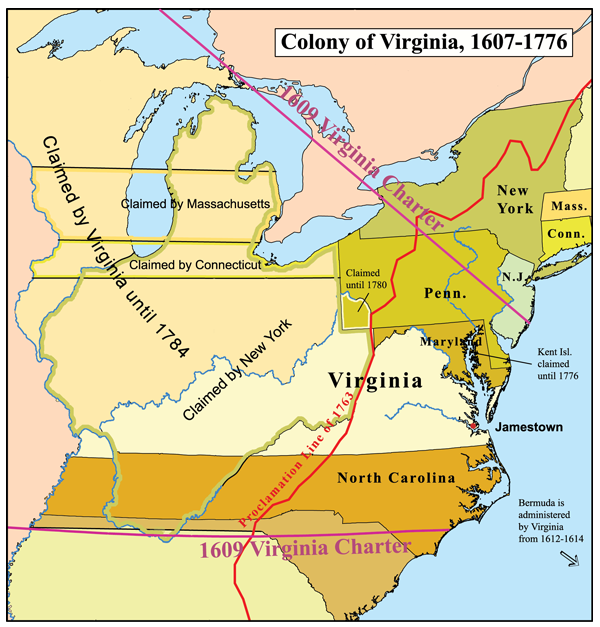
At the time of initial settlement, the English crown's grant and later colonial claims covered large tracts of the continent. Over the 18th century those claims were refined, ceded, or subdivided as the United States took shape. From the lands once administered by colonial Virginia later emerged entire states (notably Kentucky and West Virginia) and portions of other states in the Old Northwest. The colony's legal, political, and economic patterns — including representative government and plantation agriculture — left a lasting imprint on American development.
Notable facts and historical context
Virginia received the nickname "Old Dominion" from Charles II in recognition of its perceived loyalty during the turbulent years of the English Civil War and Commonwealth. The colony's shifting status — from private company to royal colony and then a component of Great Britain after the 1707 union — reflects broader changes in English imperial policy. Virginia also served as a stage for early experiments in colonial self-government that influenced later revolutionary thought.
Related topics and resources
- Thirteen Colonies
- North America
- Roanoke Colony
- Virginia settlement
- Jamestown
- Royal colony
- British colonies
- Sir Walter Raleigh
- Queen Elizabeth I
- English Civil War
- King Charles II
- Commonwealth of England
- Colonial geography
- England
- West Virginia
- Kentucky
- Indiana
- Illinois
- Ohio
For readers seeking a concise timeline: early Roanoke attempts in the 1580s failed and a resupply effort in 1590 found the colonists missing; Jamestown was founded in 1607; representative government emerged in 1619; the royal takeover occurred in 1624; and the colony continued to develop through the 17th and 18th centuries until the American Revolution transformed its political identity.
The Colony of Virginia remains a central subject for understanding English colonization, plantation economies, colonial governance, and the early interactions—both diplomatic and violent—between European settlers and Indigenous nations.
Related articles
Author
AlegsaOnline.com Colony of Virginia (Virginia Colony) Leandro Alegsa
URL: https://en.alegsaonline.com/art/21728
Sources
- historyisfun.org : "A History of Jamestown"
- teachingushistory.org : teachingushistory.org/lessons/col_his_bg_notes.html
- statesymbolsusa.org : "Old Dominion, Virginia State Nickname"
- commons.wikimedia.org : Colony of Virginia