
English Civil War: causes, course, and consequences
A clear, concise overview of the English Civil War (mid-17th century): origins, principal actors, major events across England, Scotland and Ireland, and the political and constitutional outcomes.
Overview
The English Civil War was a series of armed conflicts and political maneuvers in the mid‑17th century that transformed the British Isles. It is usually dated to the 1640s and is commonly described as a civil war in that the fighting involved rival forces from within the same states: England, Scotland and Ireland. For a brief definition of the term civil war, see civil war explanation, and for a general time frame consult mid‑17th century timeline. The three kingdoms were ruled by a single monarch but contained distinct political and religious tensions; the idea of parties drawn from the same country is discussed further at what makes a civil war.
Image gallery
10 Images




Principal actors and immediate causes
The conflict revolved around the relationship between King Charles I and the English Parliament. Disagreements concerned the limits of royal authority, taxation without parliamentary consent, and religious policies. Contemporary supporters of the king were commonly called Royalists or "Cavaliers," while those who supported parliamentary authority were known as Parliamentarians or "Roundheads." For background on the king central to these disputes, see Charles I, and for the competing institutional force read about Parliament. Many of the disputes were concentrated in England but had crucial repercussions across the other kingdoms of the same monarch, notably England itself.
Geography and chronology
The period of large‑scale fighting extended from roughly 1639 to 1653 and is sometimes treated as three overlapping conflicts: the civil wars in England (1642–1651), separate but connected campaigns in Scotland and the Bishops' Wars, and a prolonged uprising and intervention in Ireland. These events are collectively referred to by some historians as the Wars of the Three Kingdoms. Scotland's role and its earlier clashes are described at Scottish conflicts, and the Irish dimension — including rebellion and counterinsurgency — is covered at Irish events. The English phase itself is often split into the First (1642–46), Second (1648) and Third (1649–51) English Civil Wars for analytical clarity.
Military, political developments and leadership
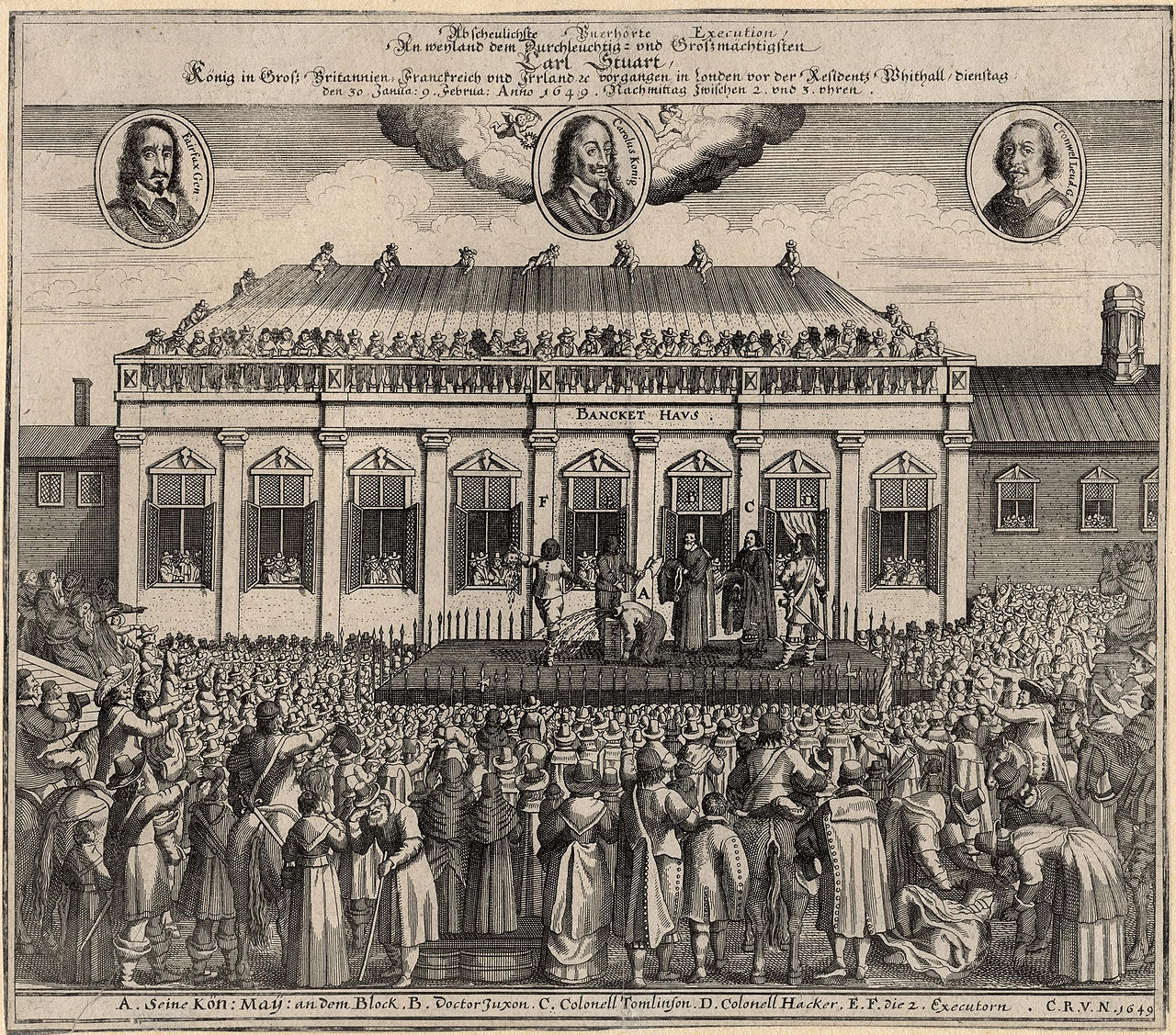
Military organization and political leadership changed the nature of warfare and government. The Parliamentarians created the New Model Army, a more professional force whose commanders and ideology exerted strong influence on politics. Prominent military and political figures, especially Oliver Cromwell, played decisive roles; see Oliver Cromwell for his military and later governance role. The conflict ended in a dramatic constitutional rupture: King Charles I was captured, tried and executed in 1649, an act sometimes described as regicide; background on the monarch is at Charles I. His son, Charles II, later attempted to regain the throne and eventually returned at the Restoration, but only after a period when monarchy was suspended.
Outcomes and significance
The immediate result was the abolition of the monarchy and the House of Lords for a time, the establishment of a republican commonwealth and a period often called the Interregnum. For about eleven years the three kingdoms were governed without a king and subject to military and parliamentary rule, with long‑term consequences for the balance of power between crown and parliament. After Cromwell's death, political instability led to the Restoration of Charles II, but the authority of kings was thereafter constrained by precedent, parliamentary institutions and evolving constitutional practice. The wars also produced lasting religious and social changes across the British Isles.
Notable features and distinctions
- Terminology: historians differ on whether to treat the episodes as one civil war, a series of related wars in England, or the interconnected Wars of the Three Kingdoms.
- Nicknames: Royalists were called "Cavaliers" and Parliamentarians "Roundheads," reflecting dress, hairstyle and political identity.
- Regime change: the trial and execution of a reigning monarch was unprecedented in English history; details of the trial and its legality remain a subject of study.
- Military innovation: the New Model Army introduced more meritocratic promotion and discipline compared with older feudal levies.
- Longer legacies: constitutional developments after the conflict influenced later debates about sovereignty, the rule of law and religious toleration.
- Further reading and resources: biographies of central figures and contemporary documents are available for deeper study at Parliamentary records, royal archives and collections covering Scottish and Irish material.
Questions and answers
Q: What is the English Civil War?
A: The English Civil War was a conflict in the middle 17th century between King Charles I and Parliament of England over how England should be ruled.
Q: Who were the two sides involved in the war?
A: The two sides involved in the war were King Charles I's supporters, known as Royalists or Cavaliers, and Parliament's supporters, known as Parliamentarians or Roundheads.
Q: How long did the war last?
A: The fighting that took place in each of England, Scotland and Ireland lasted from 1639 to 1653. In England specifically, it lasted from 1642 to 1651.
Q: What other names are used for this conflict?
A: This conflict is also sometimes referred to as the Wars of the Three Kingdoms due to its involvement with three separate countries (England, Scotland and Ireland), or alternatively as the First English Civil War (1642-46), Second English Civil War (1648) and Third English Civil War (1649-51).
Q: Who won the war?
A: The Parliamentarians won the war.
Q: What happened to King Charles I after he lost?
A: After losing, King Charles I was captured, put on trial and executed in 1649. His son Charles II then tried to take over but failed and escaped abroad.
Q: Who ran England during this time without a king?
A: During this time without a king, Oliver Cromwell - a former Parliamentarian general - ran England for most of this period.
Related articles
Author
AlegsaOnline.com English Civil War: causes, course, and consequences Leandro Alegsa
URL: https://en.alegsaonline.com/art/31467
Sources
- history.com : "ENGLISH CIVIL WARS"
- worldcat.org : 842879605
- spartacus-educational.com : "The English Civil War – Tactics"
- worldcat.org : 505954051