
Illinois: geography, history, economy and culture
Illinois is a Midwestern U.S. state with Chicago as its largest city and Springfield as its capital. It features major waterways, diverse economy, and a history from indigenous peoples to industrial and agricultural development.
Illinois is a U.S. state in the Midwest with a mix of large urban centers, small towns and extensive farmland. Its largest city, Chicago, is a national transportation, finance and cultural hub, while Springfield serves as the state capital and seat of government. Illinois plays a central role in American transportation because of its rail, road and river links.
Image gallery
1 Image
Geography and borders
Illinois occupies a varied landscape from the shores of a great lake to river valleys and prairie. It lies within the United States and is bounded on the north by Wisconsin, on the west by Iowa and, farther south along the same line, by Missouri. Much of the western boundary follows the Mississippi River. To the southeast the state is separated from Kentucky by the Ohio River, and to the east it meets Indiana. The northeastern corner opens onto Lake Michigan, giving Illinois important access to Great Lakes shipping routes. The state capital, Springfield, lies inland, roughly in the central part of the state.
History and development
The region now called Illinois was inhabited for millennia by Indigenous peoples and later became part of French and British colonial claims in North America. It entered the United States as a state in the early 19th century and grew rapidly with canals, railroads and later industrial expansion. The state has strong historical ties to figures such as Abraham Lincoln and is often associated with the nickname Land of Lincoln.
Economy and infrastructure
Illinois combines agricultural production—corn, soybeans and livestock—with manufacturing, services and a major financial sector concentrated in Chicago. The state's central location and access to waterways and rail networks make it a distribution and logistics center. Chicago's airport and inland waterways serve both domestic and international trade.
Government, cities and society
State government functions are centered in Springfield, while metropolitan Chicago contains the largest concentration of people, jobs and cultural institutions. Other notable cities and regions include industrial and agricultural communities across the northern, central and southern parts of the state. Political and economic differences between Chicago and the rest of the state shape public life and policy debates.
Culture, natural features and distinctions
Illinois offers diverse cultural attractions—from museums, theaters and music venues in Chicago to small-town festivals and state parks. Its rivers and Lake Michigan shoreline support commerce and recreation. The state is known both for urban innovation and for its role in national agriculture; these contrasts contribute to Illinois's distinctive identity within the United States.
Further reading
Geography
Geographical location
In the west, the Mississippi River forms the border to the states of Iowa (in the northwest) and Missouri (in the southwest). In the southeast, the Ohio River takes over this role to the state of Kentucky. North of Illinois is Wisconsin and to the east is Indiana. Flowing through the state are the Illinois River and Kaskaskia River, which flow into the Mississippi River, and the Embarras River, Chicago River, and Sangamon River, which flow into the Wabash and Illinois Rivers, respectively. To the northeast, the state shares a border with Michigan in the middle of Lake Michigan. The highest natural elevation in Illinois is Charles Mound in Jo Daviess County with an elevation of 376 m. The highest point overall, however, is the aerial peak of Willis Tower in Chicago (708 m above sea level, 527 m above street level). The lowest point (85 m) is at the confluence of the Mississippi and Ohio Rivers, in the city limits of Cairo in Alexander County.
With its flat terrain, Illinois is strongly influenced by the survey of the Congressional Survey System. The exceptions in the square street pattern and field boundaries to the regular north-south and east-west pattern are the railroads and the trunk roads that parallel them.
Structure
Illinois is divided into 102 counties. See list of counties in Illinois.

Population
| Population development | |||
| Census | Inhabitants | ± in % | |
| 1800 | 2458 | - — | |
| 1810 | 12.282 | 399,7 % | |
| 1820 | 55.211 | 349,5 % | |
| 1830 | 157.445 | 185,2 % | |
| 1840 | 476.183 | 202,4 % | |
| 1850 | 851.470 | 78,8 % | |
| 1860 | 1.711.951 | 101,1 % | |
| 1870 | 2.539.891 | 48,4 % | |
| 1880 | 3.077.871 | 21,2 % | |
| 1890 | 3.826.352 | 24,3 % | |
| 1900 | 4.821.550 | 26 % | |
| 1910 | 5.638.591 | 16,9 % | |
| 1920 | 6.485.280 | 15 % | |
| 1930 | 7.630.654 | 17,7 % | |
| 1940 | 7.897.241 | 3,5 % | |
| 1950 | 8.712.176 | 10,3 % | |
| 1960 | 10.081.158 | 15,7 % | |
| 1970 | 11.113.976 | 10,2 % | |
| 1980 | 11.426.518 | 2,8 % | |
| 1990 | 11.430.602 | 0 % | |
| 2000 | 12.419.293 | 8,6 % | |
| 2010 | 12.830.632 | 3,3 % | |
| Estimate 2017 | 12.802.023 | −0,2 % | |
| Before 1900 1900–1990 2010 2000 | |||
Illinois has a population of 12,802,023 as of 2017.
Age and gender structure
The age breakdown of Illinois is as follows:
- up to 18 years: 3,216,387 (26.8 %)
- 18-64 years: 8,083,210 (63.0 %)
- 65 years and older: 1,532,373 (10.2 %)
The median age is 38.7 years. 49.2% of the population is male and 50.8% female.
Ancestry
The ethnic composition of the population is mixed. Data from the 2014 American Community Survey revealed that the ethnic German population made up the largest percentage at 18.6%, followed by Hispanics (16.7%), African Americans (14.7%), Irish (11.6%), Polish (6.9%), English (5.7%), and Italian (5.8%). Asian Americans also made up 5.3% of the population and Native Americans 0.6%.
Beginning in the 1980s, a large wave of immigrants arrived in the country, mostly from Asia and Latin America, mostly to Chicago. This is also where about 95% of the state's Polish-born residents live, some of whom immigrated themselves, but some of whom are the descendants of an earlier wave of immigration.
Religions
The religious denominations with the largest number of members in 2000 were the Catholic Church with 3,874,933, the United Methodist Church with 365,182, and the Southern Baptist Convention with 305,838 adherents.
Education
The largest state universities include the three campuses of the University of Illinois, the two campuses of the Southern Illinois University System, Northern Illinois University, Eastern Illinois University, Western Illinois University, and Illinois State University. The most prominent private colleges in Illinois are the University ofChicago and Northwestern University. Other colleges are listed in the list of universities in Illinois.
Largest cities
Cities that form the core of a metropolitan region are marked in red. The remaining cities (except Bloomington) are part of the Chicago metropolitan region.
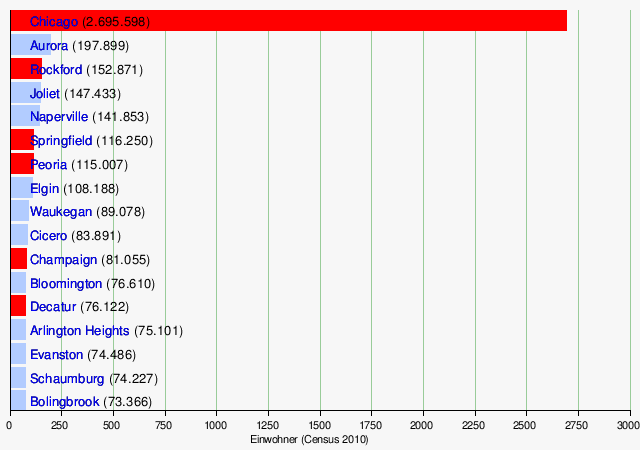
- List of localities in Illinois

Related articles
Author
AlegsaOnline.com Illinois: geography, history, economy and culture Leandro Alegsa
URL: https://en.alegsaonline.com/art/46735
Sources
- kff.org : "Median Annual Household Income"
- ilga.gov : "(5 ILCS 460/20) (from Ch. 1, par. 2901‑20) State Designations Act"
- interestingstatefacts.com : "Interesting Facts About Illinois"
- eia.gov : "Illinois – U.S. Energy Information Administration (EIA)"
- commons.wikimedia.org : Illinois