
Treaty of Tordesillas (1494): division of newly discovered lands
Agreement between Spain and Portugal in 1494 that drew an imaginary meridian to divide overseas lands, shaping early colonial boundaries, legal doctrines, and the linguistic map of the Americas.
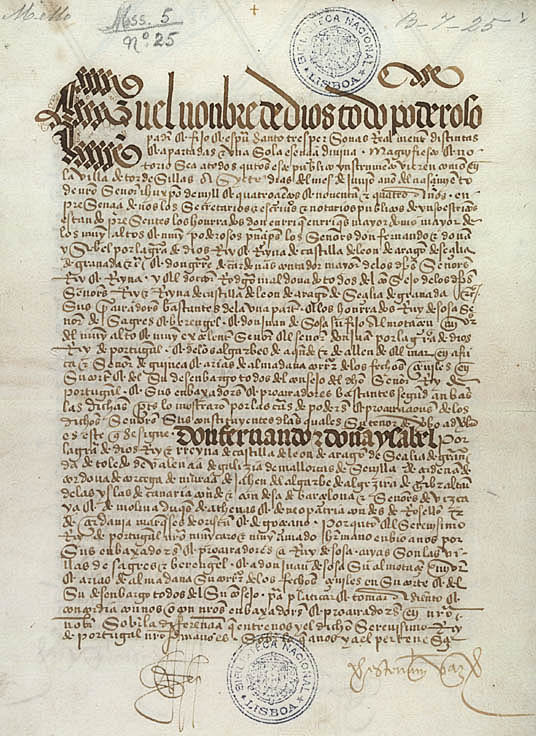
The Treaty of Tordesillas, concluded in 1494, was a bilateral accord between the kingdoms of Portugal and Castile (Spain) intended to allocate newly discovered overseas territories between the two maritime powers. Negotiated after a series of papal decrees and voyages of exploration, the treaty established an imaginary north–south line in the Atlantic and assigned lands to the east of the line to Portugal and to the west to Spain. Although aimed at preventing conflict between the two crowns, the agreement ignored the presence and rights of indigenous peoples and later proved limited in practice as other European states and local realities complicated its application.
Image gallery
10 Images



Nature and basic terms
The central idea of the treaty was spatial division. The negotiators specified a meridian running a set number of leagues west of certain Atlantic islands; territories east of this meridian were to fall under Portuguese sovereignty and those west under Spanish sovereignty. Key provisions were concise and technical rather than exhaustive: the line was drawn to produce a clear frontier on charts, and the crowns agreed to respect each other's claims on newly discovered lands. The text sought to prevent naval and commercial clashes while leaving many practical details unresolved, notably the treatment of already inhabited regions and the legal basis for conquest.
Context, authority and legal justification
The treaty must be read against two overlapping contexts: papal intervention in late medieval Christendom and a developing European doctrine about discovery and sovereignty. Pope Alexander VI issued bulls in 1493 that supported Spanish claims to lands west of a demarcation; these documents and the concept commonly called the "Doctrine of Discovery" provided a religious and legal rationale that European monarchs used to justify overseas expansion. Portugal and Spain accepted or negotiated around papal pronouncements, but other European powers — including later arrivals such as England, France and the Netherlands — did not recognize papal authority as decisive for their imperial ambitions.
Negotiation, signatories and immediate consequences
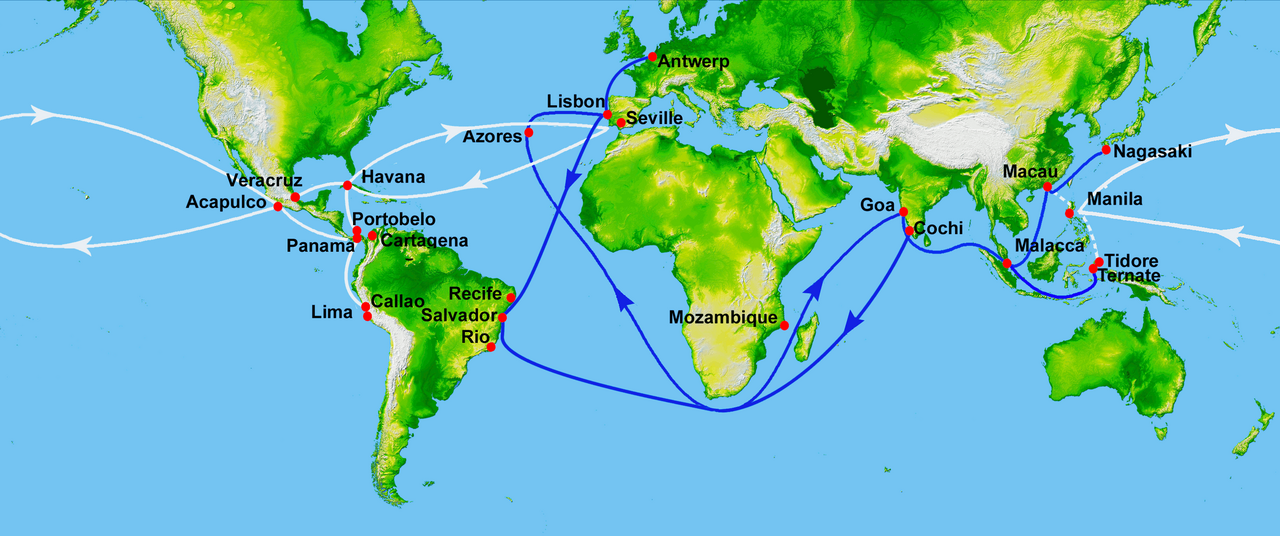
Spanish monarchs Ferdinand and Isabella and the Portuguese crown arranged the treaty in the Spanish town of Tordesillas, hence its name. The settlement had immediate practical effects: it influenced the routes and targets of early voyages, contributed to Portuguese interests in Africa and Asia, and, most consequentially in the Western Hemisphere, left the eastern bulge of South America within Portugal's sphere. That outcome helps explain why the territory that became Brazil developed under Portuguese language and legal institutions, while much of the rest of the continent was colonized by Spain and later became Spanish-speaking independent states.
Limits, disputes and longer-term legacy
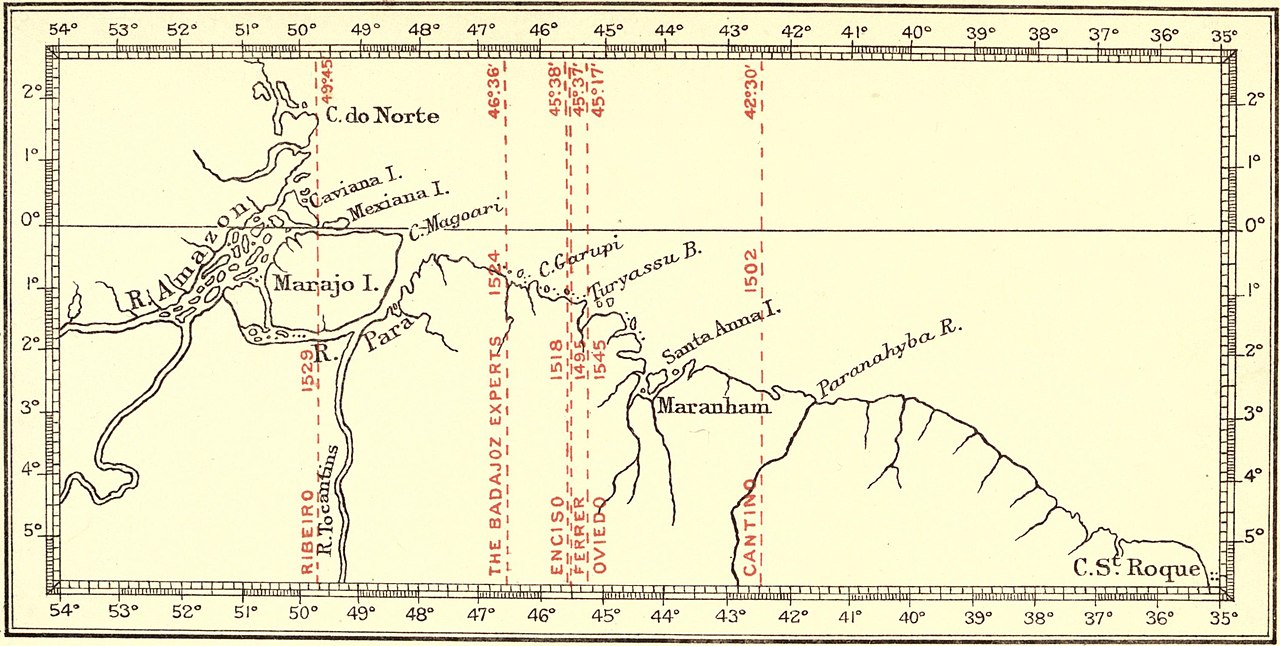
Limitations were substantial. Cartography of the period was imprecise, the meridian's exact location was debated, and many territories lay far from the Atlantic line or were claimed by other European powers who disregarded papal divisions. Disputes over islands and Asian possessions led Spain and Portugal to negotiate further adjustments, including an agreement in the 1520s to delimit their Asian spheres. Over time, shifting naval power, colonial settlement patterns, and competition from England, France, the Netherlands and others weakened the treaty's practical force. Nevertheless, its geopolitical imprint endured: language, legal traditions and trade routes in the Americas reflect the early separation of Iberian influence, and the treaty remains a reference point in discussions of colonialism and international law.
Notable facts and modern perspective
- The treaty was bilateral; indigenous peoples and non-Iberian states were not parties to it.
- Because of uncertain longitude measurements, the line's precise position could be disputed, producing later treaties and conflicts.
- Modern historians and indigenous advocates critique the treaty as an early instrument of colonial dispossession and highlight its role in legitimizing conquest.
For readers seeking primary texts, diplomatic summaries and further analysis, the following links indicate topics and sources often consulted in scholarship and teaching. Each link is a placeholder to a category or document type commonly used by researchers:
- Treaty text and translations
- Portuguese royal archives
- Spanish royal archives
- Maps and cartographic studies
- Studies of the Americas in the 15th–16th centuries
- Accounts of indigenous perspectives and resistance
- Papal bulls of the 1490s
- Papal history and Alexander VI
- Cape Verde and Atlantic island geography
- Portuguese exploration routes
- Spanish voyages and colonization
- Ferdinand of Aragon
- Isabella of Castile
- Age of Discovery overviews
- Religion and imperial justification
- Consequences for New World settlement
- Portuguese language and law in Brazil
- Geography of South America
- Emergence of independent Latin American states
- History of Brazil
- Spanish colonial administration
- Spanish-language colonies
- Independence movements in the Americas
- Argentina and southern cone history
- Colombia and northern South America
Overall, the Treaty of Tordesillas is best understood as an early attempt at international division of space born of specific historical circumstances: emerging global navigation, papal authority within Catholic Europe, and the political need to avoid war between Iberian monarchies. Its immediate effects were significant in shaping the first century of Atlantic expansion, even as later political, economic and technological changes altered or overtook the arrangements it described.
Related articles
Author
AlegsaOnline.com Treaty of Tordesillas (1494): division of newly discovered lands Leandro Alegsa
URL: https://en.alegsaonline.com/art/101315